


 Home
Home
Hi, I'd like to ask—is calcium chloride a solid under normal conditions? How does temperature affect its physical state, and at what point does it melt or vaporize? Are there different crystalline forms of solid calcium chloride? What are the practical uses of calcium chloride in its solid state across industries? Thanks!
Is Calcium Chloride Naturally Present as a Solid Substance?
Related Encyclopedia

- 10043-52-4
- CaCl2
- 110.98
- All (479)
- China (34)
- (479)
- 99886-95-0
- CaClI
- 202.43500
- All (0)
- China (0)
- (0)
- 14031-58-4
- CaClHO
- 92.53830
- All (0)
- China (0)
- (0)
- 127886-77-5
- CaClHO
- 92.53830
- All (0)
- China (0)
- (0)
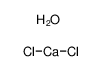
- 22691-02-7
- CaCl2H2O
- 128.99900
- All (0)
- China (0)
- (0)
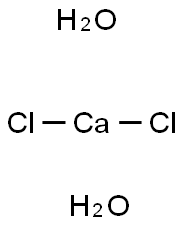
- 10035-04-8
- CaCl2H4O2
- 147.01
- All (116)
- China (17)
- (116)
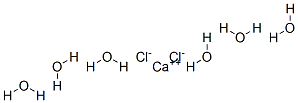
- 7774-34-7
- CaCl2H12O6
- 219.08
- All (16)
- China (1)
- (16)
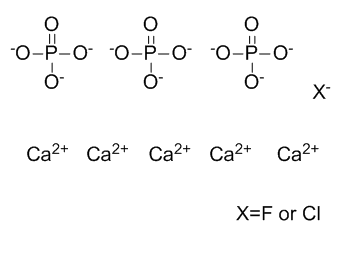
- 75535-31-8
- CaClFH4O4P-3
- 193.53000
- All (0)
- China (0)
- (0)
- 135732-52-4
- C4H12CaCl2O
- 187.12100
- All (0)
- China (0)
- (0)
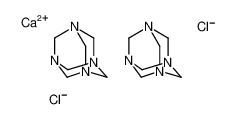
- 20280-08-4
- C12H24CaCl2N8
- 391.35700
- All (0)
- China (0)
- (0)
Related Products More >

- 10035-04-8
- CNY 110.0000
- 25kg
- 10043-52-4
- USD 4.8000
- 25kg
- USD 35.0000
- 25kg
- 7774-34-7
- Request For Quotation
- 25kg
- 7774-34-7
- Request For Quotation
- 1ton
- 10035-04-8
- Request For Quotation
- 10g
- 10035-04-8
- Request For Quotation
- 500g
- 10035-04-8
- Request For Quotation
- 100g


Temperature affects its physical state by inducing thermal energy that disrupts ionic bonds. As heat increases, the solid lattice structure breaks down, leading to melting. Vaporization requires overcoming stronger intermolecular forces, hence the much higher temperature. Notably, calcium chloride can absorb moisture from the air (hygroscopic), which may cause it to clump or form a liquid solution if exposed to high humidity, even below its melting point.
In its solid state, calcium chloride has diverse industrial uses. In construction, it acts as a concrete accelerator to speed up curing. In road maintenance, it’s spread as a de-icer to melt ice and snow due to its ability to lower the freezing point of water. The food industry uses it as a preservative and firming agent, while the pharmaceutical sector employs it in dialysis solutions.
There are different crystalline forms of calcium chloride. These include the anhydrous form and various hydrated forms such as calcium chloride dihydrate and calcium chloride hexahydrate. The hydrated forms have different properties compared to the anhydrous form. For example, calcium chloride hexahydrate has a lower melting point than the anhydrous form, melting at around 30 degrees Celsius.
In its solid state, calcium chloride has numerous practical applications across different industries. In the field of road maintenance, solid calcium chloride is used as a deicing agent. It effectively lowers the freezing point of water, making it useful for melting ice and snow on roads and sidewalks during winter. This application is crucial for ensuring safety and maintaining traffic flow in cold climates.
In the construction industry, calcium chloride is used as an accelerator for concrete. It speeds up the hydration process, allowing concrete to set more quickly. This is particularly useful in projects where rapid construction is necessary. However, its use must be carefully controlled as excessive amounts can lead to long-term weakening of the concrete structure.
In the pharmaceutical industry, calcium chloride is used as a source of calcium ions. It is often included in intravenous solutions to treat conditions such as hypocalcemia. Additionally, it is used in the production of various medications where calcium ions are required for therapeutic effects.
In the chemical industry, solid calcium chloride is used as a drying agent. Its hygroscopic nature allows it to absorb moisture from the air, making it useful for drying gases and organic liquids. This application is important in processes where the presence of water can interfere with chemical reactions or the stability of products.
The solid form of calcium chloride can exhibit different crystalline structures depending on temperature and hydration state. Anhydrous calcium chloride, which contains no water molecules, forms a dense, highly soluble crystalline lattice. However, it readily absorbs moisture from the air, leading to the formation of hydrated variants such as the dihydrate (CaCl2·2H2O) or tetrahydrate (CaCl2·4H2O). These hydrated forms are also solids but have slightly different physical properties, including lower melting points and higher solubility in water compared to the anhydrous version. The tendency to absorb water makes anhydrous calcium chloride particularly useful as a desiccant, where it is employed to dry gases and organic solvents in laboratory and industrial settings.
Practically, solid calcium chloride serves a wide range of industrial and commercial purposes. In de-icing applications, it is spread on roads, sidewalks, and airport runways to melt ice and prevent its formation, leveraging its ability to lower the freezing point of water even at subzero temperatures. Its exothermic dissolution—releasing heat as it dissolves—makes it especially effective in cold weather. In the oil and gas industry, solid calcium chloride is used in drilling fluids to increase density and control well pressure, while in food processing, it acts as a firming agent in canned vegetables and a coagulant in cheese production.
The construction sector utilizes calcium chloride to accelerate the setting of concrete, particularly in cold weather when traditional curing would be too slow. Additionally, it is employed in water treatment to adjust hardness and in textile manufacturing as a dye fixative. The compound’s high solubility and hygroscopic nature make it versatile, though its corrosive properties require careful handling, especially in metal equipment. Proper storage in airtight containers is essential to prevent caking caused by moisture absorption, ensuring its effectiveness across these diverse applications.
Different crystalline forms exist. Anhydrous calcium chloride has no water, while hydrates like CaCl₂·2H₂O and CaCl₂·6H₂O include bound water. Hydrates differ in melting points and how much moisture they absorb, which matters for various uses.
Industrially, its solid form is versatile. As a desiccant, it soaks up moisture in air conditioners or to keep goods dry. In construction, it speeds up concrete hardening. For de-icing, it melts ice by lowering the freezing point. Food industries use it as a preservative and firming agent, and it helps in wastewater treatment for coagulation. Each use taps into its physical and chemical traits.