


 Home
Home
I’m trying to understand molecular polarity. Here’s what I wonder: 1. Is F2 polar or nonpolar? 2. What causes polarity in molecules? 3. How does F2’s structure affect this? 4. Does polarity influence F2’s properties? 5. How does fluorine compare with other halogens? Thanks!
Is F2 (fluorine gas) a polar molecule?
Related Encyclopedia

- 14762-94-8
- F
- 18.99840
- All (0)
- China (0)
- (0)
- 7782-41-4
- F2
- 38
- All (0)
- China (0)
- (0)
- 14986-60-8
- FN3
- 61.01850
- All (0)
- China (0)
- (0)

- 14701-13-4
- F+
- 18.99840
- All (0)
- China (0)
- (0)
- 42088-15-3
- CFNO
- 61.01520
- All (0)
- China (0)
- (0)
- 83620-44-4
- CFNS
- 77.08080
- All (0)
- China (0)
- (0)
- 67249-89-2
- CFNO
- 61.01520
- All (0)
- China (0)
- (0)
- 67249-87-0
- CFNO
- 61.01520
- All (0)
- China (0)
- (0)
- 38578-15-3
- FNO3
- 81.00330
- All (0)
- China (0)
- (0)

- 67862-54-8
- F
- 18.00090
- All (0)
- China (0)
- (0)
Related Products More >

- 82419-35-0
- Request For Quotation
- 82419-35-0
- Request For Quotation
- 82419-35-0
- Request For Quotation
- 52623-00-4
- Request For Quotation
- Bottle,barrel,cargo,container,etc.
- 3952-78-1
- Request For Quotation
- 3952-78-1
- Request For Quotation
- 3952-78-1
- Request For Quotation
- 3952-78-1
- Request For Quotation


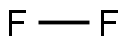
Fluorine gas (F₂) is a nonpolar molecule. This is because fluorine atoms share electrons equally due to their identical electronegativity values. As a result, there is no separation of charge or dipole moment in the molecule.
Characteristics of F₂'s Nonpolarity
In molecular terms, polar molecules have a positive and a negative end due to unequal electron sharing between atoms. In contrast, nonpolar molecules, like F₂, have symmetric electron distribution, which leads to no overall dipole moment. Since both fluorine atoms have the same ability to attract electrons, they share them equally, keeping the molecule neutral in terms of charge distribution.
Conclusion
The nonpolar nature of F₂ is an important characteristic that influences its behavior in chemical reactions and interactions with other molecules.
Why F2 is Nonpolar
The absence of polarity in F2 arises from the symmetry of the molecule. In diatomic molecules like F2, when both atoms are identical, the electron cloud is distributed equally between them. This symmetry cancels out any potential dipole moments.
Implications for Chemical Behavior
Because F2 is nonpolar, it does not interact strongly with polar solvents or molecules. This impacts its reactivity, as F2 is more likely to participate in reactions where its reactivity, rather than its polarity, is the driving factor.
Conclusion
F2’s nonpolarity is an interesting feature when considering its applications, such as in industrial fluorination reactions where its high reactivity is harnessed.