


 Home
Home
Hi, I'd like to ask—how long does it usually take for UV resin to cure under a standard UV lamp? Will a stronger UV light make it cure faster? If the resin layer is thicker, does it take much longer to cure completely? Can it cure properly if exposed to sunlight instead of a UV lamp? Thanks!
How long does UV resin take to cure with different strengths of UV light and does thickness affect it?
Related Encyclopedia
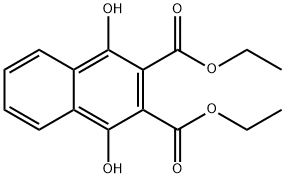
- 59883-07-7
- C16H16O6
- 304.29
- All (0)
- China (0)
- (0)
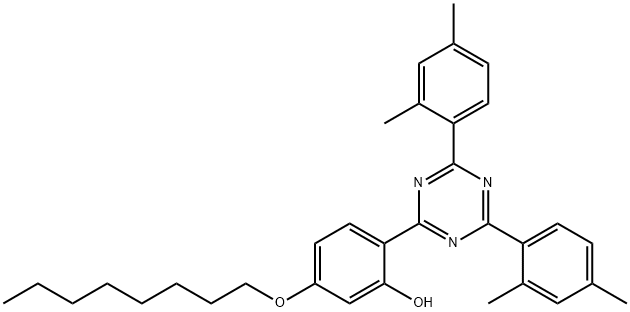
- 2725-22-6
- C33H39N3O2
- 509.68
- All (3)
- China (0)
- (3)
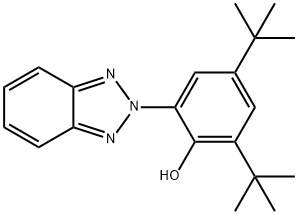
- 3846-71-7
- C20H25N3O
- 323.43
- All (7)
- China (0)
- (7)
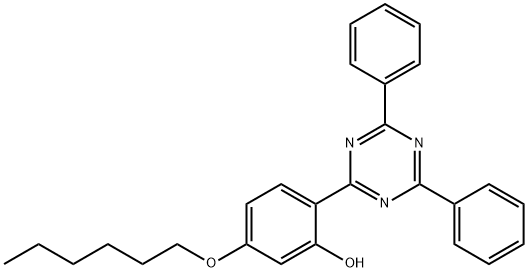
- 147315-50-2
- C27H27N3O2
- 425.52
- All (3)
- China (0)
- (3)
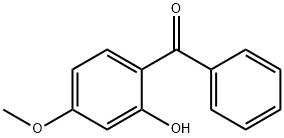
- 131-57-7
- C14H12O3
- 228.24
- All (3)
- China (1)
- (3)
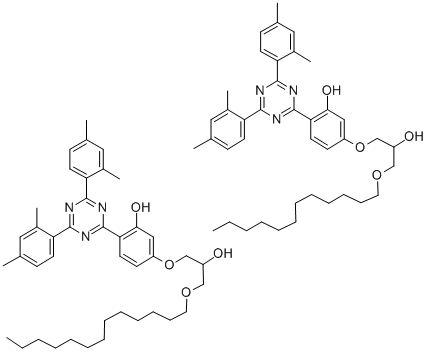
- 153519-44-9
- C81H108N6O8
- 1293.76
- All (0)
- China (0)
- (0)
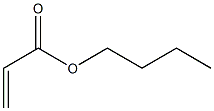
- 9003-49-0
- C7H12O2
- 128.16898
- All (1)
- China (0)
- (1)
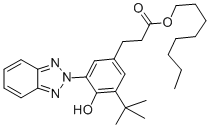
- 127519-17-9
- C27H39N3O3
- 451.61
- All (0)
- China (0)
- (0)
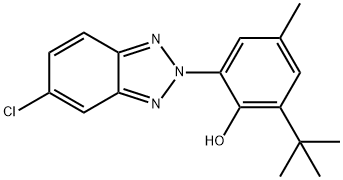
- 3896-11-5
- C17H18ClN3O
- 315.8
- All (4)
- China (0)
- (4)
![3-[(E)-4,6-dimethylhept-2-enyl]oxolane-2,5-dione,2-[3-(oxiran-2-ylmethoxy)propoxymethyl]oxirane,4-(oxiran-2-yl)-7-oxabicyclo[4.1.0]heptane](https://chemcloud-1304660855.cos.ap-shanghai.myqcloud.com/compound/bbb16ce2863d42899585d90674283a10.png?imageMogr2/format/webp)
- 52368-54-4
- C30H48O9
- 552.69700
- All (0)
- China (0)
- (0)
Related Products More >

- 9002-86-2
- CNY Request For Quotation
- 14643-87-9 Zinc acrylate
- CNY Request For Quotation
- 818-61-1
- CNY Request For Quotation
- 818-61-1
- CNY Request For Quotation
- CNY Request For Quotation
- CNY Request For Quotation
- CNY Request For Quotation
- 465-42-11
- CNY Request For Quotation


A stronger UV light, with higher wattage or greater intensity, can speed up the curing process. Lamps with 80 watts or more may reduce curing time by 30% to 50%. However, overexposure to intense UV light can sometimes cause issues like surface cracking or yellowing, so it’s important to follow the resin manufacturer’s guidelines to avoid such problems.
Thicker resin layers do require significantly more time to cure completely. UV light can only penetrate a few millimeters into the resin, so layers thicker than 3 to 5 millimeters often cure unevenly. The surface may harden, but the inner layers can remain tacky. For thicker applications, curing in multiple thin layers—each exposed to UV light individually—is more effective than trying to cure one thick layer at once.
Sunlight can cure UV resin, but it’s far less reliable. The sun’s UV intensity varies with factors like time of day, weather conditions, and geographic location, leading to inconsistent results. On bright, sunny days, it might take 10 to 20 minutes, but cloudy weather or indirect light can leave the resin undercured. Additionally, sunlight increases the risk of long-term yellowing compared to using controlled UV lamps.
A stronger UV light can indeed accelerate the curing process. For instance, a UV lamp with higher wattage, such as 36 watts, can significantly reduce the curing time compared to a standard 12-watt lamp. This reduction in time can be as much as 50%, meaning a resin layer that might take 3 minutes to cure under a standard lamp could cure in approximately 1.5 minutes under a more powerful lamp. However, it is important to note that the resin must be exposed to the UV light at the correct wavelength for effective curing.
When the resin layer is thicker, the curing time increases. A thicker layer, say 3 mm or more, may require additional curing time, often extending beyond the standard 5 minutes. In some cases, it may take up to 10 minutes or longer to ensure complete curing. This extended time is necessary because UV light penetration decreases with depth, and the deeper layers of the resin may not receive sufficient UV exposure to cure properly.
Exposure to sunlight can also cure UV resin, but the process is generally slower and less predictable than using a UV lamp. Sunlight curing can take anywhere from 2 to 10 hours, depending on factors such as the intensity of sunlight, the angle of exposure, and the presence of cloud cover. In regions with strong, direct sunlight, UV resin may cure in as little as 3 minutes. However, sunlight curing is not always reliable, as it can be affected by environmental conditions. For example, on a cloudy day, the UV light intensity may be insufficient to cure the resin effectively.
A stronger UV light, say 80 watts or more, can make it cure faster—sometimes cutting the time in half. But if the light is too strong, the surface might harden before the inside, leaving the middle sticky. That’s something to watch out for.
Thicker layers take longer to cure completely. If the layer is more than 3 to 4 millimeters thick, you might need to cure it in stages, maybe flipping it to make sure the bottom hardens. Trying to rush this can leave parts uncured.
Sunlight can cure UV resin, but it’s not as consistent. On cloudy days or in indirect light, it might take 15 to 30 minutes. Direct, bright sunlight works faster, but the heat could make the resin warp a bit. It’s good to test small amounts first to get the timing right.
The relationship between UV light intensity and curing speed follows a direct correlation. Stronger UV lamps emit more photons per second, accelerating the photopolymerization reaction that hardens the resin. However, there's a practical limit to this effect. Extremely high-intensity UV sources may cause surface overheating, leading to issues like bubbling or incomplete internal curing. Some resins include inhibitors specifically designed to prevent premature curing under intense UV exposure, which helps maintain consistent results across different power levels.
Layer thickness dramatically impacts curing duration. Thin applications (under 1mm) typically cure completely within the standard 1-5 minute window because UV light penetrates easily through shallow material. As layer thickness increases beyond 2mm, the curing process becomes increasingly uneven. The outer surface may appear hardened while the deeper layers remain soft and uncured. For thicker applications, multiple curing passes with the UV lamp are necessary, allowing each surface to cure before adding the next layer. Some specialized thick-layer resins include special photoinitiators that work at greater depths, but even these require extended curing times compared to thin coatings.
Sunlight can indeed cure UV resin, though with significant limitations. Natural sunlight contains UV-A and UV-B rays that activate photoinitiators, but the intensity varies dramatically based on geographic location, time of day, season, and weather conditions. On a clear summer day at noon, sunlight might provide enough UV energy to cure thin resin layers in 10-30 minutes. However, winter months, cloudy conditions, or indoor applications near windows (which block significant UV radiation) can extend this time to several hours or prevent proper curing entirely. Additionally, sunlight's broad spectrum includes infrared and visible light wavelengths that don't contribute to curing but may cause unwanted heating or color changes in the resin.
Temperature affects the curing process both directly and indirectly. Warmer ambient temperatures accelerate the chemical reaction, while cold conditions slow it down. Some UV resins incorporate temperature-sensitive components that modify their curing behavior across different thermal conditions. In cold environments, pre-warming the resin or using a heated work surface can help maintain efficient curing. Conversely, excessive heat may cause the resin to cure too quickly on the surface while remaining soft underneath, creating a tacky finish that requires additional post-curing.