


 Home
Home
In a recent press briefing, former U.S. President Donald Trump reignited his "America First" trade agenda, declaring that the U.S. should prioritize producing military equipment and cutting-edge tech like tanks and AI over "old-school" industries such as textiles. “We don’t need T-shirts or socks,” he said, emphasizing efforts to boost domestic manufacturing of defense systems and semiconductors. This stance aligns with his proposed 50% tariffs on EU goods and potential 25% taxes on imported iPhones, aiming to reshore industries he deems “strategic.” But as the world asks: What materials and processes actually fuel these two wildly different sectors—and can America realistically swap socks for steel?
Trump Says U.S. Doesn’t Want Socks—But Tanks? What Materials and Processes Do They Need?
Related Encyclopedia

- 7631-86-9
- O2Si
- 60.08
- All (126)
- China (40)
- (126)
- 83957-02-2
- O2Si
- 64.08380
- All (126)
- China (40)
- (126)
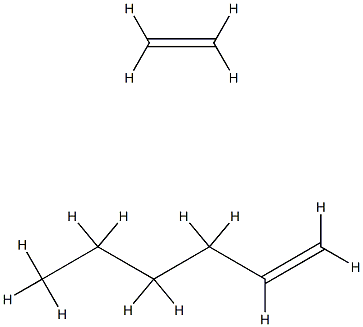
- 25213-02-9
- C8H16
- 112.21264
- All (24)
- China (2)
- (24)
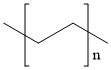
- 9002-88-4
- (C2H4)n
- 28.05316
- All (24)
- China (2)
- (24)
- 23382-09-4
- H2O3Si
- 78.09960
- All (1)
- China (0)
- (1)
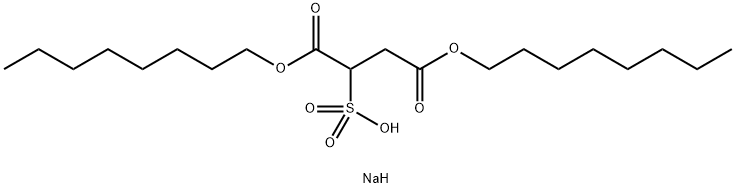
- 1639-66-3
- C20H39NaO7S
- 446.57
- All (3)
- China (2)
- (3)
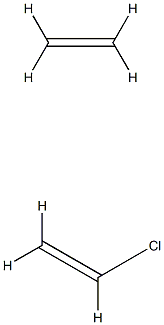
- 63231-66-3
- C4H7Cl
- 90.55138
- All (3)
- China (3)
- (3)
- 68131-73-7
- C12H5N7O12
- 0
- All (2)
- China (0)
- (2)
- 68441-17-8
- C51H102O21Si2
- 0
- All (29)
- China (28)
- (29)
- 64754-90-1
- 0
- All (3)
- China (3)
- (3)
Related Products More >

- 63231-66-3
- CNY Request For Quotation
- 9002-88-4
- Request For Quotation
- 112945-52-5
- Request For Quotation
- 112945-52-5
- Request For Quotation
- 112945-52-5
- Request For Quotation
- 112945-52-5
- Request For Quotation
- 112945-52-5
- Request For Quotation
- 112945-52-5
- Request For Quotation


Socks (Textiles):
Materials: Cotton, polyester blends, spandex, and natural dyes.
Processes: Spinning fibers into yarn, knitting or weaving fabric, dyeing, and finishing (e.g., water-repellent coatings).
Challenges: Decades of offshoring have hollowed out U.S. textile mills. Retooling factories for small-batch, eco-friendly socks clashes with cheap labor abroad. Tariffs could raise prices for consumers, but reviving the sector requires overcoming automation hurdles and labor shortages.
Tanks (Defense Manufacturing):
Materials: High-grade steel alloys (e.g., AR500 for armor), titanium, depleted uranium plating, and composite ceramics.
Processes: Precision welding, CNC machining, thermal spraying for armor, and ballistics testing.
Challenges: The U.S. faces a shortage of skilled welders and engineers. Supply chains for rare metals (e.g., titanium from China/Russia) are vulnerable to geopolitical risks. Plus, R&D costs for next-gen tanks (e.g., autonomous models) dwarf textile budgets.
The Problem with Prioritizing Tanks Over Socks
Trump’s pivot ignores interconnected realities. For example, textile machinery relies on components made in Germany or Japan. Cutting textile jobs could weaken domestic supply chains for defense tech. Meanwhile, global allies like the EU may retaliate against tariffs, sparking trade wars that hurt U.S. farmers and tech exporters. “You can’t build a tank without bolts made overseas,” quipped one industry analyst.
Global Impact
Trade Tensions: EU nations may slap counter-tariffs on U.S. agricultural goods.
Supply Chain Shocks: Ramping up steel production could strain energy grids and mining resources.
Tech Monopolies: U.S.-only AI/tank development might alienate allies, slowing global innovation.
Socks
Materials:
Natural fibers: Cotton (75–85% for "all-cotton" socks) , wool.
Synthetic fibers: Nylon (for durability), polyester (strength), and spandex/lycra (elasticity) .
Accessories: Polyester thread for stitching, rubber or elastic bands for cuffs.
Processes:
Spinning: Converting raw cotton/polyester into yarn.
Knitting: Using circular or flat knitting machines to form fabric tubes .
Seaming: Joining the toe and heel with automated sewing machines.
Dyeing: Applying eco-friendly dyes to achieve colors.
Finishing: Washing, drying, and shaping with metal molds for uniformity .
Tanks
Materials:
Structural armor: High-hardness steel (e.g., HY-100), aluminum alloys (for lighter components), and composite armor (layers of steel, ceramics, and fiberglass) .
Specialized components:
Turret: Cast steel or welded steel plates .
Engine: High-strength alloys for heat resistance.
Tracks: Rubberized steel or composite materials.
Stealth technologies: Radar-absorbing coatings and infrared-reflective materials .
Processes:
Casting/Welding: Forming hulls and turrets via casting (molding molten steel) or welding steel plates .
Machining: Precision-cutting parts like gun barrels and gears.
Composite armor assembly: Bonding layers of steel, ceramics, and fiberglass under high pressure .
Integration: Installing engines, electronics, and weapon systems.
Testing: Ballistic trials to ensure armor withstands anti-tank rounds.
This shift highlights the U.S. prioritizing advanced materials science and industrial capabilities over labor-intensive textile production, aiming to reassert dominance in critical sectors like defense manufacturing.
So, what exactly does it take to make socks versus tanks?
Socks are made using simple materials like cotton, polyester, or wool. The process involves spinning yarn, dyeing it, and then using knitting machines to shape the fabric. It’s labour-intensive but doesn’t need super high-tech tools or rare resources.
Now, building a tank? That’s a whole different story. Tanks require advanced materials like reinforced steel, aluminium alloys, and high-grade ceramics for armour. Inside, they’re packed with electronics, GPS systems, powerful engines, and weaponry. The manufacturing process includes heavy-duty welding, precision machining, and assembly lines that look more like aerospace plants than textile factories. It's not just metal and bolts—it’s sensors, optics, and AI-driven targeting systems.
Even more high-tech are products like microchips and computers. These demand ultra-clean environments, complex photolithography, and rare earth elements like gallium and tantalum. AI development also relies on powerful hardware and software engineering.
Trump’s point may spark debate, but it does underline a real strategy: use America’s edge in technology and defence rather than trying to compete on low-margin goods. Whether or not everyone agrees, the future of “Made in America” might be more about missiles than mittens.