


 Home
Home
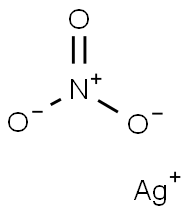
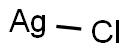
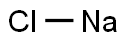
In a chemistry lab, a student mixes silver nitrate (AgNO₃) with sodium chloride (NaCl), observing the immediate formation of a white precipitate. Curious about the reaction, they wonder: Is AgCl soluble?
Is AgCl Soluble? Understanding the Properties and Applications of Silver Chloride
Related Encyclopedia
- 7761-88-8
- AgNO3
- 169.87
- All (2)
- China (2)
- (2)
- 14614-74-5
- AgNO3
- 171.91100
- All (2)
- China (2)
- (2)
- 7783-90-6
- AgCl
- 143.32
- All (14)
- China (7)
- (14)
- 15702-88-2
- C6H15AgClP
- 261.47800
- All (0)
- China (0)
- (0)
- 7647-14-5
- ClNa
- 58.44
- All (45)
- China (29)
- (45)
- 136371-38-5
- C4H6Ag2N8O6
- 477.87700
- All (0)
- China (0)
- (0)
- 2942-53-2
- C12H16ClN4NaOS
- 322.78900
- All (0)
- China (0)
- (0)
- 82474-94-0
- C36H30AgClP2
- 667.89200
- All (0)
- China (0)
- (0)
- 124273-39-8
- C26H26AgClP2
- 543.75300
- All (0)
- China (0)
- (0)
- 57111-08-7
- C38H34AgClP2
- 695.94500
- All (0)
- China (0)
- (0)
Related Products More >

- 7761-88-8
- Request For Quotation
- 10g
- 7761-88-8
- Request For Quotation
- 100g
- 7761-88-8
- Request For Quotation
- 500g
- 7761-88-8
- Request For Quotation
- 1kg
- 851199-59-2
- Request For Quotation
- 25kg/Drum
- 851199-59-2
- Request For Quotation
- Plastic bottles
- 851199-59-2
- Request For Quotation
- 25kg/Cardboard Drum
- 851199-59-2
- Request For Quotation
- 25kg/Cardboard Drum


Physical and Chemical Properties
AgCl is a white crystalline solid with a density of 5.56 g/cm³. It has a cubic crystal structure and melts at 455°C. Chemically, AgCl is photosensitive, decomposing into silver and chlorine gas under light. It reacts with strong reducing agents or ligands (e.g., CN⁻, S₂O₃²⁻) to form soluble complexes.
Applications in Industry and Daily Life
Electrochemical Sensors: AgCl-coated electrodes are used in pH sensors and reference cells due to their stable redox behavior.
Photography: Historically, AgCl’s light sensitivity made it vital for photographic films.
Antimicrobial Agents: Silver-based compounds, including AgCl, are incorporated into wound dressings and water purification systems for their antibacterial properties.
Analytical Chemistry: AgCl precipitation reactions help quantify chloride ions in water quality testing.
In daily life, AgCl’s low solubility ensures its stability in jewelry (as tarnish-resistant coatings) and in antimicrobial household products.
Physical and Chemical Properties
Physical: AgCl appears as a white, crystalline solid. It exhibits a notable photosensitive property, darkening when exposed to light due to decomposition into silver metal and chlorine gas.
Chemical: It sparingly dissolves in dilute nitric acid (HNO₃) but reacts with ammonia (NH₃) to form [Ag(NH₃)₂]⁺, a soluble complex. AgCl also undergoes halide displacement reactions (e.g., with Br⁻ or I⁻ ions).
Applications
Photography: Historically used in film as a light-sensitive material.
Analytical Chemistry: Employed in gravimetric analysis to quantify chloride ions via precipitation.
Antimicrobial Agent: Used in some topical ointments due to silver’s biocidal properties.
Safety Precautions
Handle with care: Silver compounds are toxic; avoid inhalation or skin contact.
Dispose properly: Follow hazardous waste protocols to prevent environmental contamination.
How Is AgCl Made in the Chemical Industry?
In industrial or lab-scale settings, AgCl is typically synthesized by mixing aqueous solutions of silver nitrate (AgNO₃) with sodium chloride (NaCl). The reaction is straightforward:
AgNO₃ + NaCl → AgCl↓ + NaNO₃
That white solid that forms and sinks to the bottom? That’s AgCl. After filtering and drying, it's ready for further use. Because the process is easy and doesn’t require extreme conditions, it's commonly used for producing pure silver compounds.
Applications and Industry Use
Even though AgCl isn’t very soluble, it’s super useful:
Photography: Before digital cameras, AgCl was a go-to light-sensitive material in film photography.
Antibacterial materials: It’s used in coatings for medical devices, wound dressings, and even water filters.
Electrochemistry: Silver/silver chloride electrodes are commonly used as reference electrodes in pH meters and electrochemical cells.
Glass manufacturing: It can help create special types of photochromic glass that darken in sunlight.
Electronics: AgCl is sometimes used in conductive pastes for printed electronics.