


 Home
Home
Hello, I want to ask about where to buy potassium hydroxide safely. Are there trusted suppliers or online stores? What precautions should I take when handling it? Are there safer alternatives available for home use? Thank you.
Where to Buy Potassium Hydroxide Safely and What Precautions Should Be Taken?
Related Encyclopedia

- 12401-70-6
- HKO
- 56.10560
- All (43)
- China (34)
- (43)
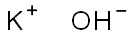
- 1310-58-3
- KOH
- 56.11
- All (43)
- China (34)
- (43)
- 8068-05-1
- C30H25ClN6
- 505.01
- All (0)
- China (0)
- (0)
- 26288-25-5
- H3KO2
- 74.12090
- All (0)
- China (0)
- (0)
- 89091-89-4
- HK3O
- 134.30200
- All (0)
- China (0)
- (0)
- 100330-18-5
- HKO
- 58.10540
- All (0)
- China (0)
- (0)
- 87208-53-5
- C44H28CdN4O-
- 741.13000
- All (0)
- China (0)
- (0)
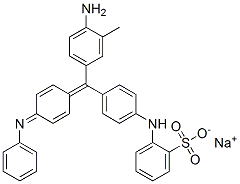
- 62152-67-4
- C38H31N4NaO3S
- 646.73
- All (0)
- China (0)
- (0)
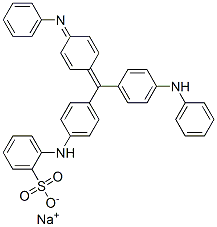
- 8004-90-8
- C74H59N6NaO7S2
- 1231.42
- All (6)
- China (0)
- (6)
Related Products More >

- 1310-58-3
- CNY 13.0000
- 25kg
- 1310-58-3
- USD 800.0000
- 25kg
- 1310-58-3
- Request For Quotation
- 1ton
- 1310-58-3
- Request For Quotation
- 1ton
- 1310-58-3
- Request For Quotation
- 1ton
- 1310-58-3
- Request For Quotation
- 1ton
- 1310-58-3
- Request For Quotation
- 25kg


Medically, potassium hydroxide is a strong alkali that dissociates fully in water, releasing hydroxide ions which are highly reactive. Exposure to KOH can cause severe chemical burns on skin and mucous membranes, respiratory irritation if inhaled, and serious eye damage. Thus, improper handling or accidental exposure can lead to acute health risks such as tissue damage or respiratory distress.
For patients or consumers considering KOH for any use, it is essential to understand that direct contact must be avoided. If necessary, personal protective equipment like gloves and goggles should be used. In cases of accidental exposure, immediate flushing with water and prompt medical evaluation are critical. Safer alternatives exist for many household or minor industrial uses, such as milder bases or buffered solutions that reduce corrosivity.
When acquiring potassium hydroxide, ensure that the supplier complies with safety and regulatory standards. For personal or small-scale use, purchasing pre-diluted solutions or products containing KOH at safe concentrations may be preferable.
Potassium hydroxide (KOH) is a strong inorganic base composed of potassium (K⁺) ions and hydroxide (OH⁻) ions. Chemically, it is an ionic compound where the bond between potassium and hydroxide is ionic due to the transfer of an electron from potassium to the hydroxide ion. This ionic bonding results in a highly polar compound, making KOH very soluble in water and dissociating completely into its ions.
KOH is known for its strong alkalinity and its ability to react vigorously with acids, neutralizing them by forming water and corresponding potassium salts. This property makes it valuable in various industrial processes such as soap making, chemical synthesis, and pH regulation. Due to its high reactivity and corrosiveness, it must be handled with care under controlled laboratory or industrial conditions.
In terms of stability, potassium hydroxide is generally stable in solid form but is highly hygroscopic—it readily absorbs moisture from the air. This characteristic means it must be stored in airtight containers to prevent it from absorbing water and forming a concentrated aqueous solution, which is even more reactive.
For those interested in where to buy potassium hydroxide, it is typically available through chemical suppliers, industrial distributors, and specialized online stores serving educational, laboratory, or manufacturing needs. Purchasing from reputable suppliers is essential to ensure the product's purity and safety, especially because KOH is hazardous if mishandled.
In everyday applications, diluted forms of potassium hydroxide are sometimes found in drain cleaners or used in certain food processing techniques. However, due to its corrosiveness, safety precautions like wearing gloves and eye protection are always recommended.
What to know about sources: Hardware stores typically sell it as drain cleaners (diluted with other ingredients) or in pure form for heavy-duty tasks. Online, you’ll find it for soap-making or industrial uses, sometimes in high concentrations (50%+). Craft shops might stock it in small quantities for DIY soap kits, but even these need caution.
Who should think twice? Families with young kids or pets. Pure KOH is corrosive: it burns skin on contact, and if ingested, damages the throat and stomach. Even diluted versions (like drain cleaners) can irritate eyes or lungs if fumes are inhaled, especially in small, unventilated spaces.
Common myths? Myth 1: “It’s safe because it’s used in soap.” Soap-making uses precise dilution and chemical reactions that neutralize KOH. Raw KOH in its pure form is far from safe. Myth 2: “Any concentration works for home use.” High-strength KOH (over 30%) is overkill for drains or crafts—stick to diluted, pre-mixed products if you must use it.
Do you need it? Probably not. Most clogs clear with a plunger or enzyme-based drain cleaners (no KOH needed). For soap-making, many beginner kits use safer alternatives.
Family-friendly tips:
Skip pure KOH. Opt for gentle drain cleaners labeled “enzymatic” or “plant-based”—they work slower but are safer.
If buying KOH for crafts, choose small, pre-measured packets and store them in a locked cabinet, far from food or kids’ reach.
Never let kids handle KOH—even “small amounts” can cause harm.
KOH has its uses, but it’s not a household essential. Prioritize safer alternatives to keep your home hazard-free.
Here’s why: Imagine you’re baking a cake, but instead of flour, you need a super-strong “alkali powder” to react with acidic ingredients (like vinegar) to create a fizzy, cleaning-like effect. That’s KOH—it’s used industrially to make soap, clean metal, or even adjust pH in pools. But unlike baking soda, it’s way more aggressive (think: burns through organic material like a hot knife through butter).
Pro tip: If you’re buying KOH for DIY projects (e.g., soap-making or rust removal), always wear nitrile gloves, goggles, and a lab coat, and work in a well-ventilated area. Store it in a sealed plastic container away from moisture (it absorbs water from the air and turns into a gooey mess). And never mix it with acids (like vinegar) without proper training—it can explode!
Bonus fact: Your stomach acid (HCl) is strong, but KOH is so caustic it’s used to dissolve animal carcasses in forensic science. Science: always respect the power of chemicals! ??