


 Home
Home
Hello, I’d like to ask what is in hydrochloric acid exactly? Is it safe for the body? Why is it present in the stomach and how does it help digestion? Are there any risks if levels are too high or too low?
What Is in Hydrochloric Acid and How Does It Affect the Body?
Related Encyclopedia
- 9001-75-6
- n.a.
- 0
- All (9)
- China (0)
- (9)
- 32119-90-7
- DOT
- 22.02930
- All (50)
- China (13)
- (50)
- 20272-95-1
- DOT
- 21.02960
- All (50)
- China (13)
- (50)

- 358616-29-2
- H3O2
- 35.02260
- All (50)
- China (13)
- (50)
- 61468-85-7
- OT2
- 23.03120
- All (50)
- China (13)
- (50)
- 53774-37-1
- OT2
- 24.03130
- All (50)
- China (13)
- (50)
- 32113-92-1
- HOT
- 22.02320
- All (50)
- China (13)
- (50)
- 32119-89-4
- HOT
- 21.02310
- All (50)
- China (13)
- (50)
- 32113-93-2
- DOT
- 23.02930
- All (50)
- China (13)
- (50)
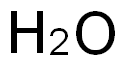
- 7732-18-5
- H2O
- 18.01
- All (50)
- China (13)
- (50)
Related Products More >

- 9003-05-8
- USD 30.0000
- 25kg
- 9003-05-8
- USD 30.0000
- 25kg
- 1336-21-6
- CNY 500.0000
- 1ton


From a physiological perspective, hydrochloric acid in the stomach is secreted by parietal cells in the gastric lining and is composed of water and hydrogen chloride gas, which dissociates into hydrogen ions (H⁺) and chloride ions (Cl⁻) in solution. These ions generate a highly acidic environment (pH 1.5–3.5), essential for activating pepsinogen into pepsin—an enzyme that breaks down proteins. It also sterilizes ingested food by killing most pathogens and facilitates the absorption of certain nutrients, such as calcium and iron.
However, an imbalance in hydrochloric acid levels can have significant clinical consequences. Too much acid can lead to conditions like gastroesophageal reflux disease (GERD), peptic ulcers, or Zollinger-Ellison syndrome. Too little acid (hypochlorhydria) may result in poor digestion, nutrient deficiencies (e.g., vitamin B12), and increased susceptibility to infections. Both extremes can impact overall gastrointestinal function and patient health.
To manage acid-related conditions, physicians may recommend proton pump inhibitors (PPIs), H2 blockers, or antacids to reduce stomach acid production. For those with low acid, supplementation with betaine HCl under medical supervision might help. Diet modification—like avoiding trigger foods, eating smaller meals, and limiting alcohol or caffeine—can also support acid balance.
From a molecular structure perspective, HCl is a diatomic molecule, meaning it contains just two atoms. The hydrogen and chlorine atoms are connected by a single covalent bond. However, this bond is polar, because chlorine is significantly more electronegative than hydrogen. This polarity causes the electron density to shift toward the chlorine atom, giving it a partial negative charge and hydrogen a partial positive charge.
This polar nature makes HCl highly soluble in water. When HCl is added to water, it completely dissociates into hydrogen ions (H⁺) and chloride ions (Cl⁻). This dissociation is what makes hydrochloric acid a strong acid—it ionizes completely in aqueous solution, resulting in a high concentration of free hydrogen ions, which is responsible for its low pH and high reactivity.
In terms of stability, HCl as a gas is relatively stable under standard conditions, but in aqueous form, its reactivity is heightened due to the availability of free protons. This is why HCl is used in various industrial applications, such as pH control, metal cleaning, and food processing. It's also the key component of gastric acid, where it aids digestion and acts as a barrier to pathogens.
To visualize this in a lab, think of the reaction between hydrochloric acid and calcium carbonate (CaCO₃), which produces carbon dioxide gas—a classic demonstration of acid–base chemistry.
Hydrochloric acid forms when hydrogen chloride gas (HCl) dissolves in water. Industrially, this is done in controlled labs using specialized equipment to handle toxic fumes. At home, attempting this would require mixing strong chemicals (like sulfuric acid and salt) under high heat—reactions that release corrosive gas, burn skin, or even explode if not controlled.
Why home production is risky: Even small amounts of hydrogen chloride gas irritate lungs, eyes, and skin. Kids, pets, or anyone with asthma are especially vulnerable. The acid itself, once formed, eats through clothing, metal, and surfaces, making spills hazardous to clean up.
Common myths? Myth 1: “It’s easy with household items.” Mixing vinegar (a weak acid) and salt doesn’t make hydrochloric acid—it creates only trace amounts, not usable or safe concentrations. Myth 2: “Diluting it makes it harmless.” Even weak HCl can burn skin with prolonged contact and damage pipes if poured down drains.
When would you need it? You almost certainly don’t. Household cleaners with small amounts of HCl (like toilet bowl cleaners) are already diluted and regulated for safety. There’s no home task that requires making your own—store-bought versions, while still needing caution, are far safer than DIY attempts.
Family-friendly tips:
Never try to make it. If a project claims to need hydrochloric acid, find a safer alternative (e.g., baking soda for cleaning, citric acid for descaling).
Use store-bought HCl cleaners sparingly, following labels strictly: wear gloves, work in well-ventilated areas, and keep kids/pets away.
Store any HCl products in their original containers, locked in a high cabinet—out of reach of curious hands.
Hydrochloric acid is best left to professionals. For home use, stick to pre-made, regulated products (if necessary) and prioritize safety over DIY experiments.
Here’s the breakdown: HCl is a simple binary compound: one hydrogen atom (the tiniest, most reactive element) hooks up with one chlorine atom (a toxic green gas in its pure form). When dissolved in water, it splits into H⁺ (proton) and Cl⁻ (chloride ion), creating the super-acidic solution we know.
Real-life example: Think of HCl like a lemonade mix for chemistry nerds. Pure lemon juice is weak acid (citric acid), but if you could extract the pure sourness (H⁺) and pair it with chlorine gas (Cl₂), you’d get HCl—a liquid so corrosive it can eat through metal! (Don’t try this at home—chlorine gas is deadly.)
Pro tip: If you’re handling diluted HCl (like muriatic acid for pool cleaning), always wear gloves, goggles, and work in a ventilated area. And never mix it with bleach or ammonia—that creates toxic chlorine gas (the same stuff used in chemical warfare). Stick to water-based neutralizers like baking soda if you spill it!
Bonus hack: Your stomach makes its own HCl to digest food—nature’s way of saying, “I’ve got this chemical warfare covered!” But outside the body, treat HCl with respect. It’s not just “acid”—it’s a tiny, powerful molecule that demands safety first! ??⚠️