


 Home
Home
Hi, I'd like to ask—does hydrogen peroxide work better than bleach for blood stains on concrete? Should I dilute sodium hypochlorite before applying? Can vinegar or baking soda help remove old blood stains? How long should I let the cleaner sit before scrubbing? Will these cleaners damage the concrete's surface texture? Thanks!
How to Effectively Remove Blood Stains from Concrete Using Household Cleaners?
Related Encyclopedia
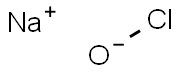
- 7681-52-9
- ClNaO
- 74.44
- All (22)
- China (20)
- (22)
- 34322-11-7
- DHO2
- 35.02080
- All (27)
- China (27)
- (27)
- 71426-84-1
- O2T2
- 38.03090
- All (27)
- China (27)
- (27)
- 13813-07-5
- H2O2
- 36.01000
- All (27)
- China (27)
- (27)

- 7722-84-1
- H2O2
- 34.01
- All (27)
- China (27)
- (27)
- 64131-03-9
- ClH14NaO8
- 200.54900
- All (0)
- China (0)
- (0)
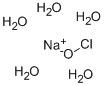
- 10022-70-5
- NaClO.5H2O
- 165.53
- All (0)
- China (0)
- (0)
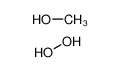
- 1000623-92-6
- CH6O3
- 66.05650
- All (0)
- China (0)
- (0)
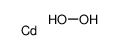
- 12289-44-0
- CdH2O2
- 146.42600
- All (0)
- China (0)
- (0)

- 8076-25-3
- CH4O3
- 64.04070
- All (0)
- China (0)
- (0)
Related Products More >

- 7681-52-9
- CNY 450.0000
- 1ton
- 7681-52-9
- CNY 650.0000
- 1ton
- 980-26-7
- Request For Quotation
- 87435-55-0
- Request For Quotation
- 7681-52-9
- Request For Quotation
- 100g;1kg;25g
- 7681-52-9
- Request For Quotation
- 25kg/drum
- 7681-52-9
- Request For Quotation
- 25KG/Bag
- 7681-52-9
- Request For Quotation
- 1kg/bag,25kg/drum,25kg/bag


For old blood stains, household items like vinegar or baking soda can be effective. Vinegar’s acidic nature helps dissolve dried blood proteins, while baking soda’s gentle abrasiveness assists in lifting the stain when scrubbed. To use, apply diluted vinegar (half water, half vinegar) or a paste made from baking soda and water, letting the solution sit for 10 to 15 minutes before scrubbing gently with a soft brush.
Allowing cleaners to rest for 5 to 15 minutes ensures they penetrate the stain, but leaving them on for more than 20 minutes may harm the concrete’s texture, especially if it’s porous. Always test cleaners on a small, inconspicuous area first to avoid unexpected damage, and wear protective gloves to prevent skin irritation. This method balances effectiveness with care to preserve the concrete’s integrity while removing blood stains.
Bleach, containing sodium hypochlorite, can also eliminate blood stains. However, it's a more potent and corrosive substance. If used undiluted, bleach can react aggressively with the minerals in concrete, especially if the surface is unsealed or porous. To mitigate this risk, it's essential to dilute bleach properly, usually by mixing 1 part bleach with 10 parts water. This dilution reduces the harshness of the chemical while still allowing it to break down the stain-causing components in blood.
For old, dried - out blood stains, vinegar and baking soda can be valuable allies. Vinegar, with its acetic acid content, works by dissolving the dried proteins in the blood. When using vinegar, it's advisable to dilute it in a 1:1 ratio with water to avoid potential damage to the concrete surface. Applying the diluted vinegar to the stain and letting it sit for 10 - 15 minutes helps loosen the dried blood, making it easier to scrub away. Baking soda, on the other hand, has a slightly abrasive texture. When mixed with water to form a paste, it can gently scrub at the stain without scratching the concrete. Spread the paste on the stain, allow it to dry slightly, and then scrub to remove the old blood.
The time that a cleaner sits on the stain is an important factor. For fresh stains treated with hydrogen peroxide, 5 - 10 minutes is usually sufficient for the chemical reaction to take place. For old stains, whether treated with diluted bleach or vinegar, 15 - 20 minutes gives the cleaning agent enough time to penetrate and break down the dried - on blood. Before applying any cleaner to the entire stain, it's always a good practice to test it on a small, inconspicuous area of the concrete. This test helps determine if the cleaner will cause any discoloration or damage to the surface texture. After scrubbing, thoroughly rinse the area with water to remove all traces of the cleaning agent.
Regarding sodium hypochlorite dilution, industrial-grade 5.25% solution must be diluted at least 1:10 with water for safe concrete surface application. Undiluted or overly concentrated solutions can induce chlorination reactions with calcium-containing minerals in concrete. A parking lot maintenance project in Florida last year documented surface powdering caused by applying undiluted sodium hypochlorite. Always wear butyl rubber gloves and maintain ventilation, as sodium hypochlorite reacts with atmospheric CO2 to produce trace amounts of chlorine gas.
The vinegar and baking soda combination can indeed treat stubborn blood stains. Acetic acid (pKa 4.76) disrupts hemoglobin's secondary structures, while sodium bicarbonate generates CO2 bubbles that aid mechanical stain removal. However, strict pH control is necessary—when the solution pH exceeds 8.5, it may trigger alkali-silica reactions with concrete's silicate minerals. A phased treatment approach is recommended: first soak with 5% acetic acid for 30 minutes, then neutralize with saturated sodium bicarbonate solution, and finally rinse thoroughly with deionized water.
Cleaning duration depends heavily on concrete type. Ordinary Portland cement concrete typically has 15% porosity, allowing 15-20 minutes for cleaning solution penetration. In contrast, high-performance concrete with silica fume may have only 5% porosity, where prolonged exposure risks surface crystallization of active ingredients. A case study in Minnesota last winter showed that at subzero temperatures, hydrogen peroxide's decomposition rate slowed considerably, requiring 30-minute treatment duration to achieve desired results. The concrete's water-to-cement ratio also affects cleaning efficacy—higher ratios create more capillary pathways but may also increase chemical absorption depth, potentially damaging reinforcing steel if chlorides are introduced.
This helps prevent damage to the concrete and reduces the risk of harmful fumes. Vinegar and baking soda can also be useful for removing old blood stains. Vinegar is acidic and helps break down organic material, while baking soda acts as a mild abrasive. You can create a paste with baking soda and water, apply it to the stain, and let it sit for a while before scrubbing. Alternatively, you can spray vinegar on the stain and let it sit for a few minutes before scrubbing. The cleaner should be allowed to sit on the stain for about 10 to 30 minutes to allow it to penetrate and break down the blood proteins.