


 Home
Home
Hi, I'd like to ask—what determines the polarity of ozone molecules? Is its bond distribution asymmetrical? As an atmospheric gas, how does ozone's polarity affect its chemical properties? Compared to oxygen molecules, why does ozone have different polarity? Thanks!
Is Ozone Polar or Nonpolar? Analyzing Its Molecular Structure and Polarity
Related Encyclopedia
- 10028-15-6
- O3
- 47.9982
- All (5)
- China (1)
- (5)

- 119623-14-2
- O3
- 52.99750
- All (5)
- China (1)
- (5)
- 167874-66-0
- O3
- 51.99740
- All (5)
- China (1)
- (5)
- 167874-65-9
- O3
- 49.99770
- All (5)
- China (1)
- (5)
- 26057-96-5
- O3
- 49.99800
- All (5)
- China (1)
- (5)
- 21424-30-6
- O3
- 52.99750
- All (5)
- China (1)
- (5)
- 21424-25-9
- O3
- 50.99740
- All (5)
- China (1)
- (5)
- 80731-27-7
- C7H8O3
- 140.13700
- All (0)
- China (0)
- (0)

- 153851-84-4
- O3
- 47.99820
- All (0)
- China (0)
- (0)
- 84508-01-0
- H2O4
- 66.01350
- All (0)
- China (0)
- (0)
Related Products More >

- 67634-15-5
- Request For Quotation
- 10028-15-6
- Request For Quotation
- 25
- 10028-15-6
- Request For Quotation
- Tankers
- 10028-15-6
- Request For Quotation


This polarity affects ozone’s chemical properties by enhancing its reactivity. As a polar molecule, ozone experiences stronger intermolecular forces, such as dipole-dipole interactions, which influence how it interacts with other substances. Its polarity allows it to participate more readily in oxidation reactions, as the uneven charge distribution makes ozone more susceptible to forming bonds with other elements or compounds. For example, in the atmosphere, ozone’s polarity contributes to its role in breaking down pollutants or reacting with other gases, though it also makes ozone more reactive and potentially harmful near the Earth’s surface.
In contrast, oxygen (O2) is nonpolar because its linear, symmetrical structure results in balanced electron density. Ozone’s polarity enhances its chemical reactivity: as a polar molecule, it can form stronger interactions with other polar substances, making it more effective as an oxidizing agent. For example, its polarity allows ozone to readily break down pollutants or disinfect surfaces by reacting with polar compounds. This polarity-driven reactivity, combined with its unstable structure, makes ozone more chemically active than oxygen, explaining its unique role in atmospheric processes like the ozone layer’s UV absorption and ground-level air purification.
This polarity significantly affects ozone's behavior as an atmospheric gas. Unlike nonpolar O₂, which interacts primarily through weak van der Waals forces, ozone's dipole moment allows it to engage in stronger dipole-dipole interactions and hydrogen bonding with water molecules. This increased intermolecular attraction explains why ozone is about 10 times more soluble in water than oxygen, enabling it to dissolve in atmospheric moisture and participate in aqueous-phase reactions. These reactions are critical in the troposphere, where ozone acts as a powerful oxidant, breaking down volatile organic compounds (VOCs) and other pollutants. The polarity also enhances ozone's reactivity toward polar and electron-rich organic molecules, contributing to its role in smog formation and its use as a disinfectant in water treatment.
Compared to oxygen, ozone's different polarity stems directly from its molecular structure. Oxygen's symmetrical diatomic form ensures that electron density is evenly shared between the two atoms, resulting in no permanent dipole. In contrast, ozone's bent shape and resonance hybridization create an asymmetrical electron cloud, leading to the observed polarity. This structural difference not only explains their contrasting physical properties—such as solubility and boiling points—but also their divergent chemical behaviors. For example, ozone's polarity allows it to participate in complex atmospheric reactions, including the destruction of stratospheric ozone by chlorofluorocarbons (CFCs), while oxygen's nonpolarity limits it to simpler processes like respiration and combustion.
The asymmetrical charge distribution in ozone also influences its environmental impact. As a polar molecule, ozone interacts more strongly with other atmospheric components, such as water vapor and aerosols, affecting cloud formation and radiative forcing. Its reactivity toward organic pollutants makes it both beneficial in the stratosphere—where it absorbs harmful UV radiation—and detrimental at ground level, where it damages lung tissue and vegetation.
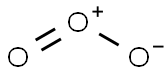
Though O-O bonds in ozone are nonpolar (same element), the molecule’s V-shape (bond angle ~117° from sp² hybridization and lone-pair repulsion) gives it a net dipole moment of about 0.53 D. This polarity enhances ozone’s reactivity: it acts as a stronger oxidant than O₂, readily decomposing pollutants like sulfur dioxide (SO₂). A 2023 Nature Chemistry study showed ozone’s polar interactions with SO₂ lower oxidation activation energy, critical for reducing acid rain precursors. Ozone’s polarity also allows it to dissolve in polar solvents like water, unlike O₂, influencing tropospheric chemistry.
Compared to O₂, ozone’s polarity enables dipole-driven reactions, such as electrophilic attacks on polar substrates. For example, in water treatment, it decomposes organic pollutants more efficiently. Additionally, ozone’s polar nature lets it absorb UV-B radiation via vibrational transitions, vital for the ozone layer’s role. Recent 2024 research at MIT highlights how ozone’s polar interactions with atmospheric nanoparticles affect cloud formation, underscoring its importance in climate modeling. These properties stem from the fundamental difference in molecular structure between polar O₃ and nonpolar O₂, shaping their roles in both laboratory chemistry and global atmospheric processes.