


 Home
Home
The other day at breakfast, a friend asked while pouring milk over cereal, "Hey, is cow milk acidic or basic?Why?" It sounds simple, but it actually got us into a surprisingly cool chemistry talk!
Is Cow Milk Acidic or Basic?Why?
Related Encyclopedia
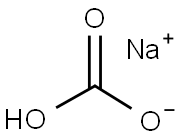
- 144-55-8
- CHNaO3
- 84.01
- All (83)
- China (59)
- (83)
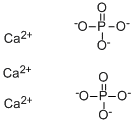
- 7758-87-4
- Ca3O8P2
- 310.18
- All (75)
- China (0)
- (75)
![SODIUM BICARBONATE, [14C]](https://chemcloud-1304660855.cos.ap-shanghai.myqcloud.com/compound/4ca1cb1df0ef47f58653c7f46f805e3b.png?imageMogr2/format/webp)
- 7279-86-9
- CHNaO3
- 86.02000
- All (0)
- China (0)
- (0)
- 32119-90-7
- DOT
- 22.02930
- All (50)
- China (13)
- (50)
- 20272-95-1
- DOT
- 21.02960
- All (50)
- China (13)
- (50)

- 358616-29-2
- H3O2
- 35.02260
- All (50)
- China (13)
- (50)
- 61468-85-7
- OT2
- 23.03120
- All (50)
- China (13)
- (50)
- 53774-37-1
- OT2
- 24.03130
- All (50)
- China (13)
- (50)
- 32113-92-1
- HOT
- 22.02320
- All (50)
- China (13)
- (50)
- 32119-89-4
- HOT
- 21.02310
- All (50)
- China (13)
- (50)
Related Products More >

- USD 30.0000
- 6kg
- 7757-82-6
- CNY Request For Quotation
- 10124-56-8
- CNY Request For Quotation
- 7664-38-2
- CNY Request For Quotation
- CNY Request For Quotation
- CNY Request For Quotation
- CNY Request For Quotation
- CNY Request For Quotation


Lactic acid: Produced by natural fermentation of lactose by bacteria, even in fresh milk (though pasteurization reduces bacterial activity).
Casein: The main protein in milk, which forms complexes that contribute to acidity.
Citric acid: A natural organic acid present in small amounts.
While milk may taste neutral, its pH confirms its acidic nature. This acidity helps stabilize milk’s structure and prevents rapid spoilage. Factors like the cow’s diet, breed, or milk processing (e.g., homogenization) can slightly affect pH, but it remains consistently acidic. In contrast, "alkaline milk" is rare and usually linked to abnormal conditions in the cow. Overall, cow milk is classified as a weakly acidic food.
Now, why does that matter? For human health, it’s important because some folks worry acidic foods might affect things like digestion or bone health. But don’t stress—cow milk is actually rich in calcium, protein, and vitamins, which are good for your bones, muscles, and overall growth, especially in kids.
In terms of chemistry and food science, milk contains lactic acid, which forms when lactose (the natural sugar in milk) breaks down. This is also why milk can spoil—it becomes more acidic over time as bacteria produce more lactic acid.
From an environmental and chemical industry standpoint, milk’s acidity plays a role in fermentation, cheese-making, and dairy product formulation. It also factors into wastewater treatment at dairy processing plants, where acidity must be balanced before disposal.
Why Acidic? Science Churning:
Lactic Acid Trap:
Milk sugar (lactose) ferments → lactic acid (C₃H₆O₃) forms via bacteria.
Fresh milk: 0.15% acidity (natural buffers keep pH stable).
Protein Buffering:
Casein micelles resist pH changes initially (like a stubborn buffalo).
Heat/age dissolves buffers → acidity surges!
pH Spectrum:
State pH Taste
Fresh Cow Milk ~6.6 Mildly sweet
Spoiled Milk 4.6 Sour (chaas time!)
"Alkaline" Milk >7.0 Fraud Alert!
Fermentation Magic → Dahi Science!
Lactobacillus bacteria eat lactose → lactic acid explosion 🔥.
At pH 4.6, proteins curdle → dahi solidifies!
Pro Tip: Boil milk to kill competing bacteria for perfect dahi.
⚠️ Adulteration Red Flags:
Stray pH > 7? Likely added soda (Na₂CO₃) or chalk for fake freshness!
FSSAI Rule: Natural milk MUST be acidic. Alkaline = artificial!
Real-World Impact:
✅ Cooking Chemistry:
Acidic milk thickens gravies (reaction with besan).
Makes soft paneer (pH 5.2 ideal for curdling).
☠️ Spoilage Danger:
pH < 4.6 invites toxic bacteria → diarrhoea hazard!
Myth vs Truth:
Myth: "Alkaline milk = healthier!"
Truth: Alkaline milk = adulterated or digested (stomach acids temporarily neutralize it).
Cow milk sits in the middle. Its pH hovers around 6.5–6.7, slightly below neutral. Why? Milk contains lactose (milk sugar), which breaks down into weak acids like lactic acid, and traces of citric acid from dairy fat. These acids give milk its faintly sour note—think of how milk turns more acidic when left out. However, milk also has a built-in buffer: proteins like casein and minerals like calcium phosphate absorb excess H⁺ ions, preventing a sharp drop in pH.
So, is milk acidic? Yes, but barely. It’s no surprise—mother nature designed it to nourish calves, not corrode their tiny stomachs!