


 Home
Home
Hi, I’m curious about something I recently read regarding calcium oxide. I understand it’s a chemical often used in construction and agriculture, but I’m wondering how it behaves with water. Does it just dissolve like sugar, or does something else happen? How quickly does this reaction take place, and what should I expect if I handle calcium oxide near water? Could it be dangerous, or is it relatively safe to mix?
Is Calcium Oxide Soluble in Water and How Does It React?
Related Encyclopedia

- 20665-52-5
- GaH2O2
- 103.73800
- All (0)
- China (0)
- (0)

- 14280-30-9
- HO
- 17.01000
- All (0)
- China (0)
- (0)

- 18933-05-6
- H2MnO2
- 88.95270
- All (0)
- China (0)
- (0)
- 34118-37-1
- H7O4
- 71.05320
- All (0)
- China (0)
- (0)
- 75594-07-9
- HOTi
- 64.87430
- All (0)
- China (0)
- (0)
- 154726-68-8
- C16H30N2O
- 266.42200
- All (0)
- China (0)
- (0)
- 134123-42-5
- C12H28O2S
- 236.41500
- All (0)
- China (0)
- (0)
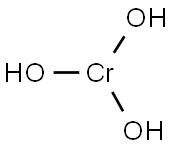
- 1308-14-1
- CrH5O4
- 121.03
- All (0)
- China (0)
- (0)

- 17287-03-5
- C3H10OS
- 94.18
- All (0)
- China (0)
- (0)

- 68355-44-2
- CH4MgO
- 56.34690
- All (0)
- China (0)
- (0)
Related Products More >

- CNY Request For Quotation
- CNY Request For Quotation
- CNY Request For Quotation
- 1310-73-2
- Request For Quotation
- 1310-73-2
- Request For Quotation
- 1310-73-2
- Request For Quotation
- 1310-73-2
- USD 1.0000
- 25kg
- 1305-62-0
- USD 270.0000
- 900kg


Chemically, this reaction is driven by the ionic nature of CaO. The calcium ion (Ca²⁺) in CaO has a strong tendency to interact with water molecules, which act as ligands, forming hydrated calcium ions. Simultaneously, the oxide ion (O²⁻) reacts with water to produce hydroxide ions (OH⁻), raising the pH of the solution to around 12–13. Physically, the heat generated during this reaction can cause the water to boil if large quantities of CaO are added suddenly, a phenomenon utilized in self-heating cans and industrial heating processes.
The solubility-related behavior of CaO has profound implications across various fields. In construction, the reaction with water is harnessed to produce lime plaster and mortar, where the heat helps accelerate curing and the alkaline environment promotes adhesion. Industrially, CaO is used in water treatment to soften hard water by precipitating calcium and magnesium ions as hydroxides. Medically, calcium hydroxide solutions derived from CaO are applied as antiseptics and in dental treatments to disinfect root canals. These applications highlight how the interplay between solubility and chemical reactivity enables CaO to serve as a versatile material in infrastructure, environmental management, and healthcare.
Calcium hydroxide has limited solubility in water (approximately 1.7 g per liter at 20°C), meaning only a small portion dissolves to form a dilute solution called lime water. The rest remains as a suspension of solid particles, giving the mixture a milky appearance. This contrasts with highly soluble ionic compounds like sodium chloride (NaCl), which dissolves completely in water to form a clear solution of Na⁺ and Cl⁻ ions.
A common misconception is conflating the reaction of CaO with water as solubility. While the product (Ca(OH)₂) has some solubility, CaO itself does not dissolve; it chemically transforms. This distinction is critical because the reaction is exothermic, releasing significant heat, which can make the mixture boil—unlike simple dissolution, which is often endothermic or only slightly exothermic.
In chemistry and industry, understanding this behavior is vital. The reaction of CaO with water is essential in applications like cement production, where the formation of calcium hydroxide contributes to the hardening process, and in agriculture, where lime water is used to adjust soil pH. Recognizing that CaO reacts with water rather than dissolving helps predict handling requirements, such as avoiding contact with moisture to prevent hazardous heat release.
This solubility behavior is not just a theoretical detail; it has practical applications in various industries. For instance, in construction, slaked lime produced from calcium oxide is used to make mortar, plaster, and cement, providing both strength and stability to building materials. In agriculture, this reaction is leveraged to adjust soil pH by neutralizing acidic soils, enhancing crop growth. The formation of calcium hydroxide also plays a role in water treatment, where it is used to remove impurities and soften water.
Understanding this reaction mechanism highlights the dual role of calcium oxide: it acts as a reactant rather than a simple solute. The oxide ions readily interact with water molecules, producing hydroxide ions and resulting in a basic solution. This property requires careful handling in laboratory and industrial settings, as the reaction can be vigorous and produce heat sufficient to cause burns. Observing calcium oxide’s transformation in water demonstrates fundamental principles of ionic reactivity and showcases its versatile applications across everyday chemical processes.