


 Home
Home
Hi, I’ve been trying to understand why sometimes I don’t feel hungry even when it’s time to eat. I read that certain chemicals in our brain can actually suppress appetite. I’m curious about which two neurotransmitters are most involved in this process and how they affect our eating behavior. Are they the same ones that influence mood or energy? How do they interact with daily habits like sleep, exercise, or stress? Could understanding them help manage cravings better, and which two neurotransmitters are associated with appetite suppression?
Curious About Which Two Neurotransmitters Are Associated with Appetite Suppression and How They Work in Everyday Life?
Related Encyclopedia
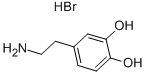
- 645-31-8
- C8H12BrNO2
- 234.09
- All (9)
- China (2)
- (9)
- 240124-73-6
- C17H16N2O2
- 280.32100
- All (0)
- China (0)
- (0)
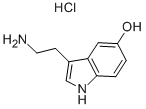
- 153-98-0
- C10H13ClN2O
- 212.68
- All (2)
- China (0)
- (2)
- 1220710-22-4
- C11H15NO2
- 193.24200
- All (0)
- China (0)
- (0)
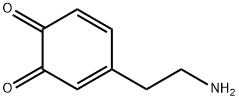
- 50673-96-6
- C8H9NO2
- 151.16
- All (0)
- China (0)
- (0)
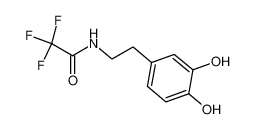
- 65846-04-0
- C10H10F3NO3
- 249.18700
- All (0)
- China (0)
- (0)
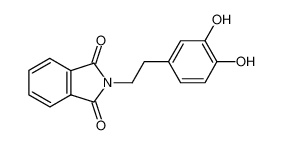
- 57894-18-5
- C16H13NO4
- 283.27900
- All (0)
- China (0)
- (0)
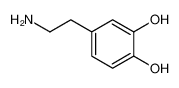
- 51079-99-3
- C8H11NO2+
- 154.18600
- All (0)
- China (0)
- (0)
- 1251958-94-7
- C26H21NO4
- 411.44900
- All (0)
- China (0)
- (0)
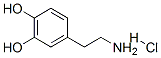
- 62-31-7
- C8H12ClNO2
- 189.64
- All (23)
- China (20)
- (23)
Related Products More >

- 62-31-7
- Request For Quotation
- 25kg/Cardboard Drum
- 62-31-7
- Request For Quotation
- customized
- 62-31-7
- Request For Quotation
- 1kg ,25kg or according to customer's detail requirement.
- 62-31-7
- Request For Quotation
- 25kg/Drum
- 62-31-7
- Request For Quotation
- 1kg/bag;25kg/Cardboard Drum
- 62-31-7
- Request For Quotation
- 25
- 62-31-7
- Request For Quotation
- according to the clients requirement
- 62-31-7
- Request For Quotation
- Bottle,barrel,cargo,container,etc.


Another way to look at it is, if these signals are off, you might feel hungry even when your body doesn’t need food. That’s why sometimes people crave snacks after a stressful day or a poor night’s sleep. Paying attention to lifestyle habits can naturally support serotonin and dopamine levels, helping you manage appetite without strict dieting.
In practical terms, these neurotransmitters interact with lifestyle factors and daily behaviors. For example, consistent sleep patterns can enhance serotonin synthesis, while physical activity can boost dopamine availability, both contributing to better appetite control. Pharmaceutical interventions targeting these neurotransmitters have also been explored for weight management, though lifestyle modifications often remain the first-line approach. In real-life scenarios, someone trying to reduce snacking might benefit indirectly from activities that enhance serotonin and dopamine, such as regular exercise, exposure to natural light, and stress reduction techniques.
Understanding the mechanisms of serotonin and dopamine in appetite suppression provides insight into both metabolic and behavioral interventions. Serotonin’s role in signaling fullness and dopamine’s influence on reward-driven eating combine to create a complex regulatory system. Dysregulation of either pathway can lead to overeating or poor appetite control, emphasizing the importance of maintaining healthy lifestyle patterns. Effective strategies often integrate knowledge of these neurotransmitters with practical measures for daily living, illustrating how molecular neuroscience directly informs behavioral outcomes.
Dopamine, derived from tyrosine, functions differently, influencing reward and motivation circuits that intersect with appetite regulation. While often associated with pleasure from food, dopamine also plays a role in suppressing excessive intake by signaling satiety through its action on receptors in the nucleus accumbens and prefrontal cortex. It helps terminate feeding behavior by reducing the reinforcing value of food, making continued consumption less rewarding once energy needs are met.
Distinguishing these neurotransmitters is critical: serotonin primarily regulates the physiological sense of fullness, while dopamine modulates the motivational and reward-related aspects of eating. A common misconception is that dopamine solely promotes food-seeking; in reality, its role in appetite suppression is equally vital, as dysregulation can lead to compulsive overeating despite satiety signals. Understanding their distinct mechanisms is key to developing targeted therapies for eating disorders and obesity, as interventions that enhance serotonin or dopamine signaling in specific brain regions can effectively reduce excessive appetite without disrupting other vital functions.
Dopamine, while often associated with reward and pleasure, also contributes to appetite control through its role in the mesolimbic pathway. Dopaminergic signaling in the nucleus accumbens and ventral tegmental area (VTA) influences motivation to seek food, but its interaction with D2 receptors in the hypothalamus can suppress hunger when activated by certain stimuli. For instance, high-protein diets or exercise elevate dopamine levels, reducing cravings for calorie-dense foods. The chemical synthesis of dopamine involves tyrosine hydroxylase converting tyrosine to L-DOPA, a rate-limiting step regulated by genetic and environmental factors. Physically, dopamine’s release is tightly coupled with reward prediction errors, meaning unexpected rewards (or their absence) dynamically adjust feeding behavior.
In daily life, these neurotransmitters underpin strategies for managing obesity and eating disorders. Serotonin-targeted drugs like selective serotonin reuptake inhibitors (SSRIs) are sometimes prescribed off-label for binge-eating disorder, though their efficacy varies. Dopamine agonists, conversely, are used cautiously due to risks of compulsive behaviors. Industrially, understanding these pathways informs the development of functional foods and nutraceuticals designed to boost serotonin or dopamine precursors. Medically, GLP-1 receptor agonists (e.g., semaglutide) mimic gut-derived signals that enhance serotonin and dopamine activity, offering a multi-modal approach to weight loss.
Cross-disciplinarily, neuroscience, nutrition, and pharmacology converge to decode how these molecules interact with gut microbiota, circadian rhythms, and stress responses. For example, chronic stress depletes serotonin, potentially driving emotional eating, while probiotics that modulate gut serotonin production are being explored as adjunct therapies. The broader significance lies in redefining appetite not just as a physiological drive but as a complex interplay of neural, hormonal, and environmental cues, paving the way for personalized interventions that address both biological and psychological aspects of overeating.