


 Home
Home
Hi, I’ve been reading a bit about schizophrenia and I’m curious about how it affects the brain. I know certain chemicals, or neurotransmitters, play a role, but I’m not clear which ones are involved or how they actually influence thoughts, feelings, or behavior. Can understanding these brain chemicals help explain symptoms like hallucinations or trouble focusing? How do they interact with daily life, medications, or therapy, and what exactly are the neurotransmitters involved in schizophrenia?
Understanding What Neurotransmitters Are Involved in Schizophrenia and How They Affect Daily Life
Related Encyclopedia
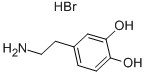
- 645-31-8
- C8H12BrNO2
- 234.09
- All (9)
- China (2)
- (9)
- 78543-55-2
- C5H8NO4-
- 146.12100
- All (0)
- China (0)
- (0)
- 1220710-22-4
- C11H15NO2
- 193.24200
- All (0)
- China (0)
- (0)
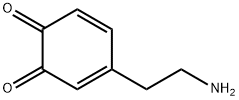
- 50673-96-6
- C8H9NO2
- 151.16
- All (0)
- China (0)
- (0)
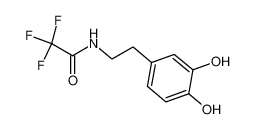
- 65846-04-0
- C10H10F3NO3
- 249.18700
- All (0)
- China (0)
- (0)
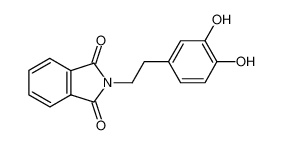
- 57894-18-5
- C16H13NO4
- 283.27900
- All (0)
- China (0)
- (0)
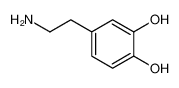
- 51079-99-3
- C8H11NO2+
- 154.18600
- All (0)
- China (0)
- (0)
- 1251958-94-7
- C26H21NO4
- 411.44900
- All (0)
- China (0)
- (0)
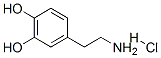
- 62-31-7
- C8H12ClNO2
- 189.64
- All (23)
- China (20)
- (23)
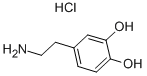
- 335081-04-4
- C8H12ClNO2
- 189.64
- All (23)
- China (20)
- (23)
Related Products More >

- CNY Request For Quotation
- CNY Request For Quotation
- CNY Request For Quotation
- 9029-12-3
- Request For Quotation
- 25kg drum
- 9024-58-2
- Request For Quotation
- 86061-04-3
- Request For Quotation
- Plastic bottles
- 85344-30-5
- Request For Quotation
- 10g/Bottle
- 7558-63-6
- Request For Quotation
- 25kg drum


Another way to think about it is that these chemicals are like traffic signals in the brain—if they’re not working properly, messages get mixed up. Medications for schizophrenia often help balance dopamine and glutamate levels, which can reduce symptoms. Lifestyle factors, like regular sleep, stress management, and social support, can also help the brain work more smoothly, making day-to-day life a bit easier for those affected.
Glutamate, the brain’s primary excitatory neurotransmitter, operates through NMDA receptors, and hypofunction of these receptors is linked to cognitive impairments and disorganized thinking in schizophrenia. Glutamate signaling in the prefrontal cortex and hippocampus—regions critical for memory and reasoning—becomes disrupted, weakening neural connections that support coherent thought processes. This contrasts with dopamine’s role, as glutamate dysregulation affects broader neural networks rather than specific reward or cognitive pathways.
Serotonin, while secondary, modulates both dopamine and glutamate systems. Abnormalities in serotonin receptors, particularly 5-HT2A, can exacerbate positive symptoms by potentiating dopamine release in the mesolimbic pathway. This interaction explains why atypical antipsychotics, which target both dopamine D2 and serotonin 5-HT2A receptors, often address a wider range of symptoms than older drugs focusing solely on dopamine.
A common misconception is that schizophrenia is purely a “dopamine disorder.” In reality, it involves a complex interplay of neurotransmitter systems, with glutamate and serotonin dysfunction contributing significantly to the disorder’s heterogeneity. Understanding these interactions is vital for developing therapies that target multiple pathways, improving outcomes by addressing both positive and negative symptoms more comprehensively.
In practical terms, understanding these neurotransmitter dynamics informs treatment approaches. Antipsychotic medications primarily target dopamine receptors to reduce excessive signaling, helping alleviate hallucinations and agitation. Newer interventions and adjunctive therapies may focus on restoring glutamate balance, which can improve cognitive processing and social functioning. For instance, cognitive-behavioral therapy and structured social support can leverage residual neurotransmitter function, enabling patients to better manage daily tasks and interactions. Lifestyle factors like consistent sleep, physical activity, and stress reduction can also modulate dopamine and glutamate pathways, supporting medication effects.
In everyday life, neurotransmitter imbalances translate into tangible challenges. Someone with schizophrenia might struggle to stay focused during conversations, misinterpret social cues, or experience fluctuating motivation. Recognizing the role of dopamine and glutamate helps both clinicians and patients understand why these symptoms occur and guides strategies that combine pharmacological and behavioral support for improved quality of life.
Glutamate, the brain’s primary excitatory neurotransmitter, interacts with dopamine through N-methyl-D-aspartate (NMDA) receptors, which are critical for synaptic plasticity and learning. Hypofunction of NMDA receptors, potentially due to autoimmune antibodies or genetic mutations affecting receptor subunits, disrupts the balance between glutamate and gamma-aminobutyric acid (GABA), leading to excitatory-inhibitory imbalance. This dysfunction may underlie both positive and negative symptoms, as well as cognitive deficits. For example, NMDA receptor antagonists like phencyclidine (PCP) and ketamine induce schizophrenia-like symptoms in healthy individuals, mimicking psychosis and thought disorder.
Serotonin modulates dopamine and glutamate systems via 5-HT2A receptors, which are targeted by second-generation antipsychotics like clozapine and risperidone. These drugs’ serotonin-dopamine antagonism helps alleviate negative symptoms and reduce side effects compared to first-generation agents. Additionally, serotonin influences mood and perception, areas often disrupted in schizophrenia.
Cross-disciplinarily, neuroscience, genetics, and immunology converge to explain these interactions. Polymorphisms in genes encoding dopamine receptors (e.g., DRD2) or glutamate transporters (e.g., SLC1A1) increase susceptibility, while maternal infections or prenatal stress may trigger immune responses that alter neurotransmitter signaling. In daily life, these insights guide treatment strategies, such as combining antipsychotics with cognitive-behavioral therapy to address residual symptoms. Industrially, they inform drug development, with researchers exploring NMDA receptor modulators or glutamate-targeted therapies. Medically, understanding neurotransmitter roles in schizophrenia advances personalized medicine, enabling treatments tailored to individual symptom profiles. The broader significance lies in redefining mental illness as a disorder of neural communication, bridging molecular biology and clinical care to improve outcomes for millions worldwide.