


 Home
Home
I’m trying to figure out where I can buy acrylic resin for some DIY projects at home. I’ve seen it mentioned online and in craft stores, but I’m not sure which places actually sell it or if there are different types I should be aware of. Can it be found in hardware stores, online shops, or specialty craft stores? Also, are there any tips for picking the right one for beginners? How do people usually get acrylic resin without getting confused by all the options out there?
Where Can I Buy Acrylic Resin? A Simple Guide
Related Encyclopedia
- 27698-54-0
- C5H8AlCl3O2
- 233.45600
- All (0)
- China (0)
- (0)
- 122973-06-2
- C6H5NO+
- 108.11800
- All (38)
- China (36)
- (38)
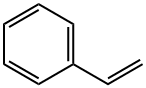
- 100-42-5
- C8H8
- 104.15
- All (38)
- China (36)
- (38)
- 79637-11-9
- C8H8
- 104.15000
- All (38)
- China (36)
- (38)
![3-[(E)-4,6-dimethylhept-2-enyl]oxolane-2,5-dione,2-[3-(oxiran-2-ylmethoxy)propoxymethyl]oxirane,4-(oxiran-2-yl)-7-oxabicyclo[4.1.0]heptane](https://chemcloud-1304660855.cos.ap-shanghai.myqcloud.com/compound/bbb16ce2863d42899585d90674283a10.png?imageMogr2/format/webp)
- 52368-54-4
- C30H48O9
- 552.69700
- All (0)
- China (0)
- (0)
- 856646-54-3
- C12H14O2
- 190.23800
- All (0)
- China (0)
- (0)
- (C14H13NO)n
- 211.26000
- All (0)
- China (0)
- (0)
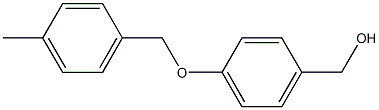
- 201058-08-4
- C15H16O2
- 228.28634
- All (0)
- China (0)
- (0)
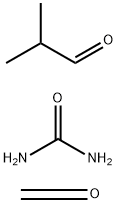
- 28931-47-7
- C6H14N2O3
- 162.19
- All (0)
- China (0)
- (0)

- 11041-12-6
- C27H47N
- 385.66878
- All (0)
- China (0)
- (0)
Related Products More >

- 9002-86-2
- CNY Request For Quotation
- CNY Request For Quotation
- CNY Request For Quotation
- CNY Request For Quotation
- CNY Request For Quotation


In practice, these properties enable uses like automotive clear coats or museum-grade displays, where clarity and longevity are critical. For instance, artists use casting acrylic resin to embed objects or create sculptures, leveraging its low shrinkage and bubble-release qualities during curing. Chemically, the resin’s toughness stems from cross-linked polymer chains, providing impact resistance while remaining lightweight.
Industrial formulations might include additives to enhance flexibility or adhesion, tailored for specific environments such as marine coatings or dental appliances. The versatility of acrylic resin bridges functional demands with aesthetic needs, evident in architectural panels or DIY projects where its ease of application and finishing are valued.
In practical terms, acrylic resin finds widespread application in artistic, industrial, and biomedical contexts. Artists and hobbyists use it for casting, coatings, and embedding objects because it provides a clear, glossy finish and can be tinted with pigments. In industrial settings, it serves as a coating, adhesive, or component in composite materials due to its chemical stability and adhesion characteristics. Its optical clarity and biocompatibility also make it suitable for certain medical devices, dental prosthetics, and laboratory equipment. The material’s adaptability stems from its tunable viscosity, curing time, and hardness, which allows professionals to optimize performance based on specific use cases.
Regarding accessibility, acrylic resin is commercially available through multiple channels. Specialized chemical suppliers provide high-purity resins for research or manufacturing, while craft and online marketplaces offer formulations tailored for hobby and artistic purposes. Selection often depends on desired viscosity, curing mechanism, and intended application, as these factors directly influence the ease of handling, safety precautions, and end-product quality. Understanding the interplay between chemical composition and physical behavior is essential for both practical use and innovative applications.
The broader significance of acrylic resin lies in its contribution to material science and daily life. Its combination of optical clarity, structural integrity, and chemical resistance allows for the creation of durable consumer goods, protective coatings, and visual displays. Moreover, the ongoing development of modified acrylic resins with improved toughness, reduced toxicity, or enhanced UV resistance illustrates the interdisciplinary nature of modern polymer science, bridging chemistry, engineering, and design. These advancements reinforce the relevance of acrylic resin beyond simple craft use, highlighting its role in both technological innovation and everyday materials.
When considering where to purchase acrylic resin, options vary based on intended use. For industrial or large-scale applications, chemical distributors and specialized suppliers that cater to manufacturing sectors often provide bulk quantities, with products tailored to specific performance requirements such as heat resistance or flexibility. These suppliers may also offer technical support to ensure the resin matches the intended production process. For smaller projects or hobbyist use, art supply stores, craft retailers, and online marketplaces are common sources, where the resin is often available in smaller containers alongside compatible additives like pigments or catalysts.
It is important to note that not all products labeled "acrylic resin" are identical, and this can lead to potential misunderstanding. Some formulations may be designed for specific purposes, such as coating applications versus casting, and using the wrong type can result in suboptimal performance. For example, a resin intended for clear coatings may not have the viscosity required for detailed casting, leading to incomplete filling of molds. Therefore, when purchasing, it is crucial to check the product specifications, including curing time, mechanical properties, and recommended applications, to ensure it aligns with the intended use, regardless of the source.