


 Home
Home
When you work on epoxy resin projects, sometimes the surface doesn’t look as glossy as you want. It might have a dull or uneven look after curing. Many people wonder if they can make it look better by polishing or buffing it. Is there a simple way to get that crystal-clear shine without damaging the piece? What tools and products do you actually need for this process, and how careful do you have to be while doing it?
How to Buff Epoxy Resin for a Smooth and Shiny Finish?
Related Encyclopedia
- 83873-16-9
- C22H28O4
- 356.46
- All (0)
- China (0)
- (0)
- 24969-06-0
- C3H5ClO
- 92.52
- All (27)
- China (14)
- (27)

- 14464-46-1
- O2Si
- 60.08
- All (28)
- China (22)
- (28)
- 41846-91-7
- 0.00000
- All (28)
- China (22)
- (28)
- 38891-59-7
- C20H28ClNO4
- 381.9
- All (2)
- China (0)
- (2)
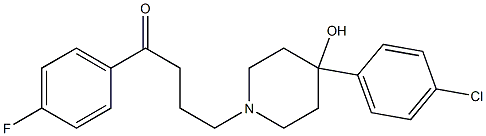
- 61788-97-4
- C21H23ClFNO2
- 375.8642232
- All (1)
- China (0)
- (1)
![3-[(E)-4,6-dimethylhept-2-enyl]oxolane-2,5-dione,2-[3-(oxiran-2-ylmethoxy)propoxymethyl]oxirane,4-(oxiran-2-yl)-7-oxabicyclo[4.1.0]heptane](https://chemcloud-1304660855.cos.ap-shanghai.myqcloud.com/compound/bbb16ce2863d42899585d90674283a10.png?imageMogr2/format/webp)
- 52368-54-4
- C30H48O9
- 552.69700
- All (0)
- China (0)
- (0)
- 444994-08-5
- ClO2Si
- 95.53730
- All (0)
- China (0)
- (0)

- 112945-52-5
- O2Si
- 60.08
- All (1)
- China (1)
- (1)
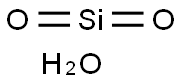
- 10279-57-9
- H2O3Si
- 78.1
- All (15)
- China (0)
- (15)
Related Products More >

- 9002-86-2
- CNY Request For Quotation
- 9003-55-8
- CNY Request For Quotation
- CNY Request For Quotation
- CNY Request For Quotation


After sanding, use a polishing compound or even a car polish and a soft cloth. Rub it in circles until you start to see that clear, glossy finish come back. If you have a buffing wheel or a drill with a polishing pad, that can make the job faster, but doing it by hand works too. Just be patient and take your time, because rushing can leave marks.
Would you like me to also give you a quick step-by-step method for beginners that’s super easy to follow?
The practical execution relies on a meticulous step-by-step approach, typically starting with wet sanding using waterproof sandpaper. One might begin with 400-grit to address significant flaws, moving methodically through 800, 1000, 1500, and even 3000-grit papers. Each stage must thoroughly eliminate the scratches from the prior grit before progressing; skipping steps will leave deep scratches that are impossible to remove later. After sanding to a uniform haze, the actual buffing begins using a rotary tool or polisher with corresponding compounds—a coarse cutting compound followed by a fine polishing compound delivers the final clarity and depth.
In a real-world scenario, a luthier buffing an epoxy resin guitar body exemplifies this process. After the resin cures to a hard, sandable state, they meticulously wet-sand the entire surface. Following the sanding sequence, they use a buffing wheel with a heavy-cut compound to remove the sanding haze, switching to a lighter polish for the final pass. The result is a flawless, glass-smooth finish that reveals the embedded materials within the resin and provides a durable, protective surface that enhances the aesthetic value of the instrument immensely. This transformation underscores the material's potential when paired with skilled craftsmanship.
The process begins with selecting the appropriate abrasive media, a choice dictated by the resin’s condition and desired outcome. Coarse grits (80–120) are used to level deep scratches or irregularities, as their larger abrasive particles remove material more aggressively, though they must be applied with care to avoid over-abrading and thinning the resin layer. As the surface smooths, transitioning to medium grits (240–400) refines the scratch pattern, reducing the size of surface imperfections to a scale that becomes less visible to the naked eye. Finally, fine grits (600–2000) and polishing compounds—often containing micro-abrasives like alumina or cerium oxide—further minimize surface roughness, approaching the nanoscale, where light scattering is reduced and specular reflection dominates, yielding the characteristic high gloss. This progression is critical because skipping grits leaves deeper scratches that finer abrasives cannot effectively eliminate, resulting in a cloudy or uneven finish.
A common misconception is that buffing epoxy resin merely requires applying pressure with a polishing pad, but this overlooks the role of heat management and tool technique. Friction during buffing generates heat, and while epoxy is heat-resistant compared to many plastics, excessive heat—exceeding 150°C in localized areas—can cause the resin to soften, leading to discoloration, warping, or even delamination from the substrate. To prevent this, professionals maintain consistent, light pressure, allowing the abrasive to do the work without generating excess heat, and often use low-speed buffers (1500–3000 RPM) to control friction. Additionally, some assume that any polishing compound works, but compounds designed for metals or paints may be too aggressive for epoxy, introducing new scratches or leaving residue that dulls the finish; selecting compounds formulated for plastics or specifically for epoxy ensures compatibility and optimal results.
In professional contexts—such as in composite manufacturing, furniture making, or industrial coating applications—proper buffing of epoxy resin is more than an aesthetic step; it enhances functional performance. A smooth, buffed surface reduces surface tension, making the resin more resistant to water, oil, and chemical absorption, which is crucial for applications like laboratory countertops or marine coatings. It also improves wear resistance, as a uniform surface distributes stress more evenly, reducing the likelihood of micro-cracks forming at irregularities. Furthermore, in decorative applications, the ability to achieve a high gloss through buffing allows epoxy to mimic the appearance of materials like glass or polished stone, expanding its design versatility without compromising its inherent durability. This blend of aesthetic and functional benefits underscores why mastering the buffing process is essential for professionals working with epoxy resin.
When epoxy cures, even under ideal conditions, microscopic surface irregularities and a phenomenon known as amine blush can create a hazy or uneven appearance. These imperfections scatter light rather than allowing it to transmit uniformly, reducing gloss and transparency. Buffing corrects this by progressively removing surface layers through micro-abrasion, reducing the height of peaks and valleys at the microscopic level. This transforms a diffuse reflection into a specular reflection, restoring optical clarity and giving the piece a glass-like finish. The process typically involves sanding with increasingly fine abrasives, followed by polishing compounds that fill microscopic scratches, aided by mechanical energy from buffing pads or rotary tools to generate localized heat and enhance surface flow.
The significance of this practice extends beyond aesthetics. In industrial applications, such as coatings for composite materials in aerospace or marine engineering, surface smoothness affects hydrodynamics, aerodynamics, and even microbial adhesion. A highly polished epoxy coating on a hull or blade can reduce drag and improve energy efficiency. In biomedical fields, resin-based materials used in prosthetics or dental restorations are polished for hygiene and comfort, as a smoother surface minimizes bacterial retention and improves biocompatibility. Even in electronics, where epoxy encapsulates sensitive components, polishing may be required for optical-grade finishes in sensor housings or LED lenses.
This interplay between chemistry, physics, and applied engineering highlights why buffing is not merely cosmetic but a functional enhancement rooted in material science. Achieving the desired result requires understanding not only abrasive mechanics but also polymer morphology, frictional heat dynamics, and the refractive properties of cured thermosets. Each stage, from coarse sanding to high-gloss buffing, represents a controlled alteration of surface topology to align with both performance and design objectives.