


 Home
Home
Hi, I'd like to ask—does polyvinyl chloride (PVC) actually offer waterproofing? Can it stand up to wet conditions in bathrooms or outdoors? How does its water resistance stack up against other plastics? Are there certain PVC types that are more waterproof? What factors affect PVC's waterproof performance? Thanks!
Is Polyvinyl Chloride Waterproof? A Deep Dive into PVC's Water Resistance Traits
Related Encyclopedia
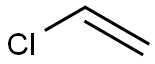
- 9002-86-2
- C2H3Cl
- 62.49822
- All (75)
- China (10)
- (75)
Related Products More >

- 9002-86-2
- CNY Request For Quotation
- 9002-86-2
- CNY 10.0000
- 25kg
- 9002-86-2
- Request For Quotation
- 220kg
- 9002-86-2
- Request For Quotation
- 1ton
- 9002-86-2
- Request For Quotation
- 25kg
- 9002-86-2
- Request For Quotation
- 1ton
- 9002-86-2
- Request For Quotation
- 1ton
- 9002-86-2
- Request For Quotation
- 1kg


When stacked against other plastics, PVC’s water resistance is notable. It outperforms polyethylene in long-term moisture exposure, as polyethylene can turn brittle after extended contact with water. It matches polypropylene in waterproofing but often lasts longer in harsh conditions because of added stabilizers that resist degradation.
Not all PVC is the same, though. Rigid PVC, used in pipes and exterior siding, is more waterproof than flexible PVC, which contains plasticizers that can break down slightly with constant water contact. Manufacturing quality also plays a role—poorly sealed seams or thin layers can create weak spots that let water in.
Factors affecting PVC’s waterproof performance include thickness (thicker pieces resist water better), extreme temperatures (high heat can loosen seals), and chemical exposure (some cleaners may erode the material). Regular checks for cracks or gaps help keep its waterproof properties intact.
In wet conditions, PVC maintains its structural integrity far better than many other plastics. For example, when compared to polyethylene—which may deform under prolonged exposure to moisture—or polystyrene—which can absorb water and lose rigidity—PVC remains stable and unaffected by water ingress. Its resistance to water absorption ensures that it does not swell, warp, or degrade, even when submerged or exposed to high humidity for extended periods. This makes PVC an ideal choice for plumbing pipes, window frames, siding, and waterproof membranes.
However, the waterproofing performance of PVC can vary depending on the type and formulation of the material. Rigid PVC is commonly used in construction and industrial applications due to its strength and superior resistance to water pressure and infiltration. Flexible PVC, which contains plasticizers to enhance elasticity, is often used in hoses, cables, and roofing membranes. While both types offer excellent water resistance, flexible PVC may be more susceptible to degradation from UV exposure or extreme temperatures unless it includes stabilizers and protective additives.
Several factors influence PVC’s waterproof performance. Additives play a crucial role in enhancing its durability in wet conditions. UV stabilizers prevent the material from degrading when exposed to sunlight, while impact modifiers improve its resistance to physical stress. Chemical-resistant additives ensure that PVC maintains its properties even when exposed to harsh cleaning agents or environmental pollutants. The thickness of the PVC material also affects its performance. Thicker sheets or pipes provide better resistance to water pressure and are less likely to develop leaks or cracks over time.
Proper installation and maintenance are essential for maximizing PVC’s waterproofing capabilities. Improperly sealed joints, connections, or seams can lead to water infiltration, regardless of the material’s inherent resistance. Therefore, ensuring precise installation and regular inspections are critical for maintaining long-term performance in wet environments.
PVC’s ability to withstand water without absorbing moisture or losing structural integrity makes it a reliable choice for a wide range of applications. Its performance can be further optimized by selecting the appropriate formulation and ensuring proper installation and care, making it a dependable material for waterproofing needs in both indoor and outdoor settings.
In bathrooms, PVC is often used for wall panels, shower curtains, and flooring. Its ability to repel water makes it a preferred material for these applications, as it prevents moisture from seeping through and causing damage to underlying structures. Similarly, in outdoor contexts, PVC is utilized for items like outdoor furniture covers, pool liners, and waterproof coatings. These applications benefit from PVC's capacity to withstand prolonged exposure to water without degradation.
When comparing PVC to other plastics, its water resistance is notable. For example, while polyethylene and polypropylene are also water-resistant, PVC generally exhibits superior performance in terms of long-term durability and resistance to chemical degradation. This is particularly important in environments where the material may be exposed to harsh cleaning agents or UV radiation, both of which can affect the integrity of some plastics over time.
However, not all PVC materials are created equal. The waterproof performance of PVC can vary depending on its formulation and processing. For instance, rigid PVC is often more water-resistant than flexible PVC due to the absence of plasticizers that can potentially leach out over time. Additionally, certain additives and stabilizers can enhance the material's resistance to UV light and thermal degradation, further improving its suitability for outdoor use.
Factors that affect PVC's waterproof performance include the thickness of the material, the presence of any surface treatments, and the specific formulation of the polymer. Thicker PVC sheets generally offer better water resistance, as they provide a more substantial barrier. Surface treatments, such as coatings or laminations, can also enhance the material's ability to repel water. Furthermore, the quality of the raw materials and the manufacturing process play a significant role in determining the final product's performance.
Watching this in a simulation showed how slight changes in ion levels can disrupt signaling, leading to misfires. It’s similar to how a battery works, with charged particles moving to balance differences, but here, the “battery” is a living cell, constantly using energy to maintain those gradients. These tiny chemical dances underpin everything from a muscle twitch to a thought, making each discovery feel like peeling back a layer of life’s complexity.