


 Home
Home
Hi, I'd like to ask—what's the deal with polyvinyl chloride material? Is it natural or synthetic? What chemicals make up PVC, and how do they shape its properties? How is PVC manufactured industrially? What sets PVC apart from other plastic materials? Thanks!
What Is Polyvinyl Chloride Material? Unpacking the Makeup of PVC
Related Encyclopedia
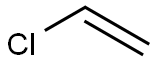
- 9002-86-2
- C2H3Cl
- 62.49822
- All (75)
- China (10)
- (75)
Related Products More >

- 9002-86-2
- CNY Request For Quotation
- 9002-86-2
- CNY 10.0000
- 25kg
- 9002-86-2
- Request For Quotation
- 220kg
- 9002-86-2
- Request For Quotation
- 1ton
- 9002-86-2
- Request For Quotation
- 25kg
- 9002-86-2
- Request For Quotation
- 1ton
- 9002-86-2
- Request For Quotation
- 1ton
- 9002-86-2
- Request For Quotation
- 1kg


PVC’s versatility stems from its ability to be formulated as rigid or flexible material. Rigid PVC (uPVC) contains minimal additives and is stiff, strong, and lightweight, making it ideal for pipes, window frames, and siding. Its resistance to corrosion and microbial growth ensures longevity in harsh environments. Flexible PVC, achieved by adding plasticizers like phthalates, becomes soft and pliable, suitable for medical devices, cables, and flooring. Stabilizers, such as lead or calcium-zinc compounds, prevent degradation from heat and UV exposure, while lubricants and pigments enhance processability and appearance.
Industrially, PVC is manufactured via suspension polymerization, where VCM is dispersed in water with initiators and surfactants. This method yields uniform resin particles that are easy to process. Alternative methods include emulsion polymerization for fine-particle resins used in coatings and paste applications.
Compared to other plastics, PVC offers unique advantages. Its fire resistance exceeds that of polyethylene (PE) and polypropylene (PP), which melt and drip when ignited. Unlike polystyrene (PS), PVC resists moisture and chemicals, making it suitable for outdoor and industrial applications. While polyethylene terephthalate (PET) is stronger and clearer, PVC is more affordable and adaptable for non-food contact uses.
Studying enzyme kinetics in lab involves measuring reaction rates. Mixing catalase with hydrogen peroxide and timing oxygen bubble formation shows how concentration affects speed. It’s surprising how a tiny amount can process large quantities of substrate, making them efficient biological tools.
Comparing different enzymes reveals unique traits. Some work best in acidic environments, like pepsin in the stomach, while others prefer neutral conditions. These adaptations make sense when you think about where they function, tying chemistry directly to biological needs in a way that feels both logical and amazing.
The industrial manufacturing of PVC involves several key steps. Initially, ethylene is chlorinated to produce 1,2-dichloroethane, which is then thermally cracked to yield vinyl chloride monomer. The VCM is subsequently polymerized through suspension, emulsion, or bulk polymerization methods. Suspension polymerization is the most common technique, where VCM is dispersed in water along with a polymerization initiator. This process results in PVC resin particles that are then separated, dried, and blended with various additives to tailor the material's properties for specific applications.
PVC's distinct properties set it apart from other plastics. Its high chlorine content provides inherent flame resistance, making it an ideal material for construction applications such as pipes, electrical conduit, and window frames. The addition of plasticizers can transform rigid PVC into flexible forms, enabling its use in diverse products like medical tubing, flooring, and automotive interiors. PVC is also known for its excellent chemical resistance, particularly against acids and bases, and its ability to withstand prolonged exposure to UV light and weathering.
Compared to other plastics, PVC offers a balance of mechanical strength, flexibility, and cost-effectiveness. It is lightweight, easy to process, and can be manufactured in various forms, including sheets, pipes, and profiles. The use of stabilizers, plasticizers, and other additives allows for customization of PVC to meet specific requirements. For example, stabilizers prevent degradation during processing and use, while plasticizers enhance flexibility without compromising durability.
In addition to its functional advantages, PVC's recyclability is an important consideration in its life cycle. Post-consumer and industrial PVC waste can be reprocessed into new products, reducing the demand for virgin material and minimizing environmental impact. This recyclability, combined with its versatile properties, makes PVC a valuable material in both industrial and consumer applications.
The chemical composition of PVC plays a crucial role in determining its physical properties. The polymer backbone consists of carbon chlorine bonds which provide exceptional chemical resistance and flame retardancy. Chlorine atoms make up approximately 57% of PVC’s molecular weight giving it self-extinguishing properties when exposed to fire. However pure PVC is inherently brittle and rigid so manufacturers incorporate additives to modify its characteristics. Plasticizers such as phthalates are added to create flexible PVC for products like cables flooring and medical tubing. Stabilizers like lead calcium or organotins are included to prevent thermal degradation during processing while pigments fillers and lubricants enhance color durability and workability. These additives allow PVC to be engineered for specific applications ranging from rigid construction materials to soft elastic goods.
Industrial production of PVC follows two main methods suspension polymerization and emulsion polymerization. In suspension polymerization vinyl chloride monomers are suspended in water and polymerized into small discrete particles using chemical initiators. These particles are then filtered dried and pelletized for further processing. Emulsion polymerization produces finer PVC particles by dispersing monomers in water with surfactants creating a stable emulsion that solidifies into a fine powder. The choice of method depends on the desired particle size and application. For example suspension PVC is typically used for rigid products while emulsion PVC is preferred for flexible applications. After polymerization the PVC resin is mixed with additives and melted down for extrusion molding calendering or other forming techniques.
PVC stands out among plastics due to its unique combination of properties. It offers excellent chemical resistance making it suitable for pipes carrying corrosive fluids and its flame-retardant nature enhances fire safety in construction materials. Compared to polyethylene or polypropylene PVC has higher tensile strength and durability which is why it’s commonly used for window frames fencing and electrical insulation. Its ability to be both rigid and flexible depending on formulation gives it an edge over many other thermoplastics. However PVC’s environmental impact remains a concern due to the release of dioxins during incineration and the potential leaching of plasticizers in certain products. This has led to ongoing debates about its sustainability and the development of alternative materials with lower ecological footprints.