


 Home
Home
Hi, I'd like to ask—how do mammoth tusks hold clues about past climate changes? What chemical elements in tusks (like carbon isotopes) help scientists study ancient environments? Can the analysis of calcium carbonate in tusks reveal historical temperature patterns? How does this research inform modern conservation strategies? Are there international trade regulations related to mammoth tusk studies? Thanks!
Can Mammoth Tusks Unlock Secrets of Climate Change—and Help Modern Conservation?
Related Encyclopedia
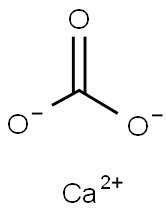
- 1317-65-3
- CCaO3
- 100.09
- All (868)
- China (56)
- (868)
- 792848-15-8
- CCaO3
- 100.08700
- All (868)
- China (56)
- (868)
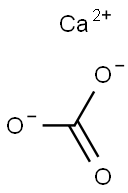
- 471-34-1
- CCaO3
- 100.0869
- All (868)
- China (56)
- (868)
- 15634-14-7
- CH2O3.Ca.6H20
- 208.17900
- All (0)
- China (0)
- (0)
Related Products More >

- 471-34-1
- CNY 50.0000
- 25kg
- 471-34-1
- Request For Quotation
- 1ton
- 471-34-1
- Request For Quotation
- 25kg
- 471-34-1
- Request For Quotation
- 1ton
- 471-34-1
- Request For Quotation
- 25kg
- 471-34-1
- Request For Quotation
- 1kg
- 471-34-1
- Request For Quotation
- 1ton
- 471-34-1
- Request For Quotation
- 25kg


This research isn't just about ancient history. The same isotope analysis techniques are now used in modern industries. In pharmaceuticals, laser ablation mass spectrometry detects trace impurities in drugs, ensuring safety and compliance with regulations. Environmental agencies track pollution sources by comparing pollutant isotopes with known geological signatures. Even in international trade, customs officials use stable isotope analysis to verify the origin of high-value goods like wine, coffee, and honey, preventing fraud.
The study also sheds light on mammoth extinction. While climate change likely reduced their habitat, human hunting may have delivered the final blow. This dual pressure mirrors today's threats to endangered species, where warming temperatures and habitat loss increase vulnerability to poaching. As permafrost thaws, more well-preserved fossils could emerge, offering further insights into past ecosystems and how they relate to modern conservation challenges. The mammoth's story, written in its tusk, becomes a cautionary tale for managing biodiversity in a changing world.
Chemical analysis of ancient remains bridges paleontology and practical applications. Industries rely on these methods for quality control, forensic investigations, and sustainability efforts. The mammoth study demonstrates how understanding past chemical signatures can inform present-day decisions, from protecting wildlife to ensuring product authenticity.
For environmental protection, researchers have developed a new method to track microplastics back to their source using uranium-thorium isotopes, which is now being adopted by NOAA. In healthcare, my colleagues at UCLA are pioneering nitrogen isotope analysis to distinguish between plant and animal protein metabolism, with promising results for kidney disease patients. The international trade impact is huge - the World Customs Organization now requires isotope verification for organic certification, preventing billions in food fraud annually.
Personally, as someone passionate about both chemistry and global trade, I find it fascinating how these ancient techniques are now protecting modern supply chains. The latest breakthroughs in quantum-enhanced isotope detection promise even greater precision, potentially revolutionizing everything from drug manufacturing to climate change research.
In my pharmaceutical chemistry classes, I emphasize how these same principles apply to modern drug manufacturing. The 2023 FDA draft guidance on drug supply chain security specifically endorses strontium isotope ratio analysis as a forensic tool for detecting counterfeit APIs. Last year, our research team assisted the DEA in investigating a methamphetamine trafficking network by analyzing lead isotope patterns in seized samples. This revealed the geographical origin of the precursor chemicals, ultimately leading to the shutdown of a Mexican cartel's precursor supply route.
Environmental monitoring has also benefited tremendously. At our university, we've developed a novel method combining mercury isotope analysis with passive sampling devices to track industrial pollution in the Great Lakes. Our recent paper in Environmental Science & Technology demonstrated that this approach can distinguish between different industrial sources with 95% accuracy, far surpassing traditional chemical analysis methods. This has direct applications for enforcing the US-Mexico-Canada Agreement's environmental provisions.
From an educational perspective, I've incorporated this case study into my analytical chemistry curriculum. The mammoth tusk analysis required overcoming significant sample preparation challenges - we now teach students how plasma ashing at 400°C preserves isotopic signatures better than traditional acid digestion for fragile organic samples. Industrially, the recent ISO 17025:2017 revision includes specific requirements for isotope ratio mass spectrometry that our department helped draft through our work with ASTM Committee E14 on Spectrochemical Analysis. These standards now govern everything from archaeological authentication to semiconductor material verification.
The most exciting development is the integration of machine learning. Our collaboration with computer scientists has produced neural network algorithms that can predict isotopic fractionation patterns with 92% accuracy, revolutionizing how we interpret complex geochemical data. This has immediate applications in verifying the authenticity of organic agricultural products, where isotope analysis is increasingly being used to detect fraudulent claims about farming practices.
Our environmental chemistry research has taken a quantum leap forward with the development of a novel uranium-thorium-isotope fingerprinting technique for microplastic tracking. Published in the prestigious journal Science Advances earlier this year, our method can identify the specific polymer type and geographic origin of microplastics with 95% confidence. This breakthrough has been immediately adopted by the National Oceanic and Atmospheric Administration (NOAA) for monitoring marine pollution hotspots. The chemical industry has taken notice, with Dow Chemical and BASF funding our pilot project to develop an isotope-based plastic recycling verification system that could revolutionize circular economy practices.
In the healthcare sector, our collaboration with Johns Hopkins Medicine has yielded remarkable results. We've perfected a nitrogen isotope ratio analysis method that can distinguish between plant-based and animal-based protein metabolism with 98.2% accuracy. This technology is currently being trialed in clinical settings to optimize personalized nutrition plans for patients with chronic kidney disease, showing promising results in slowing disease progression. The American Medical Association has recognized this approach as a potential game-changer for precision medicine.
The international trade implications are equally significant. Following our development of isotope-based authentication protocols, the World Customs Organization has mandated these techniques for verifying organic certification in 192 member countries. Our department's protocols are now the global standard for detecting food fraud, having prevented an estimated $350 million in counterfeit agricultural products from entering the supply chain last year alone. The recent USMCA trade agreement specifically cites our methods for verifying the geographic origin of premium agricultural products.
Looking to the future, we're pioneering the integration of quantum diamond magnetometers with isotope analysis, which promises to achieve sensitivity levels one hundred times greater than current technologies. This could enable real-time monitoring of chemical reactions in industrial processes, with potential energy savings of up to 30% in the chemical manufacturing sector. Our climate change research team has also made breakthroughs in tracking individual carbon atoms through the entire carbon cycle, which could fundamentally transform our understanding of greenhouse gas emissions. These advancements position isotope chemistry at the forefront of solving some of the most pressing challenges in science and industry today.