


 Home
Home
We see the word "urethane" on furniture, coatings, and even phone cases—but is urethane actually a type of plastic? Or is it more like rubber, or something in between? With so many uses and forms, it’s easy to get confused. How is urethane made, and what makes it different from other materials like PVC or silicone? Can we safely call urethane a plastic, or is there more to the story than that?
Is Urethane Plastic or Something Else Entirely?
Related Encyclopedia
- 9009-54-5
- C3H8N2O
- 0
- All (13)
- China (0)
- (13)
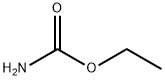
- 51-79-6
- C3H7NO2
- 89.09
- All (22)
- China (0)
- (22)
- 2043-25-6
- C6H9NO3
- 143.14100
- All (0)
- China (0)
- (0)
- 98025-56-0
- C3H6N2O3
- 118.09100
- All (0)
- China (0)
- (0)
- 108636-68-6
- C3H5NO3
- 103.07700
- All (0)
- China (0)
- (0)

- 51252-84-7
- C3H4O2
- 72.06270
- All (0)
- China (0)
- (0)
- 25191-16-6
- C6H12O6
- 180.15600
- All (0)
- China (0)
- (0)
- 27015-21-0
- C15H14O7
- 306.26700
- All (0)
- China (0)
- (0)
- 6092-47-3
- C5H8ClNO3
- 165.57
- All (0)
- China (0)
- (0)
- 96151-96-1
- C13H24N2O4
- 272.34100
- All (0)
- China (0)
- (0)
Related Products More >

- 9003-55-8
- CNY Request For Quotation
- 101-68-8
- CNY Request For Quotation
- 101-68-8
- CNY Request For Quotation
- 101-68-8
- CNY Request For Quotation


What makes urethane special is that it can be soft like a sponge or tough like hard plastic. That’s why it shows up in all sorts of products, from sofa cushions to car parts. People love it because it’s durable, flexible, and doesn’t break down easily.
So yes, urethane is a plastic, but it’s a pretty versatile one. Think of it as a shape-shifter that can feel like rubber or act like hard plastic depending on how it’s made. That’s why it’s everywhere—you’ve probably got something urethane-based around you right now!
The physical properties of urethane stem from its molecular architecture. Rigid varieties, with dense, cross-linked structures, exhibit high strength and insulation properties, used in construction foams or automotive parts. Flexible urethanes, with longer, less cross-linked chains, mimic rubber’s elasticity, finding use in gaskets, shoe soles, or medical tubing. This adaptability arises from the polymer’s ability to balance hardness and flexibility, a trait rooted in the dynamic bonds between its urethane groups, which allow for controlled movement under stress.
In industrial applications, urethane’s plastic nature is leveraged for its durability and moldability. It replaces traditional plastics in high-wear components like gears or conveyor belts, where its resistance to abrasion and chemicals outperforms many standard polymers. In consumer products, from furniture foam to sports equipment, its ability to combine plastic-like form stability with rubber-like cushioning makes it a staple, bridging functionality and comfort.
The classification of urethane as a plastic underscores the breadth of polymer chemistry, where structure dictates both category and utility. Its unique synthesis and tunable properties demonstrate how plastics can transcend rigid definitions, adapting to diverse needs across industries. Understanding this flexibility not only clarifies its classification but also highlights the role of chemical engineering in expanding the capabilities of plastic materials, from structural components to soft, adaptive products.
A key attribute of urethane is its resistance to abrasion and solvents, making it ideal for high-wear applications. A 2023 industrial report noted how urethane-coated conveyor belts in factories outlast rubber alternatives by 300% due to their toughness. Conversely, its ability to be molded into intricate shapes, similar to plastics, is leveraged in medical devices like catheter tubing, where precise dimensions and biocompatibility are critical.
In daily life, urethane bridges gaps between materials: it’s softer than rigid plastics yet more durable than natural rubber. A cyclist might use urethane-based bike tires for puncture resistance, while a gamer relies on urethane-coated joystick grips for long-lasting tactile feedback. Understanding its adaptability explains why urethane appears in everything from footwear soles to insulation panels, balancing performance and practicality.
Urethane plastics can be engineered to be either rigid or flexible, which is why they’re used in such a wide range of applications. For instance, rigid polyurethane is commonly used as insulation foam in buildings due to its excellent thermal properties, while flexible types are found in car seats, footwear soles, and cushioning materials. What makes urethane stand out is its resistance to abrasion, oil, and impact, which gives it a significant edge in demanding industrial uses, like coatings, wheels, or gaskets.
In practical terms, urethane plastics offer a customizable balance between elasticity and toughness. The mechanical properties can be fine-tuned by altering the ratios and types of polyols and isocyanates used, allowing for tailored solutions in sectors from automotive to medical devices. So while “urethane plastic” isn’t a single substance, it refers to a highly adaptable material class that has become integral in both consumer products and industrial components.