


 Home
Home
When we hear about chemicals used in big industries, terms like "bulk chemicals" often come up. But what exactly do they refer to? Are they different from the chemicals we use in daily life? Do they have specific characteristics that make them "bulk"? How are they produced, and where might we encounter their effects without even realizing it? So, what are bulk chemicals, really?
What are bulk chemicals?
Related Encyclopedia
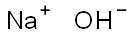
- 1310-73-2
- NaOH
- 39.99711
- All (130)
- China (116)
- (131)
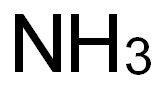
- 7664-41-7
- H3N
- 17.03
- All (8)
- China (5)
- (8)

- 12200-64-5
- H3NaO2
- 58.01240
- All (0)
- China (0)
- (0)
- 87331-12-2
- HNa3O
- 85.97670
- All (0)
- China (0)
- (0)
- 389873-17-0
- HNaO
- 40.99680
- All (0)
- China (0)
- (0)
- 73876-86-5
- O4ST2
- 102.09500
- All (24)
- China (20)
- (24)
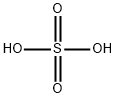
- 7664-93-9
- H2O4S
- 98.08
- All (24)
- China (20)
- (24)
- 13770-01-9
- H2O4S
- 100.98300
- All (24)
- China (20)
- (24)
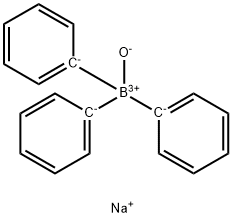
- 12113-07-4
- C18H15BNaO
- 281.12
- All (0)
- China (0)
- (0)
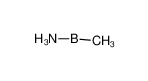
- 85688-52-4
- CH8BN
- 44.89190
- All (0)
- China (0)
- (0)
Related Products More >

- 1310-73-2
- Request For Quotation
- 1310-73-2
- Request For Quotation
- 1310-73-2
- Request For Quotation
- 1310-73-2
- USD 1.0000
- 25kg
- 1336-21-6
- CNY 500.0000
- 1ton
- 7664-93-9
- CNY 360.0000
- 1ton
- 1310-73-2
- CNY 750.0000
- 1ton
- 1310-73-2
- CNY 2.6000
- 25kg


Common ones include things like sulfuric acid, which is used in making fertilizers or even car batteries, and sodium hydroxide, which shows up in soap or paper production. They’re not fancy or specialized; instead, they’re the workhorses of industry, made in large factories because so many products depend on them.
You probably don’t see them directly, but next time you use detergent, eat food grown with fertilizer, or write on paper, there’s a good chance bulk chemicals played a part in making those things possible. They’re all about quantity and being the starting point for so much of what we use daily.
A critical distinction between bulk and specialty chemicals lies in their market dynamics: bulk chemicals are traded globally as commodities, with prices dictated by supply chains and raw material costs, whereas specialty chemicals command premium pricing due to their performance-driven formulations. Misconceptions often arise regarding their environmental impact; while bulk chemical plants generate significant emissions, advancements in catalytic converters and carbon capture technologies are mitigating these effects.
In engineering, bulk chemical production demands robust infrastructure to handle corrosive materials and hazardous reactions safely. For example, sulfuric acid plants use acid-resistant alloys and scrubbers to neutralize byproducts. Their importance extends beyond industry—bulk chemicals underpin water treatment, textile manufacturing, and even energy storage (e.g., lithium-ion battery electrolytes). Understanding their role clarifies how economies balance scale, safety, and sustainability in chemical production.
The chemical properties of bulk chemicals dictate their industrial applications. Sulfuric acid, for instance, serves as a catalyst in phosphate fertilizer production and a dehydrating agent in petroleum refining, while ethylene forms the backbone of polymers like polyethylene and PVC. These substances often exhibit high reactivity or stability under controlled conditions, enabling their use in diverse synthesis pathways. From a physical perspective, their transportation and storage pose unique challenges—anhydrous ammonia requires pressurized containers, whereas sodium hydroxide solutions demand corrosion-resistant piping. These logistical considerations shape global trade networks, with production facilities strategically located near raw material sources or major transportation hubs.
Beyond industrial manufacturing, bulk chemicals permeate modern life in subtle yet profound ways. Pharmaceuticals rely on benzene derivatives as synthetic precursors, while water treatment plants depend on chlorine for disinfection. The agricultural sector consumes vast quantities of nitrogen-based fertilizers to sustain global food production, directly linking bulk chemical output to population growth. Environmental trade-offs emerge from this reliance—the energy-intensive nature of ammonia synthesis accounts for nearly 1-2% of global CO₂ emissions, spurring research into electrochemical alternatives. This intersection of chemistry, engineering, and sustainability underscores how bulk chemicals serve as both pillars of civilization and drivers of technological innovation. Their optimized production continues to evolve through advancements in catalytic processes and circular economy models that repurpose waste streams.
Their production relies on continuous, energy-intensive processes optimized for efficiency. For example, ammonia synthesis via the Haber-Bosch process operates at high pressure and temperature, converting nitrogen and hydrogen into a compound essential for fertilizers and plastics. Similarly, sulfuric acid, one of the most produced bulk chemicals, is synthesized through the contact process, involving oxidation of sulfur dioxide to trioxide, followed by hydration; its utility spans mineral processing, battery manufacturing, and detergent production.
Bulk chemicals form the backbone of industrial supply chains. Methanol, produced from natural gas or biomass, acts as a precursor for formaldehyde (used in resins) and methyl tert-butyl ether (a fuel additive). Sodium hydroxide, generated via electrolysis of brine, finds applications in pulp bleaching, aluminum refining, and water treatment. These examples illustrate their role as intermediates: they undergo further chemical transformation to yield end products, linking raw material extraction to consumer goods.
The distinction between bulk and specialty chemicals lies in functionality: bulk chemicals provide structural or reactive building blocks, while specialties offer specific performance attributes. This division drives industrial chemistry, with bulk chemical production requiring heavy capital investment in plants and infrastructure, whereas specialty production focuses on formulation and customization. Their omnipresence in manufacturing underscores their status as critical enablers of modern industrial economies.