


 Home
Home
Kapok fiber is often mentioned as a natural alternative to synthetic materials, especially in eco-friendly products. But what exactly is it made of, and how is it different from other natural fibers like cotton or wool? Does it have any special chemical makeup that gives it unique properties? And why are some companies choosing kapok over more common fibers?
What Is Kapok Fiber and Why Is It Gaining Attention?
Related Encyclopedia
- 9005-53-2
- unspecified
- 0
- All (8)
- China (7)
- (8)

- 67701-08-0
- C18H34O2
- 282.46100
- All (0)
- China (0)
- (0)

- 67701-03-5
- C34H68O4
- 540.90132
- All (0)
- China (0)
- (0)

- 61788-66-7
- 0.00000
- All (0)
- China (0)
- (0)
- 67784-82-1
- (C3H8O3
- 0
- All (2)
- China (2)
- (2)
- 61789-31-9
- 0
- All (6)
- China (6)
- (6)
- 86403-32-9
- 0
- All (1)
- China (1)
- (1)
- 8068-05-1
- C30H25ClN6
- 505.01
- All (0)
- China (0)
- (0)
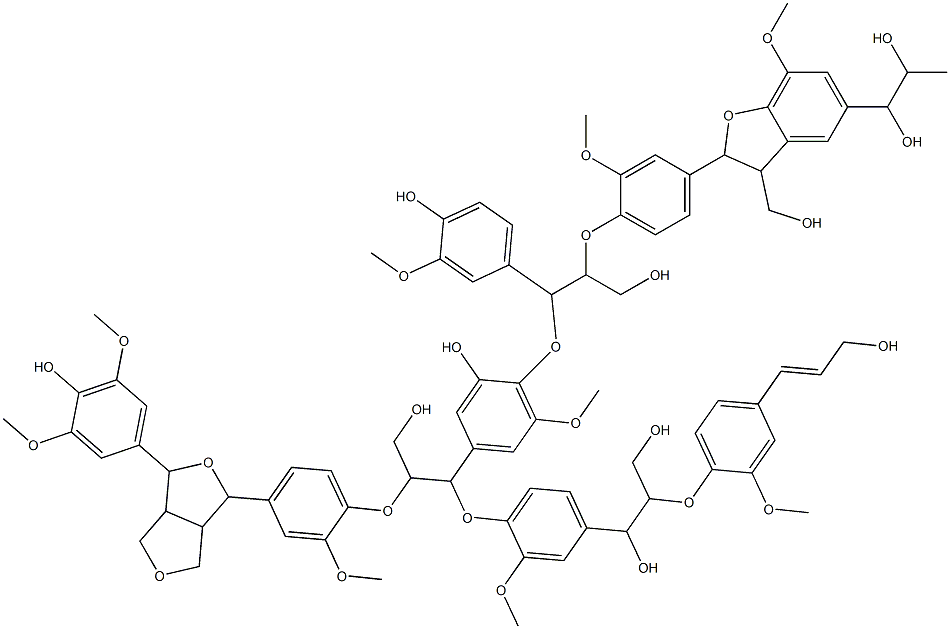
- 8068-03-9
- C81H92O28
- 1513.58038
- All (0)
- China (0)
- (0)
- 42613-30-9
- 0
- All (4)
- China (4)
- (4)
Related Products More >

- CNY Request For Quotation
- CNY Request For Quotation
- CNY Request For Quotation
- 9004-62-0
- Request For Quotation
- 9004-62-0
- Request For Quotation
- 9004-65-3
- Request For Quotation
- 9004-65-3
- USD 361.6000
- 25kg
- 9004-57-3
- USD 580.0000
- 25kg


What makes kapok really interesting is that it’s naturally water-resistant and doesn’t absorb moisture easily. That means it stays dry and doesn’t get moldy or smelly like some other materials might. It's also hypoallergenic, which is a fancy way of saying it’s less likely to cause allergies.
You’ll usually find kapok in pillows, cushions, life jackets, and even stuffed toys. Since it's all-natural and doesn’t need much processing, eco-conscious brands love using it. Plus, harvesting it doesn’t harm the tree, so it’s a pretty sustainable option.
It’s kind of amazing how something so light and soft can be so useful, right?
Chemically, kapok fiber is composed primarily of cellulose, with small amounts of lignin and waxes on its surface; this wax coating contributes to its water-repellent nature, making it less absorbent than cotton and thus suitable for applications where moisture resistance is critical. In practice, these attributes have led to its use in traditional life jackets, where its buoyancy ensures reliable flotation, and in certain insulating materials, where its ability to trap air helps regulate temperature. Unlike wool, which can mat when wet, kapok maintains its loft even after exposure to moisture, a trait that has made it valuable in environments where durability and consistent performance are essential. Its lightweight nature also reduces the bulk of products incorporating it, from bedding to protective gear, without compromising functionality.
One of the most fascinating aspects of kapok lies in its biomechanical properties. The hollow core provides excellent thermal insulation and sound absorption capabilities, making it valuable in applications beyond textiles. In industrial contexts, kapok is used in oil spill cleanup technologies because of its natural oil-attracting (oleophilic) and water-repellent properties, which allow it to absorb oil without becoming saturated with water. This same mechanism enables it to be used in filters and insulation panels in eco-friendly building materials.
From a medical and public health perspective, kapok has found a role in hypoallergenic bedding and orthopedic cushions, especially for patients requiring pressure relief or sensitive to synthetic fibers. The natural antimicrobial and antifungal resistance of the wax-coated surface also makes it a favorable choice in environments where hygiene is critical. Although not widely utilized in pharmaceutical formulations, its cellulose base has potential for use as a biodegradable excipient or natural packaging in sustainable healthcare systems.
Kapok also intersects with environmental science and sustainability studies. It represents an example of a renewable, biodegradable material with minimal ecological footprint. Since harvesting the fiber does not require felling the tree, it encourages forest preservation and offers a livelihood to communities without contributing to deforestation. In discussions around biomaterials and circular economy models, kapok is increasingly recognized as a valuable alternative to petroleum-based fibers, particularly in sectors where weight, insulation, and ecological safety are priorities.
One of kapok’s key attributes is its sustainability. The fibers are harvested without harming the tree, as they are collected from mature pods that naturally split open. This contrasts with synthetic alternatives like polyester, which rely on fossil fuels. Kapok’s biodegradability and low environmental impact have led to its use in eco-friendly products, such as organic mattresses, life jackets, and insulation for cold-weather gear. For instance, its buoyancy rivals synthetic foams in life preservers, while its breathability makes it a preferred stuffing for pillows in humid climates.
The fiber’s practical applications are rooted in its cellular structure. Each filament contains lignin, a rigid polymer that resists compaction, allowing kapok-filled products to retain shape over time. However, its smooth surface limits adhesion in woven fabrics, prompting innovations like blending it with cotton or bamboo for textiles. In regions like Indonesia, artisans hand-stuff kapok into traditional bedding, leveraging its natural resistance to moisture and mold. Its role in sustainable design continues to expand, particularly as industries seek alternatives to petroleum-based materials.