


 Home
Home
3D printing is growing fast, and carbon fiber is known for being super strong and lightweight. So naturally, people wonder—can you combine the two? Is it really possible to 3D print with carbon fiber materials at home, or is this something only big industries can do? What kind of printers or filaments would you need, and how different is it from regular 3D printing? Can beginners even try it, or is it too complicated and expensive?
Can You 3D Print Carbon Fiber at Home?
Related Encyclopedia

- 25037-45-0
- C16H18O5
- 290.32
- All (23)
- China (7)
- (23)

- 25035-04-5
- C33H63N3O3X2
- 549.87
- All (0)
- China (0)
- (0)
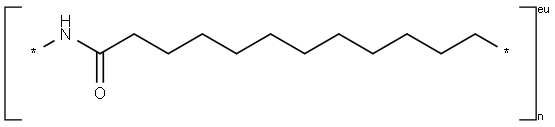
- 24937-16-4
- (C12H23NO)n
- 591.95
- All (0)
- China (0)
- (0)

- 25038-54-4
- C18H33N3O3X2
- 339.47
- All (15)
- China (3)
- (15)

- 25038-74-8
- C36H69N3O3X2
- 591.95100
- All (0)
- China (0)
- (0)
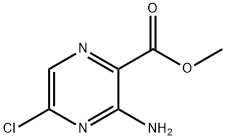
- 28643-16-5
- C6H6ClN3O2
- 187.58
- All (0)
- China (0)
- (0)

- 9008-66-6
- (C16H30N2O2)n
- 0.00000
- All (0)
- China (0)
- (0)

- 27136-65-8
- C45H84N6O6X2
- 805.19000
- All (0)
- China (0)
- (0)

- 24936-74-1
- C54H102N6O6X2
- 931.42400
- All (0)
- China (0)
- (0)

- 32131-17-2
- C36H66N6O6X2
- 678.95
- All (0)
- China (0)
- (0)
Related Products More >

- 25037-45-0
- CNY 10.0000
- 25kg
- 25037-45-0
- Request For Quotation
- 1ton
- 25037-45-0
- Request For Quotation
- 25kg
- 25037-45-0
- Request For Quotation
- 1ton
- 25037-45-0
- Request For Quotation
- 25kg
- 25037-45-0
- Request For Quotation
- 1ton
- 25037-45-0
- Request For Quotation
- 25kg
- 25037-45-0
- Request For Quotation
- 30ton


You’ll need a special kind of 3D printer that can handle high temperatures and maybe even a hardened nozzle because the carbon bits are tough on regular parts. These blends are popular for making drone parts, tools, or anything that needs to be light but strong.
If you’re just starting out, it might feel a bit tricky at first, but there are beginner-friendly printers and filaments out there now. You don’t need a giant machine or lab—just the right materials and a bit of patience!
The key to successful carbon fiber 3D printing lies in the alignment and distribution of fibers within the printed layers. Short fibers are mixed directly into the filament, offering moderate improvements in strength, while continuous fibers are laid down in specific paths using dual-nozzle systems, mimicking the performance of traditionally molded carbon fiber parts. For instance, aerospace components like drone arms or automotive brackets benefit from this method, achieving high strength-to-weight ratios unattainable with conventional plastics.
However, challenges like layer adhesion and fiber orientation must be carefully managed. The anisotropic nature of fiber-reinforced prints means strength varies with direction, requiring precise design adjustments. Industrial applications, such as custom jigs or prosthetics, leverage these properties by optimizing print paths for load-bearing needs. The ability to produce complex, lightweight structures on-demand makes carbon fiber 3D printing a transformative tool in fields demanding both precision and durability.
Short fiber 3D printing, often using fused deposition modeling (FDM), is more accessible, with filaments loaded with 10-40% carbon fiber. These materials enhance stiffness and reduce warping compared to pure plastics, making them useful for prototyping structural components like drone frames or custom tooling. Continuous fiber systems, however, offer superior strength by aligning fibers along stress paths; for example, a bicycle frame printed with continuous carbon fiber can withstand the same forces as a traditionally made one but with less weight.
The matrix material holds the fibers in place, transferring loads between them. If the matrix is too brittle, it may crack under stress, reducing the part’s overall strength. This is why choosing the right polymer—like a high-impact polyamide—is crucial for applications such as aerospace brackets, where both strength and durability are essential. By controlling fiber orientation and density during printing, engineers can tailor parts to specific load requirements, optimizing performance without excess material.
At the molecular level, carbon fiber is composed almost entirely of carbon atoms arranged in a crystalline structure aligned along the fiber's length, providing extraordinary tensile strength. When embedded in a polymer matrix, these fibers act as a reinforcing agent, distributing load and reducing material fatigue. Thermoplastics used in this process melt at high temperatures and solidify upon cooling, locking the carbon fibers in place and forming a rigid, durable part. This integration of polymer science and materials engineering illustrates how interdisciplinary innovation enables new possibilities in manufacturing.
From an industrial perspective, carbon fiber-reinforced printing materials are increasingly used in aerospace, automotive, and robotics, where reducing weight without compromising strength is crucial. In the medical field, customized braces, prosthetics, and surgical tools can benefit from the lightweight yet durable nature of carbon fiber composites. Even consumer-level users apply it in drones, camera rigs, or structural prototypes, bringing industrial-grade functionality into smaller-scale environments.
The development of carbon fiber 3D printing also raises important implications for sustainability and supply chains. Producing lightweight parts can lead to energy savings in transport and use, while on-demand local manufacturing reduces the need for global logistics. At the same time, it prompts questions about material recycling, wear on printing hardware, and access to high-performance tools. In short, carbon fiber 3D printing exemplifies how advanced materials can bridge theoretical science and real-world utility in increasingly accessible ways.