


 Home
Home
When people hear the words "latex" and "rubber," they often think of gloves, balloons, or even tires. But are latex and rubber actually the same thing, or do they have different properties and uses? Are they made from the same material? Can synthetic versions of rubber still be called latex? And what’s the difference between natural and synthetic rubber in this context?
Is Latex the Same as Rubber?
Related Encyclopedia
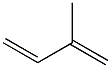
- 9006-04-6
- C5H8
- 68.11702
- All (0)
- China (0)
- (0)
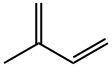
- 9003-31-0
- C5H8
- 68.12
- All (1)
- China (0)
- (1)
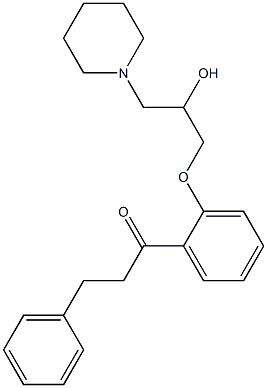
- 63148-67-4
- C23H29NO3
- 367.48126
- All (0)
- China (0)
- (0)
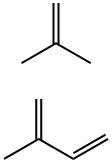
- 9010-85-9
- C9H16
- 124.23
- All (2)
- China (0)
- (2)
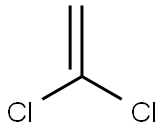
- 9002-85-1
- C2H2Cl2
- 96.94
- All (0)
- China (0)
- (0)
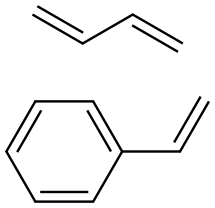
- 9003-55-8
- (C8H8.C4H6)x
- 158.24
- All (5)
- China (1)
- (5)
- 61791-14-8
- 0
- All (0)
- China (0)
- (0)
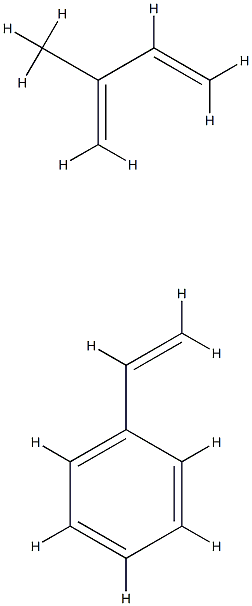
- 25038-32-8
- C13H16
- 172.26614
- All (0)
- China (0)
- (0)
- 9001-33-6
- 0
- All (0)
- China (0)
- (0)
Related Products More >

- CNY Request For Quotation
- CNY Request For Quotation
- CNY Request For Quotation
- CNY Request For Quotation
- CNY Request For Quotation
- CNY Request For Quotation
- CNY Request For Quotation
- CNY Request For Quotation


Now, rubber can be either natural (made from latex) or synthetic (made from chemicals). So not all rubber comes from latex. And not all latex is turned into rubber—some is used directly, like in latex gloves or balloons.
In everyday life, when you see things labeled “latex,” they’re often soft, stretchy, and used for things like gloves, balloons, or even certain paints. “Rubber” feels tougher—like tires or erasers.
So nope, they’re not exactly the same, but they’re definitely connected. Think of latex as the starting point, and rubber as one of the final products.
Rubber, by contrast, is a solid material derived from latex through a process called vulcanization, where heat and chemicals like sulfur are applied to cross-link the polymer chains in the latex. This transformation gives rubber enhanced durability, elasticity, and resistance to heat and chemicals. A car tire, for instance, relies on vulcanized rubber to maintain shape under pressure and temperature changes, properties that raw latex lacks. While natural rubber originates from latex, synthetic rubbers are made from petroleum-based chemicals, further distinguishing them from the raw latex form.
Practically, this means latex is often used in applications requiring its liquid state and natural adhesiveness, such as in adhesives or foam production, while rubber—both natural and synthetic—finds use in products needing strength and flexibility, from seals and gaskets to footwear and industrial hoses. Understanding this distinction helps in selecting the right material for specific functional needs.
The transformation from latex to rubber involves vulcanization, a process where sulfur bridges form between polymer chains, improving strength and heat resistance. Natural rubber retains some properties of latex, such as flexibility, but gains mechanical stability. For example, latex gloves are thin and highly flexible due to minimal processing, while rubber tires undergo extensive vulcanization for toughness. This difference underscores how material properties evolve with processing.
In practice, latex excels in applications requiring biocompatibility, like medical gloves or adhesives, whereas rubber dominates in high-stress scenarios, such as automotive parts or industrial seals. Synthetic rubbers, like neoprene, further expand utility by mimicking natural rubber’s traits with added resistance to oils or extreme temperatures. Understanding these nuances ensures optimal material selection, balancing performance and practicality.
From a chemical and molecular standpoint, natural rubber is mainly composed of cis-1,4-polyisoprene, a polymer that exhibits excellent elasticity due to the flexibility of its molecular chains and the weak intermolecular forces between them. This gives rubber its characteristic stretch and resilience. Vulcanization—a chemical process involving sulfur or other curatives—cross-links the polymer chains, transforming soft latex into durable, elastic rubber with enhanced mechanical and thermal properties. This transformation explains why raw latex is unsuitable for high-stress applications but becomes extremely versatile once cured.
Physically, latex is a liquid emulsion, while rubber is a solid material. Biologically, latex serves a protective function for the plants that produce it, deterring herbivores and sealing wounds. In contrast, rubber, as a manufactured material, becomes a cornerstone of countless industries. Its applications range from tires, seals, and belts in engineering, to gloves and catheters in healthcare. The distinction is also critical in medicine, particularly because of latex allergies—caused by proteins in natural latex, not in synthetic rubber, which is often made from petroleum-based compounds like styrene-butadiene rubber (SBR) or nitrile butadiene rubber (NBR).
In a broader context, understanding the difference between latex and rubber matters not just for scientific accuracy but for practical decisions in manufacturing, environmental impact assessments, and public health. Latex-based products are biodegradable and renewable, while synthetic rubbers offer more control over properties like chemical resistance and durability. This interplay of natural origin and synthetic innovation illustrates the balance between biology, chemistry, and industrial needs in modern materials science.