


 Home
Home
Rubber is used in so many products we see every day—tires, shoes, gloves, and more. But what happens to it after it's thrown away? Some people say rubber breaks down naturally, while others say it stays in landfills for years. So what’s the truth? Does the type of rubber matter? And are there ways to make rubber more eco-friendly? Is rubber actually biodegradable, or does it just sit around forever?
Is Rubber Biodegradable or Not?
Related Encyclopedia
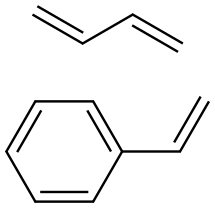
- 9003-55-8
- (C8H8.C4H6)x
- 158.24
- All (5)
- China (1)
- (5)
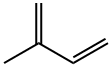
- 9003-31-0
- C5H8
- 68.12
- All (1)
- China (0)
- (1)
- 63148-67-4
- C23H29NO3
- 367.48126
- All (0)
- China (0)
- (0)
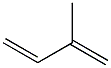
- 9006-04-6
- C5H8
- 68.11702
- All (0)
- China (0)
- (0)
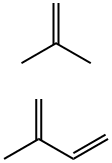
- 9010-85-9
- C9H16
- 124.23
- All (2)
- China (0)
- (2)
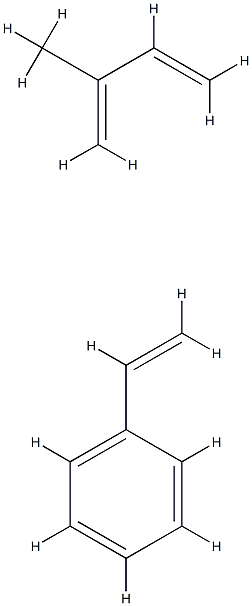
- 25038-32-8
- C13H16
- 172.26614
- All (0)
- China (0)
- (0)
Related Products More >

- CNY Request For Quotation
- CNY Request For Quotation
- CNY Request For Quotation
- CNY Request For Quotation
- CNY Request For Quotation
- CNY Request For Quotation
- CNY Request For Quotation
- CNY Request For Quotation


Most people don’t realize how long rubber sticks around once we toss it. Even though it looks “natural,” it often has added materials that make it tougher—and less friendly to the environment. Some companies are working on biodegradable rubber alternatives, but they’re not super common yet.
So, while some rubber can biodegrade, most of what we use daily won’t disappear anytime soon. It’s one of those materials that’s useful, but not very earth-friendly unless managed carefully.
In contrast, synthetic rubber, made from petroleum-based polymers like styrene-butadiene or neoprene, is not biodegradable. These materials are designed for durability and resistance to environmental degradation, which leads to persistent waste. Tires, primarily composed of synthetic rubber, can take centuries to break down, releasing microplastics and chemicals in the process. However, advancements in biodegradable additives or bio-based synthetic rubbers aim to mitigate this issue. For example, some tire manufacturers now incorporate silica or plant-based oils to enhance degradability.
The distinction between natural and synthetic rubber underscores the importance of material choice in sustainability. While natural rubber aligns with circular economy principles, its production is limited by land use and yield. Synthetic rubber, though versatile, poses environmental challenges. Practical solutions like recycling or blending natural and synthetic rubbers offer middle-ground alternatives, as seen in eco-friendly footwear or automotive parts. Understanding these mechanisms helps industries balance performance with ecological impact.
Synthetic rubber, by contrast, is chemically engineered from petroleum-based monomers like styrene and butadiene, resulting in polymers with structures resistant to microbial attack. The strong covalent bonds in these polymers, such as those in styrene-butadiene rubber, are not easily broken down by naturally occurring enzymes. As a result, synthetic rubber products, such as tires or industrial seals, persist in the environment for decades, contributing to waste management challenges. Efforts to enhance biodegradability in synthetic rubbers often involve modifying polymer structures to include bonds that are susceptible to enzymatic cleavage, though such innovations are still in early stages of practical application.