


 Home
Home
When a fiber optic cable gets damaged or needs to be extended, is it possible to splice it instead of replacing the entire cable? How exactly does the splicing work, and does it affect the speed or quality of the signal? Is this something people can do on their own, or does it always require special equipment and professionals? Can fiber optic cable be spliced effectively without causing issues in communication?
Can Fiber Optic Cable Be Spliced?
Related Encyclopedia

- 14464-46-1
- O2Si
- 60.08
- All (28)
- China (22)
- (28)
- 41846-91-7
- 0.00000
- All (28)
- China (22)
- (28)
- 25213-02-9
- C8H16
- 112.21264
- All (24)
- China (2)
- (24)
- 9002-88-4
- (C2H4)n
- 28.05316
- All (24)
- China (2)
- (24)
- 444994-08-5
- ClO2Si
- 95.53730
- All (0)
- China (0)
- (0)

- 112945-52-5
- O2Si
- 60.08
- All (1)
- China (1)
- (1)
- 10279-57-9
- H2O3Si
- 78.1
- All (15)
- China (0)
- (15)

- 60676-86-0
- O2Si
- 60.0843
- All (15)
- China (0)
- (15)
- 112926-00-8
- O2Si
- 60.0800018310547
- All (27)
- China (5)
- (27)
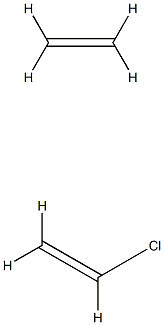
- 63231-66-3
- C4H7Cl
- 90.55138
- All (3)
- China (3)
- (3)
Related Products More >

- 63231-66-3
- CNY Request For Quotation
- 9002-88-4
- Request For Quotation
- 112945-52-5
- Request For Quotation
- 112945-52-5
- Request For Quotation
- 112945-52-5
- Request For Quotation
- 112945-52-5
- Request For Quotation
- 112945-52-5
- Request For Quotation
- 112945-52-5
- Request For Quotation


There are two main ways to do it—fusion (which melts the glass ends together) and mechanical (which just aligns them inside a sleeve). Most people don’t do this at home since it takes special tools and a steady hand, but trained technicians handle it all the time.
As long as the splice is done properly, the signal still travels through just fine. It won’t slow down your internet or mess with your connection if done right. So yes, even though it sounds high-tech, splicing fiber optic cables is pretty common and super helpful in the real world.
There are two primary splicing methods: fusion splicing and mechanical splicing. Fusion splicing uses an electric arc to melt the fiber ends, fusing them into a single continuous strand. This method minimizes loss, typically less than 0.1 dB, making it ideal for long-haul telecommunications networks where signal integrity is paramount. For example, undersea fiber cables spanning thousands of kilometers rely on fusion splicing to connect segments, ensuring uninterrupted data flow between continents. Mechanical splicing, by contrast, aligns fibers using a precision sleeve and secures them with adhesive or clamping. While it introduces slightly more loss (around 0.2-0.5 dB), it is faster and more suitable for emergency repairs or short-distance connections, such as in building-to-building links where quick restoration is needed.
The success of splicing depends on several factors, including fiber type (single-mode vs. multimode), cleanliness of the fiber ends, and alignment accuracy. Even minor dust or a 1-degree misalignment can disrupt light transmission, highlighting the need for specialized tools like cleavers and fusion splicers. In practice, spliced connections are often protected by splice enclosures to shield them from environmental factors like moisture and temperature changes, ensuring long-term reliability in applications ranging from global telecommunications to local area networks.
The ability to splice fibers is essential for extending network reach, repairing damaged cables, or customizing infrastructure layouts. For instance, when a submarine cable is damaged, technicians aboard specialized ships splice replacement sections underwater to restore global internet traffic. Similarly, in data centers, splicing enables flexible deployment of high-density fiber patches without excessive bulk. The choice between fusion and mechanical splicing often hinges on factors like cost, environment, and required durability—fusion is preferred for permanent, low-loss links, while mechanical splices suit temporary fixes or harsh conditions where fusion equipment isn’t practical.
Advancements in splicing technology, such as automated alignment systems or reduced-heat fusion techniques, continue to push the boundaries of reliability and efficiency. These innovations are particularly impactful in 5G networks, where low latency demands near-flawless fiber connections. Real-world applications, like splicing fibers in aerial deployments or tight urban conduits, highlight the technique’s adaptability. The process underscores how precision engineering underpins the invisible infrastructure powering global communication.
The underlying physics centers on total internal reflection. Light traveling through the fiber core is kept within by the surrounding cladding, which has a lower refractive index. When splicing is performed, particularly through fusion splicing, the ends of the fibers are aligned and then melted together using an electric arc. This produces a near-continuous glass medium, minimizing loss and ensuring efficient signal transmission. Mechanical splicing, while quicker, relies on aligning fibers in a sleeve with index-matching gel—adequate for temporary or lower-performance needs.
From an engineering perspective, successful splicing requires cleanliness, precise alignment (often within microns), and an understanding of the material properties, including thermal expansion, tensile strength, and optical attenuation. Physically, the process must account for not only the geometry of the fiber but also environmental durability—such as resistance to temperature fluctuation, moisture, and mechanical stress.
In terms of impact, spliced fiber optics are foundational in modern telecommunications infrastructure, including internet backbones, undersea cables, and 5G networks. Their use also extends to medical imaging technologies like endoscopy and industrial applications such as sensor networks in structural monitoring or oil exploration. Even in aerospace and defense sectors, robust fiber connections are indispensable due to their immunity to electromagnetic interference.
Moreover, the ability to splice fibers has enabled rapid deployment and repair of network systems in disaster zones or remote areas, where replacing full cable lengths would be impractical. As digital demands grow and photonic technologies evolve, understanding fiber splicing becomes increasingly relevant not only to technicians but also to researchers exploring the limits of light-based data transmission.