


 Home
Home
Rubber is everywhere — in tires, shoes, sports gear, and even household items. But what happens to it when we’re done using it? Is rubber something we can easily recycle like plastic or metal, or does it just pile up in landfills? Since rubber is often made with a mix of natural and synthetic materials, does that affect how recyclable it is? And how is rubber recycling different from regular recycling methods? Can rubber actually be reused in new products, or is it mostly wasted?
Is Rubber Recyclable or Does It Always End Up in Landfills?
Related Encyclopedia
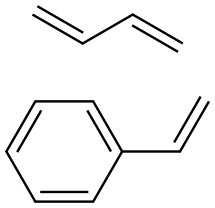
- 9003-55-8
- (C8H8.C4H6)x
- 158.24
- All (5)
- China (1)
- (5)
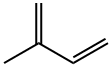
- 9003-31-0
- C5H8
- 68.12
- All (1)
- China (0)
- (1)
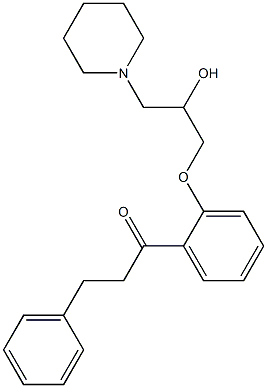
- 63148-67-4
- C23H29NO3
- 367.48126
- All (0)
- China (0)
- (0)
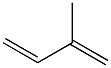
- 9006-04-6
- C5H8
- 68.11702
- All (0)
- China (0)
- (0)
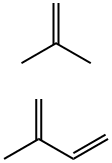
- 9010-85-9
- C9H16
- 124.23
- All (2)
- China (0)
- (2)
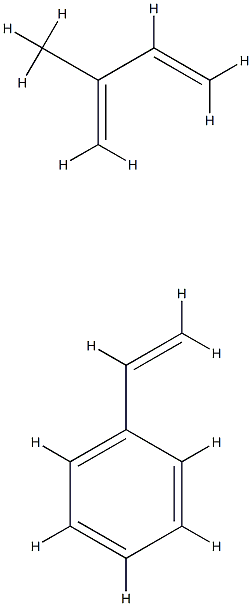
- 25038-32-8
- C13H16
- 172.26614
- All (0)
- China (0)
- (0)
Related Products More >

- CNY Request For Quotation
- CNY Request For Quotation
- CNY Request For Quotation
- CNY Request For Quotation
- CNY Request For Quotation
- CNY Request For Quotation
- CNY Request For Quotation
- CNY Request For Quotation


But that doesn’t mean it’s useless after its first life. Used rubber, especially tires, is often ground up and turned into things like playground surfaces, sports tracks, or even new rubber products. This is called “downcycling,” because the rubber usually doesn’t come back as the same thing it was before.
So yeah, rubber is recyclable — just not in the usual way people imagine. It’s not something you can throw in your curbside bin, but special facilities can give it a second life. Recycling rubber helps reduce waste and keeps bulky stuff like tires out of landfills, which is definitely a win.
The recycling mechanism often involves shredding rubber into crumb or powder, which is then incorporated into new products. A practical example is rubberized asphalt, where recycled tire crumbs enhance road durability and noise reduction. Similarly, playground surfaces frequently use recycled rubber for shock absorption. However, contamination from additives like metals or fibers can complicate the process, necessitating advanced sorting techniques.
Beyond tires, recycled rubber appears in everyday items like shoe soles, industrial mats, and even fashion accessories. The circular economy principle drives innovation here, as upcycling rubber reduces landfill waste and conserves raw materials. Yet, limitations persist: low-grade recycled rubber may lack the tensile strength for high-stress applications, prompting research into hybrid materials. Ultimately, rubber recycling exemplifies how material science intersects with sustainability, turning waste into functional solutions while addressing environmental trade-offs.
The recycling mechanism for rubber typically starts with collection and sorting, separating rubber from other materials like metal in tires. Next, size reduction through shredding or grinding turns rubber into crumbs or powder. For some applications, these crumbs are used directly—for example, in playground surfaces, where their shock-absorbing properties enhance safety, or in athletic tracks to improve traction. For more refined uses, devulcanization may be applied, a process that uses heat, chemicals, or mechanical stress to break sulfur cross-links, allowing the rubber to be reshaped into new products like floor mats or gaskets.
This practical approach bridges rubber’s inherent durability with sustainability, ensuring that items like old tires—once a major waste issue—find new life. A tire, for instance, can be recycled into rubber mulch for gardens, reducing landfill reliance while leveraging rubber’s resistance to decay. Such applications demonstrate that while rubber recycling requires specific techniques, it is both feasible and impactful, turning waste into resources across industries.
From a chemical and materials science perspective, the cross-linked structure of vulcanized rubber presents a major barrier to conventional recycling. Unlike thermoplastics, which can be re-melted and reformed, vulcanized rubber requires mechanical, thermal, or chemical treatment to break it down. Common recycling techniques include grinding it into crumb rubber, pyrolysis to convert it into oil and gas, and devulcanization, which attempts to reverse the cross-linking to make the material reusable. Each method involves trade-offs in energy use, material quality, and environmental impact, and none fully restores the original properties of the rubber.
The implications of rubber recycling span multiple sectors. In industry, recycled rubber is often incorporated into asphalt, flooring, or molded products, reducing the need for virgin rubber and contributing to resource conservation. In healthcare, where rubber is used in gloves, tubing, and medical devices, recycling is more complex due to contamination and safety standards, yet innovations in sterilization and material recovery are beginning to offer solutions. Even in everyday life, consumers encounter recycled rubber in products like playground surfaces, shoe soles, or shock-absorbing mats, often without realizing the material’s previous form.
Understanding rubber's recyclability also touches on broader themes in environmental science, engineering, and economics. The accumulation of used rubber products, especially tires, poses serious waste management and pollution challenges. As sustainability becomes central to materials innovation, the push toward more recyclable or biodegradable rubber alternatives continues to grow. This includes developing new polymers with tunable cross-linking or leveraging biotechnology to design rubber that can be broken down more easily. Ultimately, while rubber recycling is technically possible, its complexities reveal much about the limits and potentials of material reuse in a circular economy.