


 Home
Home
When people hear the term "natural rubber latex," they often wonder what it actually means. Is it something made in a lab, or does it come straight from nature? And how different is it from synthetic rubber? What chemicals are in it, and is it safe for everyday use like in gloves or balloons? Is natural rubber latex really “natural,” or is there more to the story?
Is Natural Rubber Latex a Chemical or a Natural Product?
Related Encyclopedia
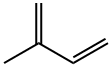
- 9003-31-0
- C5H8
- 68.12
- All (1)
- China (0)
- (1)
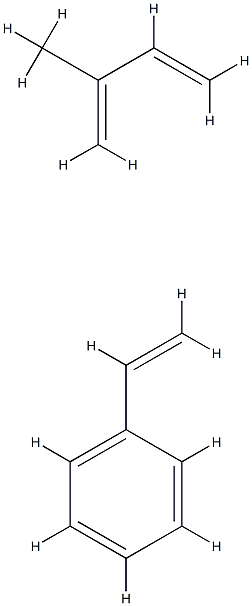
- 25038-32-8
- C13H16
- 172.26614
- All (0)
- China (0)
- (0)
Related Products More >

- 9006-04-6
- Request For Quotation
- bag
- 9006-04-6
- Request For Quotation
- 9006-04-6
- Request For Quotation
- 9006-04-6
- Request For Quotation
- 9006-04-6
- Request For Quotation
- 25kg/Drum
- 9006-03-5
- Request For Quotation
- 25KG/bag
- 9006-03-5
- Request For Quotation
- 25kg drum, or per customer requests.
- 9006-03-5
- Request For Quotation
- 25Kg/Drum


Even though it’s called “natural,” it still goes through some processing. That doesn't make it artificial, but it does mean it’s been treated to be more useful and long-lasting. Most people come across it in everyday items without even realizing it. However, a small number of people can be allergic to latex, so some products are marked "latex-free."
So while it starts in nature, natural rubber latex does go through a bit of work before ending up in things we use every day. Pretty cool how a tree can end up helping us wash dishes or blow up party balloons, right?
Latex’s physical characteristics—such as high tensile strength, flexibility, and impermeability—are the result of both its natural polymer structure and the processing it undergoes, including coagulation, drying, and vulcanization. Vulcanization, for example, involves heating with sulfur to create cross-links between polymer chains, improving durability and resistance to environmental degradation. Biochemically, latex contains over 200 distinct proteins, which explains why some individuals develop allergic reactions; these immune responses are typically triggered by specific proteins present in unprocessed latex.
The relevance of natural rubber latex spans multiple domains. In medicine, it is used in products such as surgical gloves, catheters, and other disposable items due to its tactile precision and barrier protection. In industrial applications, it contributes to tires, seals, hoses, and vibration-dampening systems where durability and elasticity are crucial. Everyday life also benefits from its use in items like balloons, adhesives, and elastic bands. Its biological properties have also intrigued researchers in materials science and biomedical engineering, where biodegradable and biocompatible materials are in increasing demand.
Understanding natural rubber latex involves crossing disciplinary lines—chemistry for its molecular behavior, biology for allergenic interactions, engineering for mechanical performance, and environmental science for sustainable production. As a material with both ancient roots and modern applications, its continued relevance lies in its unique combination of properties and adaptability to a wide range of evolving technological and societal needs.
The key attributes of natural rubber latex stem from its molecular arrangement: cross-linking between polymer chains, induced by vulcanization, enhances its tensile strength and resistance to heat and chemicals, while its inherent flexibility makes it ideal for applications requiring repeated deformation. For instance, in medical settings, gloves made from natural rubber latex provide an effective barrier against pathogens due to their tight fit and impermeability, a direct result of the material’s ability to conform to contours without tearing. Similarly, in consumer products like balloons, its elasticity allows for expansion when filled with air or gas, retaining shape until pressure is released.
In industrial contexts, its adhesion properties make it useful in adhesives and sealants, forming strong bonds between surfaces. Its resilience also contributes to its use in tires, absorbing shocks and maintaining flexibility across temperature ranges. These practical applications rely on the balance of its physical and chemical properties, which arise from the interaction of its molecular components and the way they respond to external forces and processing techniques. Understanding these underlying mechanisms helps in optimizing its use across various sectors, ensuring performance and durability in each application.
In practice, latex’s viscoelastic behavior—exhibiting both viscous flow and elastic recovery—enables precision in manufacturing. For instance, dipping molds into compounded latex produces thin-film products like condoms, where uniform thickness (typically 0.03–0.07 mm) is critical for performance. The material’s damping capacity also underpins anti-vibration mounts in machinery, isolating high-frequency oscillations. Conversely, its permeability to gases limits use in airtight applications unless laminated. Environmental factors like UV exposure degrade latex unless stabilized with antioxidants, illustrating the interplay between intrinsic properties and external conditions.
Real-world applications leverage these attributes strategically. Surgical gloves exploit latex’s tactile sensitivity and barrier efficacy against pathogens, while elastic threads in clothing rely on its cyclic deformation resistance. Natural rubber latex remains unmatched in niche areas like aerospace sealants, where synthetic alternatives cannot replicate its low-temperature flexibility. However, sustainability challenges—such as deforestation for rubber plantations—drive research into alternative sources like guayule latex. The material’s versatility persists precisely because its molecular architecture bridges biological origin with engineered performance.