


 Home
Home
When we hear the word "rubber," we often think of tires, gloves, or electric cords. But have you ever wondered why rubber is used around electrical wires or in protective gloves? What exactly makes it useful in these situations? Does rubber really stop electricity and heat from passing through it? And are all types of rubber the same when it comes to insulation? How does rubber compare to other insulating materials like plastic or glass?
Is Rubber a Good Insulator for Electricity and Heat?
Related Encyclopedia

- 1333-86-4
- C
- 12.01
- All (301)
- China (31)
- (301)
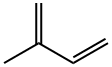
- 9003-31-0
- C5H8
- 68.12
- All (1)
- China (0)
- (1)
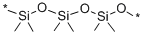
- 63148-62-9
- C6H18OSi2
- 162.38
- All (49)
- China (38)
- (49)
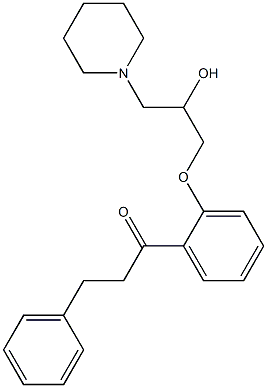
- 63148-67-4
- C23H29NO3
- 367.48126
- All (0)
- China (0)
- (0)
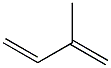
- 9006-04-6
- C5H8
- 68.11702
- All (0)
- China (0)
- (0)
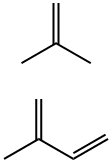
- 9010-85-9
- C9H16
- 124.23
- All (2)
- China (0)
- (2)
- 0
- All (0)
- China (0)
- (0)
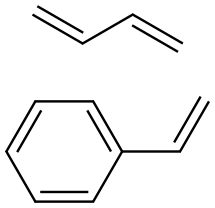
- 9003-55-8
- (C8H8.C4H6)x
- 158.24
- All (5)
- China (1)
- (5)
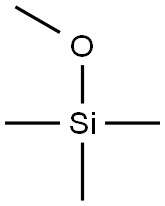
- 63148-58-3
- C4H12OSi
- 104.22298
- All (0)
- China (0)
- (0)
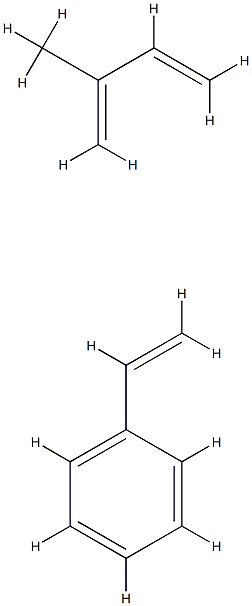
- 25038-32-8
- C13H16
- 172.26614
- All (0)
- China (0)
- (0)
Related Products More >

- CNY Request For Quotation
- CNY Request For Quotation
- CNY Request For Quotation
- CNY Request For Quotation
- CNY Request For Quotation
- CNY Request For Quotation
- CNY Request For Quotation
- CNY Request For Quotation


Yes, rubber is actually a great insulator—especially when it comes to electricity. That’s why you often see it covering electrical wires or used in the handles of tools that deal with electric current. The reason rubber works so well is because electricity doesn't easily flow through it. That means it helps keep us safe by stopping electricity from reaching our bodies.
People use rubber in everyday things like power cords, rubber gloves for electrical work, and even in some parts of household appliances. It’s especially helpful when you need to hold or touch something that might carry electricity, because rubber keeps the current from passing through your hands.
Now, not all rubber is the same. Natural rubber is already a good insulator, but synthetic types—like silicone rubber—can be made to handle heat or resist chemicals better. Still, in most daily situations, rubber does the job just fine. It's simple, affordable, and keeps things safe.
So next time you pick up a wire or a power tool, take a look—you’re probably holding a bit of rubber that’s quietly keeping you safe.
Physically, rubber exhibits high resistivity, meaning it strongly resists the flow of electric current. This is a core trait of insulating materials. Additionally, its poor thermal conductivity helps prevent the transfer of heat, which is why it’s also used in heat-resistant applications. These properties are not only based on rubber’s molecular structure but also on how it's processed—fillers like carbon black can enhance mechanical strength, but they may reduce its insulating properties, showing the trade-offs in rubber formulation for different applications.
From a practical perspective, rubber’s insulating ability plays a crucial role in various fields. In everyday life, it’s used as the protective layer around electrical wires, as insulation in household appliances, and in footwear and gloves for electrical safety. In industrial settings, rubber is essential for machinery that handles high voltages, preventing accidents and equipment damage. In the medical field, rubber insulates sensitive diagnostic equipment and ensures safe handling during procedures involving electricity or high-frequency currents.
In a broader interdisciplinary view, rubber’s insulating properties intersect with materials science, electrical engineering, and health and safety protocols. Its use supports the infrastructure of modern society, from safe housing to complex manufacturing systems. The ability to manipulate its formulation also reflects advances in polymer chemistry, allowing for rubber variants that perform under extreme temperatures, resist chemicals, or meet environmental standards.
Ultimately, rubber’s value as an insulator lies not only in its inherent physical and chemical characteristics but also in its adaptability and the critical role it plays in safeguarding human life and supporting technological systems. Its integration across diverse fields illustrates how a simple material, grounded in basic science, can carry widespread and enduring significance.
In practical applications, rubber’s insulating qualities are indispensable. For instance, electrical gloves used by linemen are often made of vulcanized rubber to protect against high-voltage currents. Similarly, the coating on power cords and cables relies on rubber to prevent short circuits and ensure safe energy transmission. Beyond electricity, rubber also excels as a thermal insulator, slowing heat transfer in applications like oven mitts or industrial pipe coverings. Its water-resistant nature further enhances its utility in outdoor or humid environments, where moisture could otherwise degrade insulation.
The effectiveness of rubber as an insulator can be attributed to its ability to adapt to diverse conditions while maintaining stability. Unlike metals or other conductive materials, it doesn’t corrode easily, ensuring long-term reliability. However, its performance can vary with temperature extremes or exposure to certain chemicals, requiring careful selection for specific use cases. For example, silicone rubber is preferred in high-temperature settings due to its superior heat resistance. These real-world examples underscore rubber’s versatility and critical role in both everyday and industrial contexts, solidifying its reputation as a dependable insulating material.
In practical applications, this trait is invaluable. For instance, electrical wires are often coated in rubber to prevent accidental contact with conductive materials, reducing the risk of short circuits or electric shock. Power tools and household appliances use rubber handles to create a barrier between users and internal electrical components, ensuring safety during operation. Similarly, in industrial settings, rubber gaskets and seals insulate machinery, preventing energy loss and maintaining operational efficiency. Even in extreme conditions, such as high temperatures or exposure to chemicals, specialized rubber compounds retain their insulating capabilities, making them a reliable choice in diverse scenarios. This combination of structural stability and electron resistance solidifies rubber’s role as a go-to insulator in both everyday and industrial contexts.