


 Home
Home
You might have seen Buna N rubber mentioned on product labels or in material descriptions, especially for gloves, seals, or hoses. But what exactly is it, and why do manufacturers choose it so often? Is it just another type of rubber, or does it have something special that makes it suitable for certain jobs? If it's synthetic, what is it made of and how is it different from natural rubber? What kind of properties does Buna N rubber have that make it useful in everyday items?
What Is Buna N Rubber and Why Is It Commonly Used?
Related Encyclopedia
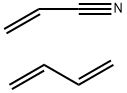
- 9003-18-3
- C7H9N
- 107.16
- All (0)
- China (0)
- (0)
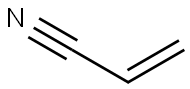
- 107-13-1
- C3H3N
- 53.06
- All (14)
- China (9)
- (14)
- 68891-46-3
- C7H9N
- 107.16000
- All (0)
- China (0)
- (0)
- 68683-29-4
- C7H9N
- 107.15300
- All (0)
- China (0)
- (0)
- 68891-47-4
- C7H9N
- 107.15300
- All (0)
- China (0)
- (0)
- 208049-95-0
- C4H6Rh2
- 259.90100
- All (0)
- China (0)
- (0)

- 930-22-3
- C4H6O
- 70.09
- All (0)
- China (0)
- (0)
- 88589-82-6
- C38H67NO7S
- 682.00600
- All (0)
- China (0)
- (0)
- 25339-57-5
- C4H6
- 54.09040
- All (2)
- China (2)
- (2)

- 106-99-0
- C4H6
- 54.09
- All (2)
- China (2)
- (2)
Related Products More >

- CNY Request For Quotation
- CNY Request For Quotation
- CNY Request For Quotation
- 9003-55-8
- CNY Request For Quotation
- 106-99-0
- CNY 6000.0000
- 1ton
- 93685-81-5
- Request For Quotation
- 25kg drum
- 93685-80-4
- Request For Quotation
- 25kg/drum
- 93685-80-4
- Request For Quotation
- Bottle,barrel,cargo,container,etc.


Unlike natural rubber, Buna N doesn’t get damaged easily by chemicals or oils, which makes it perfect for use in cars, factories, and even your home kitchen gloves. It’s also pretty tough and doesn’t tear or wear out quickly. It might not stretch as much as natural rubber, but it's more durable in messy or oily environments.
So, next time you see something labeled with Buna N, just know it’s built to last—especially around oil, fuel, or chemicals! It’s one of those quiet materials that does a lot behind the scenes.
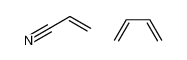
What makes Buna N particularly important from a chemical and physical perspective is its resilience in environments that typically degrade natural rubber. Unlike natural rubber, which is composed mainly of cis-1,4-polyisoprene, Buna N does not suffer from oxidative degradation or rapid swelling when exposed to petroleum-based oils. Its thermal stability generally ranges from −40°C to 108°C, and its resistance to abrasion, tensile stress, and certain chemicals gives it a long functional life in demanding settings.
From a physiological standpoint, Buna N rubber is considered safe for indirect human contact, such as in fuel-handling gloves or medical components that do not require direct contact with bodily tissues. However, its lack of biocompatibility limits its use in implants or long-term internal medical devices. Despite this, it plays a crucial supporting role in medical equipment like seals, tubing, and diaphragms, where exposure to oils, alcohols, or solvents would otherwise degrade natural rubber alternatives.
Interdisciplinary applications of Buna N span industries including automotive, aerospace, oil and gas, food handling (in FDA-compliant forms), and healthcare. Its use in seals, O-rings, fuel hoses, and gaskets is foundational to systems where fluid containment and chemical resistance are critical. Buna N also supports the development of safety gear such as chemical-resistant gloves, which are essential in laboratory and industrial settings.
Broadly speaking, Buna N rubber demonstrates how synthetic materials can be engineered for targeted performance in specific environments. Its design reflects a balance between chemical structure and practical need, revealing how polymer science intersects with everyday life. Whether under the hood of a vehicle or in the lab, Buna N stands as a vital material in the modern industrial and consumer landscape.
The key attributes of Buna N rubber include exceptional resistance to petroleum-based fluids, abrasion, and compression set, alongside moderate tensile strength and elasticity. Its molecular structure, with polar nitrile groups, creates a barrier against non-polar substances like oils, explaining its widespread use in fuel hoses, gaskets, and seals. For instance, automotive fuel systems rely on Buna N O-rings to prevent leaks, as the material maintains integrity even when exposed to gasoline or diesel.
In practice, Buna N’s performance is temperature-dependent, typically effective between -40°C and 120°C, though specialized formulations extend this range. A practical example is its use in industrial gloves for chemical handling, where its oil resistance protects workers while retaining tactile sensitivity. The rubber’s compatibility with additives further allows customization—for example, incorporating carbon black improves UV resistance for outdoor applications. Its interplay of chemical stability and mechanical adaptability ensures Buna N remains indispensable in sectors from aerospace to healthcare, bridging theoretical material science with real-world demands.
Key properties include excellent resistance to petroleum-based fluids, making it a staple in automotive applications such as fuel hoses and O-rings that come into contact with gasoline or diesel. It also exhibits good tensile strength and abrasion resistance, allowing it to maintain integrity under repeated use. The material’s performance varies with acrylonitrile content—higher levels enhance chemical resistance but reduce low-temperature flexibility, a trade-off that guides its selection for specific tasks. For instance, in industrial settings, Buna N gaskets seal hydraulic systems, preventing leaks of mineral oils, while in consumer products, it forms the flexible seals in washing machine doors, withstanding both water and detergent exposure. Its ability to function across a moderate temperature range, typically from -40°C to 120°C, further expands its utility in contexts ranging from automotive engines to household appliances, where reliable sealing under varying conditions is essential.