


 Home
Home
When people talk about natural rubber and latex, it often sounds like they’re referring to the same thing. But are they really the same? Are there any differences in how they're collected or used? Could one cause allergic reactions while the other doesn't? If you see a label saying “latex-free,” does that mean it doesn’t contain natural rubber at all? What exactly is the relationship between natural rubber and latex?
Is Natural Rubber the Same as Latex?
Related Encyclopedia
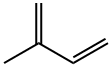
- 9003-31-0
- C5H8
- 68.12
- All (1)
- China (0)
- (1)
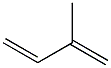
- 9006-04-6
- C5H8
- 68.11702
- All (0)
- China (0)
- (0)
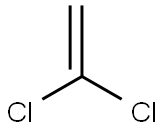
- 9002-85-1
- C2H2Cl2
- 96.94
- All (0)
- China (0)
- (0)
- 61791-14-8
- 0
- All (0)
- China (0)
- (0)
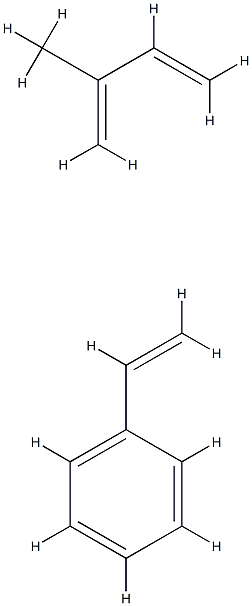
- 25038-32-8
- C13H16
- 172.26614
- All (0)
- China (0)
- (0)
- 9001-33-6
- 0
- All (0)
- China (0)
- (0)
Related Products More >

- 9006-04-6
- Request For Quotation
- bag
- 9006-04-6
- Request For Quotation
- 9006-04-6
- Request For Quotation
- 9006-04-6
- Request For Quotation
- 9006-04-6
- Request For Quotation
- 25kg/Drum
- 9006-04-6
- Request For Quotation
- 9006-03-5
- Request For Quotation
- 25KG/bag
- 9006-03-5
- Request For Quotation
- 25kg drum, or per customer requests.


So, latex is basically the starting point, and natural rubber is the end product. It’s kind of like how milk becomes cheese. They’re from the same source, but not identical in form or use. Also, some people are allergic to latex, especially in things like medical gloves, because of proteins in the raw sap. But once latex is processed into rubber, those proteins can be reduced or removed.
So in short, they're connected, but not the same thing. Think of latex as the liquid form, and natural rubber as what you get after some work is done to it.
From a chemical and physical standpoint, the transformation from latex to natural rubber involves changes in concentration, molecular orientation, and sometimes cross-linking (e.g., via vulcanization). These modifications enhance its durability and stability, making natural rubber highly valuable in a variety of applications. In contrast, raw latex—being fluid and protein-rich—has distinct properties, including its ability to form thin films, which is why it is often used directly in products like gloves, balloons, and catheters.
In medicine and health, the distinction carries further significance. Natural latex contains proteins that can trigger allergic reactions in sensitive individuals, a concern particularly relevant in clinical environments. Latex-free products often use synthetic rubber alternatives (like nitrile or neoprene), which lack these allergenic proteins. This differentiation directly impacts product labeling, regulation, and safety protocols across healthcare, childcare, and food handling sectors.
The distinction also matters in industrial and environmental contexts. Natural rubber, as a renewable material with high performance under dynamic stress, is irreplaceable in sectors like automotive and aerospace. Latex’s fluid nature, however, lends itself to surface coatings and adhesives. From a sustainability perspective, understanding this difference is key in guiding responsible material sourcing, waste management, and the development of bio-based alternatives.
In sum, while natural rubber and latex are intrinsically linked, they are not interchangeable terms. Latex is the biological origin—a complex fluid—while natural rubber is the refined, functional material derived from it. Appreciating this relationship requires a multidisciplinary view, spanning plant physiology, polymer chemistry, material science, and public health.
The molecular structure of natural rubber gives it unique properties, such as high tensile strength and resilience, which raw latex lacks due to its liquid form and additional components. Vulcanization—a process involving sulfur—further enhances rubber’s stability by creating cross-links between polymer chains. This explains why natural rubber is used for tires, conveyor belts, and medical devices, whereas liquid latex is employed in adhesives, coatings, or dipped products like gloves.
In practice, the difference matters significantly. For example, surgical gloves made from liquid latex retain proteins that can trigger allergies, while vulcanized rubber gloves are hypoallergenic. Similarly, latex paint relies on the colloidal properties of liquid latex for easy application, whereas rubberized asphalt uses solid rubber for road durability. Understanding these distinctions helps industries optimize material selection based on functionality, cost, and safety requirements.
Natural rubber, on the other hand, is the solid material derived from latex after it undergoes coagulation, washing, drying, and curing. This transformation removes the water and non-rubber components, leaving a resilient, elastic polymer. Its elasticity stems from the long, coiled polyisoprene chains that can stretch and return to their original shape, a property that makes it invaluable in products like tires, where flexibility and durability under stress are critical.
In practice, this distinction matters for both production and application. Latex, in its liquid form, is used in products like gloves and condoms, where its natural elasticity and barrier properties are preserved through minimal processing. Natural rubber, once solidified and vulcanized—treated with sulfur to cross-link polymer chains—gains enhanced strength and heat resistance, making it suitable for heavy-duty uses such as industrial hoses or shoe soles. Understanding this relationship helps clarify why latex allergies target proteins in the liquid form, while natural rubber products, having undergone processing, often pose less risk.