


 Home
Home
When people talk about rubber mulch, it might sound strange—how can rubber be used like wood chips in a garden or playground? What exactly is rubber mulch made from, and is it really safe to use around kids or plants? Does it break down like regular mulch, or last longer? If it’s made from old tires, is it still clean and environmentally friendly? And what are the pros and cons of using rubber mulch compared to more natural options?
What Is Rubber Mulch and Why Is It Used in Landscaping?
Related Encyclopedia
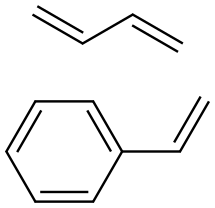
- 9003-55-8
- (C8H8.C4H6)x
- 158.24
- All (5)
- China (1)
- (5)
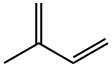
- 9003-31-0
- C5H8
- 68.12
- All (1)
- China (0)
- (1)
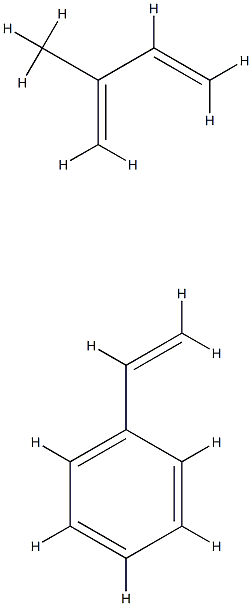
- 25038-32-8
- C13H16
- 172.26614
- All (0)
- China (0)
- (0)
Related Products More >

- 9003-55-8
- Request For Quotation
- 9003-55-8
- Request For Quotation
- 9003-55-8
- Request For Quotation
- 9003-55-8
- Request For Quotation
- 9003-55-8
- Request For Quotation
- 9003-31-0
- Request For Quotation
- 68441-58-7
- Request For Quotation
- 308067-72-3
- Request For Quotation
- 25kg/bale


One cool thing about rubber mulch is that it doesn’t attract bugs or mold, and it stays in place better during windy or rainy days. It also helps keep weeds down and lets water pass through to the soil. But some people worry about the chemicals in it, especially when it’s hot out. Still, for many, the low maintenance and long-lasting benefits are worth it.
So, in simple terms, rubber mulch is just shredded tire bits used as ground cover—and yes, it’s more common than you’d think!
From a materials science perspective, rubber mulch exhibits low thermal conductivity, allowing it to absorb and retain heat longer than wood-based counterparts. It also has hydrophobic characteristics, meaning it does not retain water, thereby reducing the risk of fungal growth or decay. Its density and elasticity contribute to impact absorption, which is a critical feature in playground applications, where it reduces the risk of injury from falls. Physically, rubber mulch does not compact as easily as soil or wood mulch, which helps maintain soil aeration over time.
On a biological level, rubber mulch does not decompose, which makes it unsuitable for enriching soil nutrients, but highly efficient in suppressing weed growth and reducing maintenance. Unlike organic mulch, it does not serve as a habitat or food source for pests or microorganisms, which can be either an advantage or disadvantage depending on ecological goals. Concerns occasionally arise regarding the leaching of volatile organic compounds (VOCs) or heavy metals under extreme heat or acidic conditions; however, most commercial products are tested and treated to minimize such risks.
In a broader context, rubber mulch plays a role in sustainable waste management by redirecting millions of scrap tires from landfills and incinerators. It contributes to the circular economy, turning industrial waste into functional landscape material. Beyond landscaping and playgrounds, research in medical and industrial sectors has explored rubber-based materials for their shock-absorbing properties, chemical resistance, and insulation potential. This reflects how cross-disciplinary knowledge—ranging from polymer chemistry to environmental science—underpins both the innovation and the debates surrounding rubber mulch.
Understanding rubber mulch involves not just its surface utility but its deeper implications for sustainability, material science, and human health. As urban design, climate resilience, and waste reduction continue to intersect, rubber mulch stands as a tangible example of how modern materials can serve both functional and environmental purposes when applied thoughtfully.
One of its critical properties is its ability to retain moisture in soil by reducing evaporation, similar to organic mulches, but with the added benefit of maintaining structure even after heavy rain or intense sunlight. It also provides effective weed suppression by blocking sunlight from reaching weed seeds, minimizing the need for chemical herbicides. In playgrounds, for instance, its shock-absorbing qualities make it a safety-focused choice, cushioning falls and reducing the risk of injuries compared to hard surfaces like concrete.
In landscaping, rubber mulch’s color retention—often dyed in earth tones—adds aesthetic appeal without fading quickly, unlike wood mulch that may turn gray over time. Its non-biodegradable nature, however, means it does not contribute organic matter to soil, distinguishing it from organic alternatives. This balance of durability, functionality, and low maintenance makes rubber mulch a practical option in settings where long-term performance and reduced upkeep are priorities.
The key attributes of rubber mulch include its resistance to weathering, moisture retention, and weed suppression. Unlike organic alternatives, it doesn’t break down over time, meaning it doesn’t require frequent replenishment. Its porous structure allows water to penetrate the soil while preventing erosion. However, it doesn’t improve soil fertility like organic mulch, as it lacks nutrients. In practice, rubber mulch is often used in high-traffic areas like pathways or sports fields, where its resilience outperforms wood or straw. For example, a playground surfaced with rubber mulch can withstand years of heavy use without significant degradation.
The mechanism behind rubber mulch’s effectiveness lies in its material properties. The elasticity of rubber provides cushioning, while its density prevents displacement by wind or rain. In landscaping, it acts as a thermal insulator, protecting plant roots from extreme temperatures. Despite its benefits, concerns exist about potential chemical leaching, though modern processing techniques mitigate this risk. For instance, high-quality rubber mulch is often washed and screened to remove contaminants. When used correctly, it offers a practical, low-maintenance alternative to traditional mulching materials, balancing functionality with environmental recycling benefits.