


 Home
Home
When people talk about materials like rubber and plastic, they often seem similar—both are flexible, used in tons of products, and can be molded into different shapes. But are they actually the same kind of material? What makes rubber different from plastic, if anything? Is rubber just a type of plastic, or is it a completely separate material? And what about things like natural rubber versus synthetic rubber—do those count as plastics too? So, is rubber a plastic?
Is Rubber a Plastic or Something Else?
Related Encyclopedia

- 9002-86-2
- C2H3Cl
- 62.49822
- All (75)
- China (10)
- (75)

- 63148-67-4
- C23H29NO3
- 367.48126
- All (0)
- China (0)
- (0)
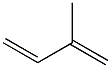
- 9006-04-6
- C5H8
- 68.11702
- All (0)
- China (0)
- (0)
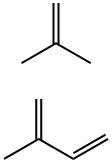
- 9010-85-9
- C9H16
- 124.23
- All (2)
- China (0)
- (2)

- 51252-84-7
- C3H4O2
- 72.06270
- All (0)
- China (0)
- (0)

- 25191-16-6
- C6H12O6
- 180.15600
- All (0)
- China (0)
- (0)

- 27015-21-0
- C15H14O7
- 306.26700
- All (0)
- China (0)
- (0)

- 9003-55-8
- (C8H8.C4H6)x
- 158.24
- All (5)
- China (1)
- (5)

- 49603-39-6
- C14H18
- 186.29300
- All (0)
- China (0)
- (0)
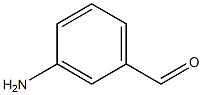
- 29159-23-7
- C7H7NO
- 121.13658
- All (0)
- China (0)
- (0)
Related Products More >

- 9002-86-2
- CNY Request For Quotation
- CNY Request For Quotation
- CNY Request For Quotation
- CNY Request For Quotation


So while they share some chemistry, they don’t act the same in everyday life. That’s why we don’t really call rubber a plastic. It’s its own thing, even if it's made in similar ways.
In practical applications, these properties dictate their uses. For example, rubber’s elasticity makes it ideal for tires, shoe soles, or seals, where repeated deformation is required. Plastics, like polyethylene or PVC, are better suited for rigid containers, piping, or packaging due to their durability and formability. However, some materials blur the line—thermoplastic elastomers (TPEs) combine rubber-like flexibility with plastic-like processability, used in products like phone cases or medical tubing.
The production processes also differ. Rubber often requires vulcanization (cross-linking with sulfur) to enhance strength, while plastics are typically molded or extruded when heated. Despite overlaps in polymer science, the distinction remains clear in functionality. Understanding these differences helps engineers select the right material—for instance, choosing silicone rubber for heat-resistant gaskets over brittle plastic alternatives. Real-world applications hinge on these fundamental properties, even as advanced materials continue to evolve.
Rubber, whether natural or synthetic, is categorized as an elastomer, a type of polymer that is characterized by its high elasticity. Natural rubber is primarily composed of polyisoprene, a polymer derived from latex extracted from rubber trees. Synthetic rubbers, like styrene-butadiene rubber (SBR) or nitrile rubber (NBR), are produced through polymerization of monomers such as butadiene and styrene. What sets rubber apart is its ability to undergo large deformations and return to its original shape—a result of its amorphous molecular structure and lightly cross-linked polymer chains, which provide flexibility and resilience at room temperature.
Plastics, on the other hand, are typically thermoplastics or thermosets. Thermoplastics like polyethylene or polyvinyl chloride (PVC) soften when heated and harden upon cooling, a reversible process. Thermosets, such as epoxy or phenolic resins, once cured, do not soften with heat. These structural differences are critical. Plastics generally have rigid, less elastic molecular architectures, making them ideal for applications requiring shape retention and mechanical strength.
In everyday life, the distinction between rubber and plastic impacts everything from how products are manufactured to how they function. Tires, for example, rely on rubber’s elasticity and abrasion resistance, while plastic containers depend on rigidity and durability. In industrial settings, rubber seals and gaskets provide flexibility and sealing capabilities that plastics cannot match. In medicine, rubber materials like silicone are vital for devices that need to be flexible yet biocompatible, such as catheters or seals in syringes.
Understanding the distinction between rubber and plastic also has implications for sustainability and recycling. Their different chemical compositions require different recycling processes, and their environmental impacts vary widely. For instance, natural rubber is biodegradable, while most plastics are not. Recognizing these materials’ fundamental differences allows for better choices in design, usage, and end-of-life treatment.
In short, while rubber and plastic share a polymeric nature, they are fundamentally different in structure, function, and application. Appreciating this distinction deepens our understanding of material science and helps inform smarter, more responsible use in both technology and daily life.
Natural rubber’s cis-polyisoprene structure, for instance, enables the flexibility needed in tires, where repeated expansion and contraction during movement demand consistent elasticity. Synthetic rubbers like styrene-butadiene rubber (SBR) mimic this behavior, enhancing durability for industrial hoses. Plastics, such as polyethylene in milk jugs, rely on their rigidity and moldability, maintaining shape under minimal stress. The key distinction lies in rubber’s entropy-driven elasticity versus plastic’s tendency to retain a fixed form, a difference that dictates their roles from gaskets (rubber) to food containers (plastic).