


 Home
Home
We use rubber in many everyday things, from shoes to wires—but what exactly is rubber when it comes to electricity? Can it carry an electric current like metal does, or does it block electricity? And what makes rubber behave that way in the first place? Is it about the material it's made from, or how it's processed? If rubber is mixed with other stuff, can it still stop electricity? So really, is rubber a conductor or insulator?
Is Rubber a Conductor or Insulator?
Related Encyclopedia

- 1333-86-4
- C
- 12.01
- All (301)
- China (31)
- (301)

- 9003-31-0
- C5H8
- 68.12
- All (1)
- China (0)
- (1)

- 7704-34-9
- S8
- 256.52
- All (4)
- China (4)
- (4)
- 12185-12-5
- S2
- 63.94410
- All (4)
- China (4)
- (4)

- 63148-67-4
- C23H29NO3
- 367.48126
- All (0)
- China (0)
- (0)
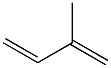
- 9006-04-6
- C5H8
- 68.11702
- All (0)
- China (0)
- (0)
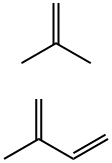
- 9010-85-9
- C9H16
- 124.23
- All (2)
- China (0)
- (2)
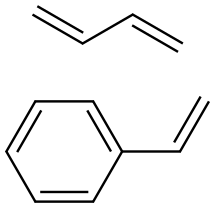
- 9003-55-8
- (C8H8.C4H6)x
- 158.24
- All (5)
- China (1)
- (5)
- 65952-74-1
- C12H8N6S
- 268.29700
- All (0)
- China (0)
- (0)
- 1177730-84-5
- O4S
- 96.06260
- All (0)
- China (0)
- (0)
Related Products More >

- CNY Request For Quotation
- CNY Request For Quotation
- CNY Request For Quotation
- CNY Request For Quotation
- CNY Request For Quotation
- CNY Request For Quotation
- CNY Request For Quotation
- CNY Request For Quotation


You’ll often see rubber used in gloves for electricians, or around plugs and cables. These everyday uses help prevent dangerous contact with live wires. However, if rubber is mixed with certain chemicals or gets very dirty or wet, it might not insulate as well—so it’s not 100% foolproof.
So to keep it simple: no, rubber doesn’t conduct electricity under normal conditions. That’s exactly why it’s so useful in keeping us safe around anything electrical.
The insulating property of rubber is not just a chemical characteristic, but also a result of its physical behavior. Its elasticity, high tensile strength, and thermal stability allow it to maintain insulating performance even under mechanical stress or temperature variation, though its effectiveness can degrade with excessive heat, UV exposure, or contamination by conductive materials like water or certain salts.
This fundamental trait has practical value across a wide range of fields. In electrical engineering, rubber is used to coat wires, cables, and tools to protect users from electrocution. In medicine, insulating gloves and mats made from rubber are essential for safety in environments where accidental electric contact is a risk. In industrial settings, rubber components are used to isolate vibrations and serve as protective barriers in high-voltage systems. Even in footwear, rubber soles reduce the chance of grounding electrical charges, providing passive safety.
From a physics standpoint, rubber’s insulating ability reinforces the understanding of materials as either conductors, semiconductors, or insulators, based on their electron mobility and atomic structure. This categorization is critical in designing circuits, protective gear, and electronic components. In materials science, innovations such as conductive rubber (infused with carbon or metal particles) show how the basic non-conductive nature of rubber can be modified for specialized applications—highlighting rubber's adaptability as a platform material in flexible electronics and sensors.
In short, rubber is fundamentally an insulator due to its molecular and structural properties. Its use extends far beyond just preventing electric shocks; it plays an integral role in enabling safe, functional, and efficient systems across various domains of modern life.
The insulating properties of rubber are leveraged in countless practical applications. Electrical gloves worn by linemen, for instance, rely on rubber to protect against high-voltage shocks. Similarly, the coating on power cords and cables often incorporates rubber to prevent short circuits or accidental electrocution. These examples highlight how rubber’s inherent resistance to conductivity ensures safety in electrical systems.
Beyond electricity, rubber’s insulating qualities extend to thermal energy. Its low thermal conductivity makes it useful in applications like handle grips for hot tools or insulating mats in industrial settings. The combination of electrical and thermal insulation, along with flexibility and durability, solidifies rubber’s role as a go-to material for isolating energy transfer. Its performance in these scenarios underscores the importance of understanding material properties when designing functional solutions.
In practical terms, this insulating capability makes rubber indispensable in numerous applications where electrical safety is paramount. For instance, electricians rely on rubber gloves and boots to create a barrier between their bodies and live wires, reducing the risk of electric shock. Similarly, power cords often have rubber or rubber-like sheaths that encase the conductive copper wires inside, preventing short circuits and protecting users from direct contact with electricity. Even in high-voltage settings, such as power substations, rubber mats are used to insulate workers from the ground, ensuring that any stray electrical current does not pass through their bodies.
It is worth noting that under extreme conditions, such as very high temperatures or intense electrical fields, rubber can lose some of its insulating properties. However, under normal circumstances, its ability to resist the flow of electrons remains consistent, solidifying its role as a reliable insulator in both industrial and everyday contexts. This combination of structural stability and practical utility is what makes rubber a staple material in electrical safety and insulation.