


 Home
Home
Fiber paper is often used in labs and crafts, but does it actually soak up liquids like typical paper towels or tissues? How does its structure affect its ability to hold or repel water? And are there certain chemicals or conditions that change how absorbent fiber paper can be? Could fiber paper really be a good choice when moisture control is important?
Is Fiber Paper Absorbent Like Regular Paper?
Related Encyclopedia

- 1310-73-2
- NaOH
- 39.99711
- All (130)
- China (116)
- (131)

- 12200-64-5
- H3NaO2
- 58.01240
- All (0)
- China (0)
- (0)
- 87331-12-2
- HNa3O
- 85.97670
- All (0)
- China (0)
- (0)
- 389873-17-0
- HNaO
- 40.99680
- All (0)
- China (0)
- (0)

- 9004-64-2
- C3H7O*
- 59.08708
- All (22)
- China (9)
- (22)
- 9004-62-0
- C29H52O21
- 0
- All (59)
- China (31)
- (59)
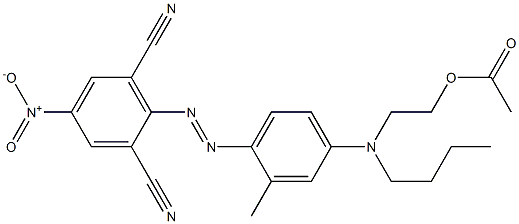
- 9004-57-3
- C23H24N6O4
- 448.47446
- All (21)
- China (2)
- (21)
- 9013-34-7
- C20H23NO5
- 0
- All (4)
- China (4)
- (4)
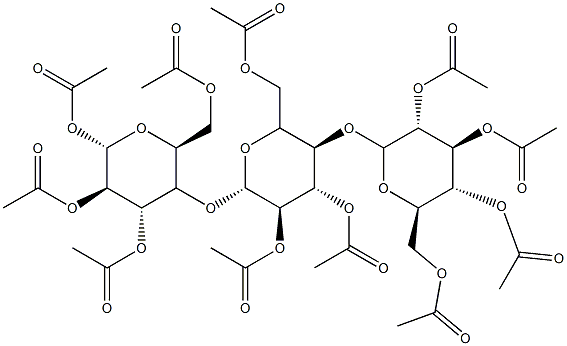
- 9012-09-3
- C40H54O27
- 966.84056
- All (3)
- China (0)
- (3)

- 9004-41-5
- C6H8N2O
- 124.14052
- All (1)
- China (1)
- (1)
Related Products More >

- CNY Request For Quotation
- CNY Request For Quotation
- CNY Request For Quotation
- 9004-62-0
- Request For Quotation
- 9004-62-0
- Request For Quotation
- 1310-73-2
- Request For Quotation
- 1310-73-2
- Request For Quotation
- 1310-73-2
- Request For Quotation


But not all fiber paper is the same. Some types are specially treated or coated to resist water, so they’re less absorbent on purpose—like when used in packaging or art where you don’t want water damage. So, if you're just using it at home or in a basic setting, chances are it's pretty absorbent. But if you're working in a lab or using it for a specific job, you might need to check the type.
In everyday life, fiber paper works a lot like a sponge—it draws in liquid through all the tiny spaces in the fibers. That’s why it’s so common in cleaning products and even medical stuff like wound dressings.
The degree of absorbency also depends on how the fibers are processed. For instance, untreated fiber papers, like blotting paper or lab-grade filter paper, are extremely absorbent due to their loose structure and uncoated surface. In contrast, fiber paper that has been chemically treated or coated with hydrophobic agents, like wax or certain polymers, can resist liquid absorption. This makes them more suitable for packaging or insulation, where moisture resistance is needed.
In practice, absorbent fiber paper plays a crucial role in filtration systems, especially in laboratory settings where separation of solids and liquids is required. It's also widely used in the medical field—for example, in wound care pads or diagnostic test strips—where controlled absorption is critical. Even in the food industry, absorbent fiber pads are placed under fresh meat to retain excess liquid and improve product appearance.
Depending on its intended function, fiber paper can be engineered for either high or low absorbency, making it a highly versatile material across industries.
Synthetic fiber papers, such as those made from glass fibers, offer different absorbent qualities. While glass itself is not inherently absorbent, the way fibers are woven or pressed creates spaces that hold liquids through capillary action—the same force that draws water up a straw. This makes them useful in industrial settings, like absorbing oils in machinery, where their resistance to chemical breakdown complements their ability to soak up specific substances without disintegrating.
The practical applications hinge on balancing absorbency with other traits. In laboratory settings, fiber paper filters for solvents need to absorb efficiently while maintaining structural integrity, preventing tearing when saturated. Conversely, fiber paper used in packaging might be treated to reduce absorbency, protecting contents from moisture. Understanding these nuances allows users to select the right fiber paper for the task, whether it’s mopping up spills in a workshop or ensuring precise filtration in a lab, where controlled absorbency directly impacts results.
In practical applications, fiber paper’s absorbency is leveraged in products like coffee filters or medical swabs, where rapid liquid uptake is critical. A coffee filter’s ability to retain oils and fine particles while allowing water to pass through relies on the precise balance between fiber spacing and chemical composition. Similarly, blotting paper used in cosmetics capitalizes on controlled absorbency to remove excess oils without damaging delicate surfaces.
The mechanics of absorption also depend on environmental conditions. Humidity, for example, can pre-saturate fiber paper, reducing its capacity for additional liquid uptake. In industrial settings, this is mitigated by storing absorbent papers in controlled environments. The interplay between material science and real-world functionality underscores how fiber paper’s absorbency is both a measurable property and a tunable feature for specific use cases.