


 Home
Home
When setting up fiber optic internet or communication systems, I often hear about “dB loss” in the cables. I understand it has something to do with signal strength dropping, but what actually causes it? Is it just the length of the cable, or are there other reasons like bends, dirt, or damage? And how much loss is considered normal before it becomes a problem? What causes dB loss in fiber cable?
What Causes dB Loss in Fiber Cable and Can It Be Prevented?
Related Encyclopedia
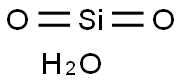
- 10279-57-9
- H2O3Si
- 78.1
- All (15)
- China (0)
- (15)

- 60676-86-0
- O2Si
- 60.0843
- All (15)
- China (0)
- (15)
Related Products More >

- 60676-86-0
- Request For Quotation
- 60676-86-0
- Request For Quotation
- 60676-86-0
- Request For Quotation
- 60676-86-0
- Request For Quotation
- 60676-86-0
- Request For Quotation
- 60676-86-0
- Request For Quotation
- 60676-86-0
- Request For Quotation
- 60676-86-0
- Request For Quotation


A big cause is bending the cable too tightly. Fiber cables aren’t like regular wires—if you bend them too much, the light inside starts leaking out, which weakens the signal. Also, dirty or damaged connectors can mess things up. Even tiny dust particles where the cables plug in can block or scatter the light. Poor splicing—where two fiber ends are joined—can also cause loss if it’s not done neatly.
Temperature changes, physical pressure, and older or low-quality cable materials can also play a role. So, while some signal loss is normal, big drops usually mean something’s wrong—like a dirty connector, bad bend, or a damaged section. If your connection seems slower or unreliable, that might be the reason.
Scattering is another intrinsic culprit: light bounces off microscopic irregularities in the fiber’s structure, redirecting photons away from the core. Rayleigh scattering, prominent at shorter wavelengths (like 850 nm), is why multimode fibers used in data centers often suffer greater loss than single-mode fibers operating at 1310 nm or 1550 nm.
External factors also play a role. Bending the fiber too tightly causes some light to leak out of the core, a problem in cramped spaces like server rooms where cables are routed around equipment. Poorly aligned connectors create gaps where light disperses, a common issue in patch panels that haven’t been properly maintained, leading to intermittent signal drops in office networks.
Even temperature fluctuations can contribute, as extreme heat or cold alters the fiber’s refractive index, disrupting light propagation—critical in industrial settings where cables are exposed to harsh environments, affecting the reliability of sensor data transmission. Each factor, alone or combined, chips away at signal strength, making careful design and handling essential for maintaining efficient fiber networks.
Extrinsic factors like bending losses manifest when fibers deviate from ideal straight paths. Macrobending (visible curvature) and microbending (small-scale deformations) force light to leak from the core. A tight bend radius under 10 mm in a patch panel can induce over 1 dB of excess loss, disrupting data center operations. Similarly, poor splicing or connector alignment—common in field installations—creates Fresnel reflections and mode mismatch. A 2-µm lateral offset between spliced fibers may cause 0.5 dB loss, degrading 5G fronthaul network performance where signal integrity is critical.
Environmental stressors further exacerbate losses. Hydrogen ingress into older cables forms hydroxyl ions that absorb 1383 nm wavelengths ("water peak"), while temperature fluctuations stress mechanical splices. In Arctic deployments, cyclic freezing can increase attenuation by 0.1 dB/km seasonally. These mechanisms collectively dictate design margins—telecom engineers might budget 3 dB total loss for a 10 km link, factoring in connectors, splices, and environmental aging to ensure QAM-64 signals remain viable.
At a fundamental level, the loss mechanisms can be categorized into intrinsic and extrinsic factors. Intrinsic losses are built into the fiber’s physical properties—mainly absorption and scattering. Absorption occurs when light energy is converted into heat due to interactions with molecular vibrations, particularly from trace materials like hydroxyl ions (OH⁻) in the silica glass. Rayleigh scattering, caused by microscopic fluctuations in the glass density, is another dominant intrinsic loss, especially at shorter wavelengths.
Extrinsic losses, on the other hand, are due to external imperfections or handling. Bending losses occur when the fiber is curved beyond a critical angle, causing the light to escape the core into the cladding or out entirely. These can be classified into macrobending (large, visible bends) and microbending (small, pressure-induced deformations), both of which disrupt the internal reflection needed for signal propagation. Additionally, connector misalignments, poor splicing, and contamination at interfaces can create reflective or absorptive losses that degrade performance.
Chemically, the purity of the glass and the presence of dopants like germanium or fluorine influence how much attenuation occurs. From a materials engineering standpoint, improving core-cladding uniformity and reducing imperfections at the molecular level leads to lower dB loss. Physically, temperature fluctuations can also affect transmission by altering the refractive index and causing expansion or contraction, particularly in outdoor or undersea environments.
The implications are wide-ranging. In telecommunications, excessive dB loss reduces bandwidth and limits the distance between signal repeaters, increasing infrastructure costs. In medical imaging, such as in fiber-optic endoscopes, clarity and resolution depend on minimizing signal degradation. In industrial automation, where sensors rely on fiber optics for real-time data, even slight losses can result in delays or errors.
Managing dB loss involves both design and maintenance strategies—choosing the right type of fiber, adhering to installation best practices, and implementing regular inspection protocols. The concept may appear simple at first glance, but the underlying science reveals a complex interplay of light, matter, and environment that shapes the efficiency of modern optical systems.