


 Home
Home
When we touch rubber materials in daily life—like gloves, tires, or phone cases—we don't usually think about whether they can carry electricity. But in some situations, like electrical safety or electronics manufacturing, knowing this becomes important. Can rubber actually conduct electricity under any conditions? And what happens when different materials are added to rubber? Is rubber always a safe insulator, or can it sometimes become conductive?
Is Rubber Conductive or Not?
Related Encyclopedia

- 1333-86-4
- C
- 12.01
- All (301)
- China (31)
- (301)

- 63148-62-9
- C6H18OSi2
- 162.38
- All (49)
- China (38)
- (49)

- 63148-67-4
- C23H29NO3
- 367.48126
- All (0)
- China (0)
- (0)

- 9006-04-6
- C5H8
- 68.11702
- All (0)
- China (0)
- (0)

- 9010-85-9
- C9H16
- 124.23
- All (2)
- China (0)
- (2)
- 0
- All (0)
- China (0)
- (0)
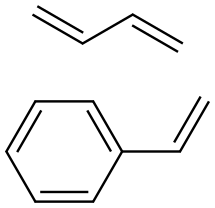
- 9003-55-8
- (C8H8.C4H6)x
- 158.24
- All (5)
- China (1)
- (5)
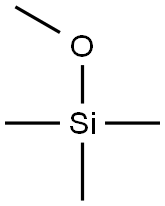
- 63148-58-3
- C4H12OSi
- 104.22298
- All (0)
- China (0)
- (0)
Related Products More >

- CNY Request For Quotation
- CNY Request For Quotation
- CNY Request For Quotation
- CNY Request For Quotation
- CNY Request For Quotation
- CNY Request For Quotation
- CNY Request For Quotation
- CNY Request For Quotation


But here's a twist—rubber can become conductive if certain things are mixed in. For example, adding carbon black or some types of metals can make it carry electricity. This kind of “conductive rubber” is used in special products, like keypads or sensors.
So, the short answer is: normal rubber? No, it doesn’t conduct electricity. But if it’s specially made with conductive stuff inside, then yes, it can. Just depends on what kind of rubber we’re talking about.
This insulating property is harnessed in numerous practical applications where electrical safety is paramount. For instance, electricians rely on rubber gloves and boots to protect against electric shock when working with live wires; the material acts as a barrier, preventing current from traveling through the body. Similarly, power cords often feature a rubber coating around their internal metal wires, isolating the conductive core from external contact and reducing the risk of short circuits or accidental electrocution.
Not all rubber, however, is strictly non-conductive. Through modifications such as adding carbon black or metal particles, engineers can create conductive rubber composites. These materials find use in specialized contexts, such as flexible sensors in robotics or anti-static components in electronics manufacturing, where both conductivity and the material’s inherent elasticity are valued. Understanding these variations allows for precise material selection based on specific electrical and mechanical requirements.
From a physical and chemical standpoint, the insulating property of rubber is not absolute. When additives like carbon black, graphite, or metallic particles are incorporated into the rubber matrix, its conductive properties can change significantly. This happens because these conductive fillers form continuous pathways within the rubber, allowing electrons to move through the material. The resulting compound is referred to as conductive rubber. The level of conductivity can be fine-tuned depending on the proportion and type of filler used, which opens up diverse possibilities for industrial and technological applications.
Conductive rubber finds applications in various fields. In electronics, it’s used in pressure-sensitive buttons, touchpads, and flexible circuits. In medicine, biocompatible conductive elastomers are used in wearable devices and certain types of implants to monitor or stimulate biological signals. In automotive and aerospace sectors, conductive rubber helps manage static electricity and electromagnetic interference. Thus, the ability to control rubber’s conductive behavior is not only a fascinating subject in materials science but also a powerful tool in advancing innovation across disciplines.
Understanding rubber’s conductive potential invites a broader conversation about material design and the way we harness properties at the molecular level to suit practical needs. Whether maintaining safety in an electrical system or enabling the next generation of wearable tech, the story of rubber illustrates how subtle changes in composition can yield entirely new functionalities.
The practical implications of rubber’s conductivity—or lack thereof—are significant in everyday technology. Electrical wires, for example, are often coated with rubber to prevent short circuits and ensure user safety. Conversely, conductive rubber variants are employed in specialized contexts, such as anti-static mats for electronics manufacturing or flexible keypads in remote controls, where controlled conductivity is essential. The interplay between rubber’s base properties and its modified forms demonstrates how material science tailors substances to meet specific functional demands.
Understanding rubber’s conductive behavior also clarifies its role in larger systems. In automotive tires, the inclusion of carbon black not only enhances durability but also dissipates static electricity, reducing the risk of sparks. Similarly, medical devices use conductive rubber for sensors that monitor vital signs, leveraging its flexibility and adjustable resistivity. These examples underscore how a material’s fundamental traits, when strategically manipulated, enable diverse applications across industries. The balance between insulation and conductivity in rubber highlights its versatility as both a barrier and a medium for electrical phenomena.