


 Home
Home
Have you ever come across the term "ramie fiber" on a clothing label or in eco-friendly fabric discussions? It might sound unfamiliar, but this natural fiber has been used for centuries. Where does it come from, and what makes it different from cotton or linen? Is it really good for the environment, and how strong is it? Also, what kind of clothes or products are made from ramie fiber? Why is it gaining more attention in recent years among sustainable material choices?
What Is Ramie Fiber and How Is It Used?
Related Encyclopedia
- 9005-53-2
- unspecified
- 0
- All (8)
- China (7)
- (8)
- 8068-05-1
- C30H25ClN6
- 505.01
- All (0)
- China (0)
- (0)
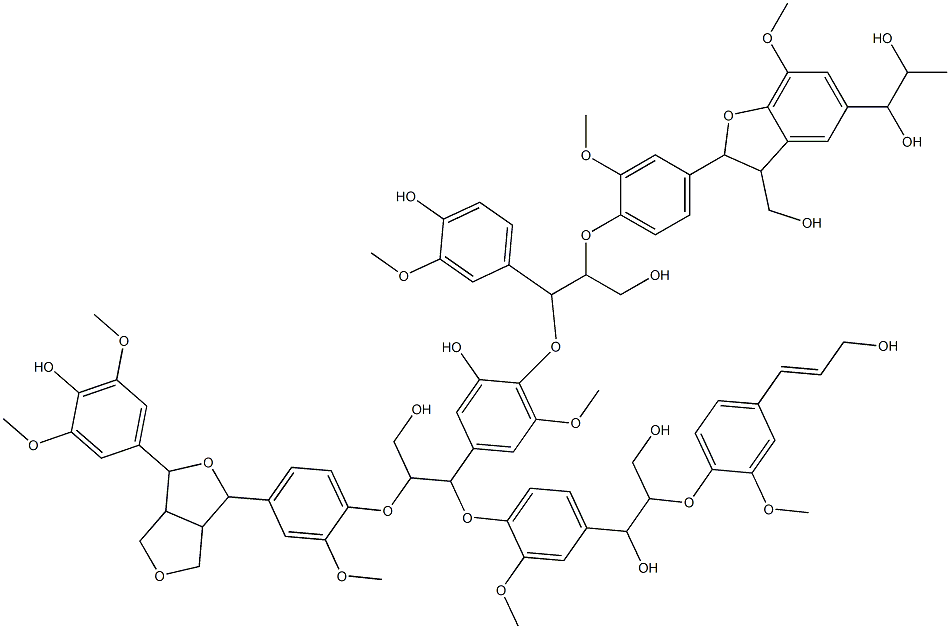
- 8068-03-9
- C81H92O28
- 1513.58038
- All (0)
- China (0)
- (0)
- 42613-30-9
- 0
- All (4)
- China (4)
- (4)

- 9004-64-2
- C3H7O*
- 59.08708
- All (22)
- China (9)
- (22)
- 9004-62-0
- C29H52O21
- 0
- All (59)
- China (31)
- (59)
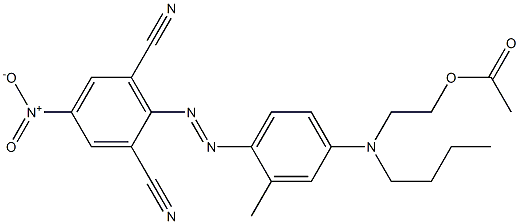
- 9004-57-3
- C23H24N6O4
- 448.47446
- All (21)
- China (2)
- (21)
- 9013-34-7
- C20H23NO5
- 0
- All (4)
- China (4)
- (4)
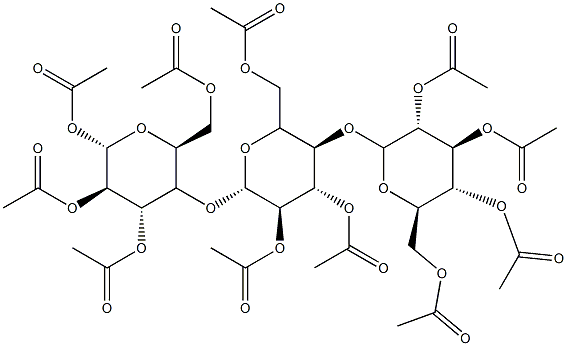
- 9012-09-3
- C40H54O27
- 966.84056
- All (3)
- China (0)
- (3)

- 9004-41-5
- C6H8N2O
- 124.14052
- All (1)
- China (1)
- (1)
Related Products More >

- CNY Request For Quotation
- CNY Request For Quotation
- CNY Request For Quotation
- 9004-62-0
- Request For Quotation
- 9004-62-0
- Request For Quotation
- 9004-65-3
- Request For Quotation
- 9004-65-3
- USD 361.6000
- 25kg
- 9004-57-3
- USD 580.0000
- 25kg


You’ll often find ramie mixed with cotton in clothes like shirts, summer pants, or home stuff like tablecloths and curtains. It helps fabrics stay in shape and not get all wrinkly. It also dries fast and doesn’t shrink much, which makes it easy to wear and wash.
What’s neat is that ramie comes from plants, so it’s renewable and biodegradable. That’s one reason why it’s becoming more popular as people look for greener fabric options. It's not super soft like some other fibers, but it’s durable and has a natural, clean look people like.
From a physical and mechanical standpoint, ramie exhibits exceptional strength, especially in wet conditions, due to the highly crystalline regions within its cellulose microfibrils. It is also notable for its low elasticity and poor elongation, meaning it resists stretching and holds form well, though this can also limit its flexibility in certain fabric blends. Its breathability and moisture-wicking properties, paired with resistance to mildew and insect attack, make it ideal for humid environments and high-performance textiles.
What makes ramie particularly interesting is how it intersects with various disciplines. In materials science, it’s studied for its reinforcing potential in polymer composites, offering a biodegradable alternative to synthetic fibers in automotive parts or construction panels. In medicine, ramie-derived cellulose has potential as a bio-compatible scaffold in tissue engineering, given its structural integrity and low cytotoxicity. Its antimicrobial resistance also lends value to wound dressings or hospital-grade fabrics where hygiene is critical.
In daily life, ramie is commonly blended with cotton, wool, or synthetic fibers to create garments that are lightweight, breathable, and wrinkle-resistant. Its natural sheen offers aesthetic appeal, often resembling linen but with improved durability. Additionally, as sustainability becomes a priority in manufacturing, ramie’s renewable origin and biodegradability place it at the forefront of eco-conscious textile development. Its cultivation requires fewer pesticides compared to cotton, making it an attractive crop in regenerative agriculture models. These characteristics make ramie not only a functional material but also a symbol of shifting industrial and environmental paradigms.
These properties make ramie fiber highly valued in textile applications, where its strength allows it to withstand repeated washing and wear without significant degradation. For example, in the production of workwear or upholstery fabrics, blending ramie with cotton enhances the material’s tensile strength, ensuring the final product resists tearing even with heavy use. Its low elasticity, while limiting stretch, makes it ideal for items requiring shape retention, such as canvas or industrial filters, where dimensional stability is critical.
Beyond textiles, ramie fiber’s resistance to microbial growth and moisture absorption adds to its practical utility. In agricultural settings, it is woven into crop covers that protect plants from pests while allowing air and water penetration, balancing durability with permeability. Its biodegradability also positions it as a sustainable alternative to synthetic fibers in single-use products, such as packaging materials, where its natural decomposition reduces environmental impact. A manufacturer switching from polyester to ramie-based packaging, for instance, can meet eco-friendly standards without sacrificing structural integrity during transit.
A defining characteristic of ramie is its low elasticity, which gives fabrics a crisp, linen-like drape but also necessitates blending with more flexible fibers like cotton or polyester for improved wearability. The extraction process involves retting, decortication, and degumming to remove pectins and gums that bind the fibers, a step critical to achieving its smooth texture. In industrial applications, ramie’s resistance to rot and mildew makes it valuable for marine cordage, canvas, and even composite materials where biodegradability and strength are prioritized.
Beyond textiles, ramie’s minimal shrinkage and ability to hold dyes vividly have led to its use in traditional Asian garments like Japanese washi paper and Korean hanbok linings. Modern innovations explore its potential in sustainable fashion and technical textiles, such as reinforcement fibers in biodegradable plastics. However, its labor-intensive processing historically limited widespread adoption, though advancements in enzymatic degumming may shift this dynamic. As demand for eco-friendly fibers grows, ramie’s blend of ancient heritage and contemporary relevance positions it uniquely in the future of sustainable materials.