


 Home
Home
Polyester is used in everything from clothing to tents and backpacks, and people often say it's good for wet weather. But does that mean polyester fiber is actually waterproof? Can it completely block water from getting through, or does it just dry quickly? How does it behave in the rain, and do all polyester fabrics work the same way? Does it need special coatings or treatments to be truly waterproof?
Is Polyester Fiber Waterproof or Just Water-Resistant?
Related Encyclopedia
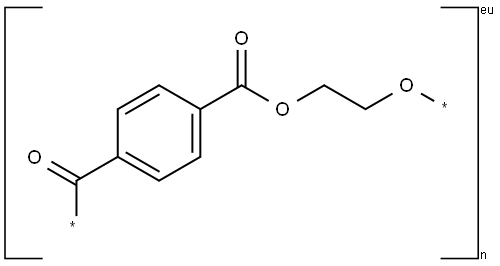
- 25038-59-9
- C10H12O6
- 228.19868
- All (3)
- China (0)
- (3)
Related Products More >

- 80595-68-2
- Request For Quotation
- Bales
- 80595-68-2
- Request For Quotation
- 80595-68-2
- Request For Quotation
- 71675-85-9
- Request For Quotation
- 60-31-1
- Request For Quotation
- 25038-59-9
- Request For Quotation
- 25038-59-9
- Request For Quotation
- 25038-59-9
- Request For Quotation


To make polyester fully waterproof—like for rain jackets or tents—manufacturers often add special coatings or layers, like polyurethane or a DWR (durable water repellent) finish. These extras help stop water from passing through at all, even in heavy rain.
So, while plain polyester fiber is good at resisting water and dries fast, it’s not fully waterproof unless it’s been specially treated. Still, it’s a solid choice when you want something that handles wet weather better than most fabrics.
The practical water resistance of polyester depends on how it is processed. When treated with waterproofing agents like polyurethane coatings or laminated with薄膜 (films), it becomes nearly impermeable. Outdoor jackets often use such treated polyester, keeping rain out while allowing some moisture from the body to escape, a balance critical for comfort during physical activity. Without these treatments, a polyester shirt might dry faster than a cotton one after getting wet but won’t block heavy rain.
This duality explains its use in diverse contexts. A polyester tent without a rainfly relies on the fiber’s natural resistance to keep light drizzle at bay, but adds a coated rainfly for downpours. Similarly, polyester upholstery in outdoor furniture resists morning dew through its intrinsic properties, though manufacturers often enhance this with water-repellent finishes to handle heavier spills or rainstorms, ensuring longevity in exposed settings.
The degree of water resistance depends largely on fabric construction and treatments. Tightly woven polyester used in outdoor jackets or backpacks can repel light rain effectively, while knitted varieties (like athletic wear) may wick moisture away from the skin without forming a true barrier. Many performance textiles enhance polyester’s natural properties with durable water repellent (DWR) coatings—a thin fluoropolymer layer that increases surface tension. For example, budget rain jackets often combine a polyester outer shell with DWR to mimic the waterproofness of higher-end materials like Gore-Tex, though they lack the breathable membranes of premium gear.
Practical applications reveal nuanced trade-offs. Polyester’s water resistance makes it ideal for swimwear linings or marine ropes, where minimal water absorption prevents weight gain and mildew. However, untreated polyester tents in heavy storms may exhibit "water penetration through hydrostatic pressure," demonstrating that fiber properties alone don’t guarantee waterproofing. Manufacturers address this by laminating polyester layers to waterproof films—a technique used in emergency shelters or military gear. The material’s adaptability allows it to straddle roles from everyday umbrellas to specialized medical drapes, where fluid resistance matters more than absolute impermeability.
However, the fiber alone is not the whole story. In practical applications, polyester is spun into yarn and woven or knitted into fabrics. The waterproof qualities of the resulting textile depend significantly on the density of the weave, the thickness of the yarn, and whether any finishing treatments are applied. A tightly woven polyester fabric can slow down water penetration, but it is not impermeable. Water can still pass through the microscopic spaces between the threads, especially under pressure. To achieve full waterproofing, fabrics often undergo additional surface treatments, such as polyurethane coatings or DWR (durable water repellent) finishes, which form a protective barrier that prevents water droplets from soaking in.
In terms of physical behavior, polyester exhibits low moisture regain, generally below 0.5%, which means it stays dry to the touch even when exposed to humid conditions. This makes it highly suitable for outdoor wear, tents, umbrellas, and gear used in wet environments. From a physiological and ergonomic standpoint, its quick-drying nature adds comfort for users, especially in performance apparel and sportswear, where moisture management is critical.
From an industrial perspective, polyester's water-resistant properties have influenced sectors ranging from fashion to packaging. It is widely used in technical textiles, including geotextiles, medical fabrics, and automotive interiors, where exposure to fluids must be controlled. Its stability in water also contributes to its long-term durability, though this hydrophobic quality raises concerns in environmental science, particularly in relation to microplastic pollution and its persistence in aquatic ecosystems.
This nuanced performance of polyester fiber highlights a broader theme in material science—the distinction between fiber-level characteristics and system-level behavior. While polyester fibers resist water by nature, achieving waterproof performance at the fabric or product level requires a multidisciplinary approach that blends chemistry, physics, textile engineering, and environmental design.