


 Home
Home
Ramie isn't as well-known as cotton or wool, but you might see it listed on clothing tags or textile labels. That makes you wonder—what exactly is it made of? Is it something that comes from nature like linen and hemp, or is it processed in a factory like nylon or polyester? And if it's natural, where does it come from, and how is it used in everyday products? Is ramie a natural fiber, and what makes it different from other materials?
Is Ramie a Natural Fiber or a Synthetic Material?
Related Encyclopedia
- 9005-53-2
- unspecified
- 0
- All (8)
- China (7)
- (8)
- 8068-05-1
- C30H25ClN6
- 505.01
- All (0)
- China (0)
- (0)
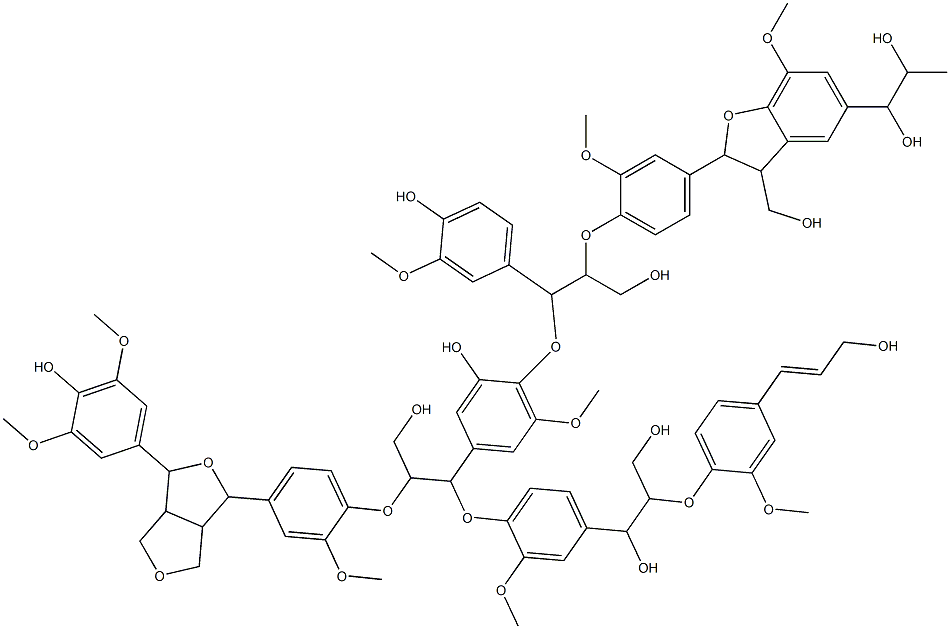
- 8068-03-9
- C81H92O28
- 1513.58038
- All (0)
- China (0)
- (0)
- 42613-30-9
- 0
- All (4)
- China (4)
- (4)

- 9004-64-2
- C3H7O*
- 59.08708
- All (22)
- China (9)
- (22)
- 9004-62-0
- C29H52O21
- 0
- All (59)
- China (31)
- (59)
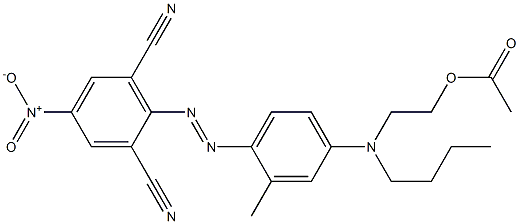
- 9004-57-3
- C23H24N6O4
- 448.47446
- All (21)
- China (2)
- (21)
- 9013-34-7
- C20H23NO5
- 0
- All (4)
- China (4)
- (4)
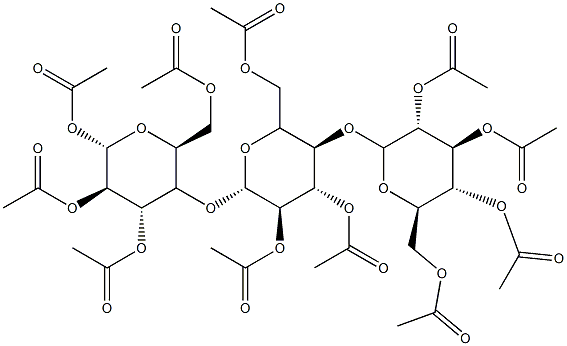
- 9012-09-3
- C40H54O27
- 966.84056
- All (3)
- China (0)
- (3)

- 9004-41-5
- C6H8N2O
- 124.14052
- All (1)
- China (1)
- (1)
Related Products More >

- CNY Request For Quotation
- CNY Request For Quotation
- CNY Request For Quotation
- 9004-62-0
- Request For Quotation
- 9004-62-0
- Request For Quotation
- 9004-65-3
- Request For Quotation
- 9004-65-3
- USD 361.6000
- 25kg
- 9004-57-3
- USD 580.0000
- 25kg


You’ll find ramie used in clothes, home textiles like tablecloths, or sometimes blended with cotton to make fabrics feel smoother and last longer. It’s got a slightly silky texture and doesn’t shrink easily, which makes it handy for things that get washed a lot.
So if you see ramie on a label, it means you're wearing something made from a plant, not plastic. It's one of those older, traditional fibers that's still used today—just not as common as cotton.
The cultivation and production of ramie reveal its unique advantages and challenges. The plant thrives in warm, humid climates and can be harvested multiple times a year, offering a renewable resource. Yet, the extraction process is labor-intensive: the outer bark must be decorticated, and the inner fibers are treated to remove gums and pectins before spinning. Historically, ramie was used in ancient Egyptian mummy wrappings due to its durability, while today it’s often blended with cotton or silk to enhance its flexibility for modern textiles. For example, ramie-cotton blends are favored for summer suiting in East Asia, combining breathability with resistance to wrinkles and bacteria.
In contemporary applications, ramie’s natural properties make it a niche but valuable fiber. Its resistance to mildew and sunlight degradation suits outdoor fabrics, while its absorbency lends itself to towels or handkerchiefs. Unlike synthetic alternatives, ramie decomposes without releasing microplastics, aligning with sustainable fashion trends. Yet its limited global adoption—despite being one of the strongest plant fibers—highlights the tension between natural material potential and industrial scalability. A ramie-blend scarf, for instance, might offer superior coolness and longevity compared to acrylic versions, but its higher cost and crisp hand feel may deter mainstream consumers. The fiber’s future may hinge on innovations in processing that preserve its ecological benefits while addressing its tactile limitations.
The key properties of ramie stem from its natural composition, primarily cellulose, which gives it exceptional strength—even greater than cotton or linen when dry. Its fibers are long and fine, contributing to a smooth, lustrous texture that feels cool against the skin, a trait linked to its low thermal conductivity. This makes ramie ideal for warm-weather clothing, as it wicks moisture efficiently and dries quickly, preventing the clinginess often associated with synthetic fabrics. Additionally, ramie’s natural resistance to mildew and pests arises from compounds in the plant itself, reducing the need for chemical treatments during processing.
In practical use, ramie’s natural traits shine in textiles ranging from lightweight shirts to home linens. For instance, a ramie blouse retains its shape after repeated washes, thanks to the fiber’s durability, while its breathability keeps the wearer comfortable in humid climates. When blended with cotton, it adds strength without sacrificing softness, a common practice in summer dresses. Unlike synthetic fibers that may release microplastics during washing, ramie biodegrades over time, making it a more environmentally compatible choice for those seeking sustainable materials. Its natural origins thus influence not only its performance but also its role in eco-conscious manufacturing.
From a materials science perspective, ramie exhibits low elasticity and high rigidity due to its dense fibrillar structure. It is naturally resistant to mold, mildew, and insect attacks, which makes it favorable for certain industrial applications. However, its stiffness and brittleness limit its use in garments that require flexibility unless blended with other fibers. Ramie also possesses a natural shine and retains its shape well, making it an attractive option for home furnishings, summer clothing, and specialty textiles where dimensional stability is desirable.
Physiologically, because it is a plant-based fiber, ramie is biodegradable and hypoallergenic. These properties make it relevant in the development of sustainable textiles and in niche medical contexts, such as wound dressings or composite materials where biocompatibility and decomposition are important. Ramie’s rapid water absorption and fast drying capabilities further enhance its value in humid climates or performance apparel, although it tends to wrinkle more easily than synthetic alternatives.
In an industrial setting, processing ramie is labor-intensive. The fiber must undergo decortication, degumming, and repeated mechanical and chemical treatments to separate the usable fibers from the woody stem and gummy substances. This complexity has limited its widespread adoption compared to cotton or synthetics. Yet, in the context of ecological and circular economies, ramie is gaining renewed interest due to its minimal need for chemical fertilizers and pesticides and its potential role in low-impact textile production.
Ramie’s story intersects with agriculture, chemistry, environmental policy, and fashion technology. It serves as a case study in how ancient fibers can be re-evaluated through the lens of modern sustainability concerns and material innovation. Understanding ramie not only broadens our knowledge of fiber taxonomy but also invites deeper questions about how natural resources are integrated into evolving production systems.