


 Home
Home
We use rubber in so many everyday things—from shoes to wires. But have you ever stopped to wonder why rubber is often used to cover electrical wires? Does that mean it doesn’t let electricity pass through? Or can rubber actually conduct electricity under certain conditions? What makes rubber different from materials like metal? Is all rubber the same when it comes to electricity, or do some types behave differently?
Can Rubber Conduct Electricity or Is It an Insulator?
Related Encyclopedia

- 1333-86-4
- C
- 12.01
- All (301)
- China (31)
- (301)

- 63148-62-9
- C6H18OSi2
- 162.38
- All (49)
- China (38)
- (49)

- 63148-67-4
- C23H29NO3
- 367.48126
- All (0)
- China (0)
- (0)

- 9006-04-6
- C5H8
- 68.11702
- All (0)
- China (0)
- (0)
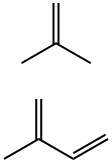
- 9010-85-9
- C9H16
- 124.23
- All (2)
- China (0)
- (2)
- 0
- All (0)
- China (0)
- (0)
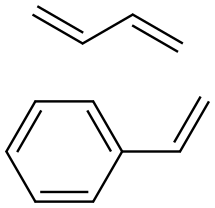
- 9003-55-8
- (C8H8.C4H6)x
- 158.24
- All (5)
- China (1)
- (5)
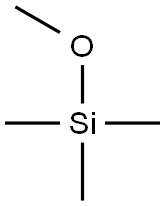
- 63148-58-3
- C4H12OSi
- 104.22298
- All (0)
- China (0)
- (0)
Related Products More >

- CNY Request For Quotation
- CNY Request For Quotation
- CNY Request For Quotation
- CNY Request For Quotation
- CNY Request For Quotation
- CNY Request For Quotation
- CNY Request For Quotation
- CNY Request For Quotation


But not all rubber is exactly the same. Pure rubber by itself is a really good insulator. However, if certain chemicals or materials—like carbon black—are mixed into it, that can change. Some of those mixtures can make rubber conduct a little electricity, but it’s still nowhere near as conductive as metal.
So, in simple terms, regular rubber won’t let electricity pass through, which is why it's used for safety. But if it's specially treated or mixed with other stuff, it might conduct a bit—but that's more for specific industrial uses, not everyday life. Pretty interesting, right?
The intrinsic insulating quality of pure rubber makes it ideal for electrical safety gear, such as gloves or cable coatings, where preventing accidental shocks is critical. Yet, the interplay between material composition and external factors like temperature or mechanical stress can influence conductivity. Silicone rubber, for example, may exhibit slight conductivity when doped with certain metals, expanding its use in flexible electronics or sensors. Real-world applications highlight this duality: while natural rubber insulates high-voltage power lines, conductive rubber variants enable touch-sensitive buttons in remote controls.
Understanding rubber’s electrical behavior requires examining both its base properties and engineered modifications. The distinction between insulating and conductive forms hinges on deliberate material design, showcasing how a single substance can serve opposing functions. This adaptability ensures rubber’s relevance across industries, from mundane household items to specialized industrial solutions. Its versatility underscores the importance of tailoring material properties to meet specific technological demands.
In practical terms, this insulating property makes rubber indispensable in countless electrical applications. For instance, power cables are often encased in rubber sheaths to prevent current leakage and protect users from electric shock; the flexibility of rubber also allows these cables to bend without compromising their insulating capacity. Similarly, rubber gloves worn by electricians create a barrier between their hands and live wires, leveraging the material’s ability to resist the passage of electrons even when in direct contact with conductive surfaces.
Under certain conditions, however, rubber can exhibit limited conductivity. If exposed to high voltages for extended periods, the material may undergo dielectric breakdown, where the electric field overcomes the insulating properties, allowing current to flow. Additionally, adding conductive fillers like carbon black to rubber composites can alter its properties, creating semi-conductive materials used in applications such as electrostatic discharge protection. These variations highlight the versatility of rubber, balancing its inherent insulating nature with adaptability to specific needs.
From a physical and chemical standpoint, the key lies in the electron configuration and bonding within rubber’s polymeric matrix. In contrast to metals, where electrons are delocalized and can flow freely, rubber’s electrons are tightly bound within covalent bonds. Additionally, rubber lacks ionic components that could facilitate conduction in the presence of moisture or other variables. Thermally, rubber can degrade or carbonize at high temperatures, and in rare cases this might create conductive paths—but that’s the exception, not the rule.
However, rubber’s behavior can be engineered. When conductive fillers like carbon black, graphite, or metal particles are incorporated into the rubber matrix, it transforms into a composite material capable of conducting electricity to varying degrees. These modified rubbers are widely used in antistatic flooring, electromagnetic shielding, or sensor applications. The amount and distribution of the conductive fillers, as well as the rubber’s elasticity and thickness, determine its conductivity. This highlights how interdisciplinary approaches—blending materials science, physics, and engineering—are essential to tailoring rubber's properties for specific uses.
In real-world applications, the insulating nature of rubber is critical in protecting human life and sensitive equipment. It’s used to sheath power cables, line laboratory gloves, and construct surgical tools where both electrical safety and flexibility are needed. In advanced medicine, conductive rubbers are now being explored in wearable biosensors and flexible electronics, opening new possibilities in patient monitoring and diagnostics.
Overall, rubber's ability—or inability—to conduct electricity is not a simple yes-or-no matter. It depends on its composition, treatment, and intended use. This adaptability is what makes rubber such a valuable material across disciplines, linking chemistry, physics, and practical innovation in profound ways.