


 Home
Home
If you're placing rubber flooring over hardwood, how do you know what thickness is enough to protect the wood? Some people use mats in home gyms, playrooms, or garages, but is a thin layer really enough to prevent dents or scratches? What about heavy equipment or frequent movement? Does the type of rubber or the density matter too, or is it just about how thick it is? How thick does rubber flooring really need to be to keep your hardwood floor safe?
How Thick Should Rubber Flooring Be to Prevent Damage to Hardwood Underneath?
Related Encyclopedia
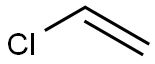
- 9002-86-2
- C2H3Cl
- 62.49822
- All (75)
- China (10)
- (75)
Related Products More >

- 9002-86-2
- CNY Request For Quotation
- 9002-86-2
- CNY 10.0000
- 25kg
- 9002-86-2
- Request For Quotation
- 220kg
- 9002-86-2
- Request For Quotation
- 1ton
- 9002-86-2
- Request For Quotation
- 25kg
- 9002-86-2
- Request For Quotation
- 1ton
- 9002-86-2
- Request For Quotation
- 1ton
- 9002-86-2
- Request For Quotation
- 1kg


Thicker rubber acts like a shock absorber—it spreads out the weight and impact, so your wood floor underneath doesn’t get scratched, dented, or cracked. You don’t have to overthink the chemical makeup, but solid rubber (like EPDM or PVC blends) is common and safe for indoor use.
Also, make sure the rubber mat doesn’t trap moisture, because over time, that could mess up your wood. Look for options with a non-slip bottom and maybe even ventilation if it’s for long-term use. So yeah, think 1/4 inch as a starting point, and thicker if you need more protection.
Rubber flooring's protective properties stem from its elasticity and compression resistance. High-density rubber offers better load distribution, while low-density variants provide more cushioning. For example, a home gym with dumbbells might use 1/2-inch thick rubber tiles to prevent indentations, whereas a yoga studio could opt for thinner, softer mats. The rubber's durometer (hardness rating) also matters—a 60-70 Shore A rating balances durability and cushioning.
In practice, the subfloor condition matters too. Hardwood floors with existing wear may need thicker protection. Anecdotal evidence suggests that interlocking rubber tiles work well because they combine thickness with seamless coverage, preventing point loads. For instance, a dance studio with hardwood floors might use 8mm thick rubber rolls to avoid scratches from foot traffic. Ultimately, the right thickness balances protection with practicality, ensuring the hardwood remains undamaged without compromising usability.
For most residential settings, ¼ inch (6mm) to ½ inch (12mm) is effective. A ¼-inch layer works well in low-traffic areas like bedrooms, where light furniture and occasional movement are common. It softens minor impacts, such as dropping a book, without adding excessive bulk. In high-traffic spaces like living rooms or home gyms, ½-inch rubber provides better shock absorption for heavier furniture, exercise equipment, or frequent foot traffic, reducing the risk of indentations from sofa legs or dumbbells.
The key mechanism is energy dissipation: rubber compresses under force, spreading the impact over a larger area instead of concentrating it on the hardwood. For example, a ½-inch rubber mat under a treadmill prevents the machine’s vibrations from loosening floorboards or creating grooves, while a ¼-inch pad under a dining table cushions chair movements, stopping scratches from metal legs. Proper thickness also minimizes moisture buildup by allowing some air circulation, which is critical for hardwood’s longevity. Matching the rubber’s thickness to the space’s usage ensures both protection and functionality.
From a physics standpoint, when a load—such as gym equipment or repeated foot traffic—is applied to rubber flooring, the energy is partially absorbed and dispersed across a broader area. Thicker rubber increases the depth of this energy dispersion, reducing the peak force transmitted to the subfloor. For example, a 1/4-inch layer may suffice for light residential use, but in environments with heavy or dynamic loads, such as commercial gyms, 3/8 to 1/2 inch is recommended. This threshold ensures the reduction of pressure below the yield strength of typical hardwoods like oak or maple, preventing denting or warping.
Chemically, the composition of the rubber also matters. Vulcanized rubber, often enhanced with sulfur cross-linking, offers improved durability and resistance to deformation over time. PVC-based blends may be less resilient under heavy loads but are often cheaper and water-resistant. These distinctions are important when rubber is used in humid environments or where exposure to chemicals is possible, such as in laboratories or healthcare settings.
In real-world applications, the implications go far beyond simple floor protection. In industrial design, rubber flooring is engineered not only for mechanical cushioning but also for acoustic insulation and thermal comfort. In hospitals or rehabilitation centers, the material’s ability to reduce joint impact for walking patients is clinically significant. In educational settings, it aids in noise reduction and enhances safety for young children. Thus, its protective function becomes part of a broader ergonomic and environmental strategy.
Overall, understanding the optimal thickness of rubber flooring is not just a matter of aesthetics or basic protection—it’s a balance of physics, chemistry, and design. Its correct implementation can extend the lifespan of hardwood, improve user comfort, and contribute to safety in both domestic and commercial environments.