


 Home
Home
We often see rubber used in tires, shoes, and household items, but have you ever wondered what happens to it under high heat? Does it melt like plastic or wax? Since rubber comes in different types—natural and synthetic—do they melt at the same temperature? And what role does vulcanization play in this process? How high does the temperature need to be before rubber starts breaking down or losing its shape? What temperature does rubber actually melt?
What Temperature Does Rubber Melt At?
Related Encyclopedia
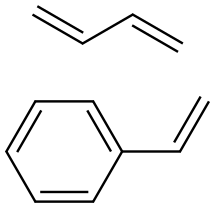
- 9003-55-8
- (C8H8.C4H6)x
- 158.24
- All (5)
- China (1)
- (5)
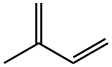
- 9003-31-0
- C5H8
- 68.12
- All (1)
- China (0)
- (1)
- 63148-67-4
- C23H29NO3
- 367.48126
- All (0)
- China (0)
- (0)
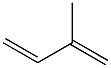
- 9006-04-6
- C5H8
- 68.11702
- All (0)
- China (0)
- (0)
- 9010-85-9
- C9H16
- 124.23
- All (2)
- China (0)
- (2)
- 65399-21-5
- C10H10O2S
- 194.25000
- All (0)
- China (0)
- (0)
- 25038-32-8
- C13H16
- 172.26614
- All (0)
- China (0)
- (0)
Related Products More >

- CNY Request For Quotation
- CNY Request For Quotation
- CNY Request For Quotation
- CNY Request For Quotation
- CNY Request For Quotation
- CNY Request For Quotation
- CNY Request For Quotation
- CNY Request For Quotation


Typically, rubber starts getting soft around 180°C (about 356°F), but if you keep heating it, it will eventually decompose or catch fire, usually above 200°C to 300°C (392°F to 572°F). So, you won’t see it “melting” into a puddle like plastic. That’s why rubber is used in hot environments like car engines or machinery—it can take the heat, to a point.
So, in short, rubber doesn’t melt in the usual sense—it just gets weaker or burns if it gets too hot.
A critical factor is the glass transition temperature (Tg), below which rubber becomes brittle. For natural rubber, Tg hovers around -70°C, explaining its flexibility in cold environments. Beyond melting, pyrolysis occurs, breaking polymer bonds and releasing hydrocarbons. This principle is exploited in tire recycling, where vulcanized rubber is heated to reclaim reusable materials. For instance, industrial shredders process melted rubber into asphalt modifiers, improving road durability.
Practical applications demand precise temperature control. In injection molding, synthetic rubber is heated just above its melting point to fill molds without oxidative damage. Overheating causes sulfur bonds in vulcanized rubber to break, weakening tensile strength. Conversely, underheating leads to incomplete molding. Everyday items like gaskets or shoe soles rely on this balance—their integrity depends on the rubber’s thermal history during manufacture. Understanding these thresholds ensures performance in extremes, from engine seals to medical tubing sterilized via autoclaving.
The key distinction lies in cross-linking: thermoset rubbers, such as those in tires, have permanent cross-links that prevent melting, making them heat-resistant but irreparable once damaged. Thermoplastic elastomers (TPEs), by contrast, lack permanent cross-links and can melt at lower temperatures—some TPEs soften around 150°C and flow like liquids at 200°C, allowing them to be molded and reused. This property makes TPEs ideal for products like phone cases, which need flexibility and easy manufacturing.
In practical terms, understanding these temperature thresholds is critical for applications like automotive hoses, which use heat-resistant rubbers to withstand engine temperatures up to 150°C, and kitchen utensils with rubber grips, where TPEs ensure safety by avoiding melting during hot use. By selecting the right rubber type based on its thermal behavior, engineers and manufacturers can ensure durability and functionality across diverse environments.
The physical behavior of rubber under heat is dictated by its polymeric chains. In natural rubber (primarily polyisoprene) or synthetic variants like styrene-butadiene rubber (SBR), heat increases molecular mobility. Below the glass transition temperature, rubber remains hard and brittle. As temperature climbs past this point, the material becomes soft and elastic. For vulcanized rubber, which contains sulfur-induced cross-links, the material resists flow even at high temperatures. At approximately 200–300°C (392–572°F), rubber undergoes thermal degradation—breaking down into smaller hydrocarbons, releasing gases, and potentially igniting. There is no liquid phase in the traditional sense.
This behavior is critically important across multiple disciplines. In automotive and aerospace industries, for instance, engineers must account for the thermal limits of rubber components used in seals, tires, and hoses. In medicine, synthetic elastomers used in devices like gloves or tubing must withstand sterilization temperatures without degrading. Even in consumer electronics, where rubber insulates wires or seals casings, thermal stability ensures durability and safety.
From a chemical perspective, understanding rubber’s thermal behavior connects to polymer chemistry, thermodynamics, and materials science. In a broader context, it influences product design, environmental safety (since burning rubber can release toxic compounds), and recycling strategies, as rubber's resistance to melting complicates reprocessing.
In essence, the question of rubber’s melting point opens up a complex interplay between chemistry, physics, and engineering. It's not just a matter of temperature—it reflects how we engineer materials to serve specific functions, endure stress, and remain safe in diverse environments.