


 Home
Home
Many people talk about the benefits of almond oil for skincare, but what exactly does it do when applied to your face? Is it suitable for all skin types, and can it help with issues like dryness, dullness, or even acne? With so many natural oils out there, how does almond oil compare, and what makes it special? Can it really improve your skin’s appearance and health, or is it just another trendy ingredient with a good reputation?
What Does Almond Oil Do to Your Face?
Related Encyclopedia

- 8013-76-1
- C7H6O
- 106.12194
- All (4)
- China (0)
- (4)
- 8007-69-0
- 0
- All (4)
- China (4)
- (4)

- 112-80-1
- C18H34O2
- 282.46
- All (141)
- China (22)
- (141)
- 141903-93-7
- C17H35N
- 253.46600
- All (141)
- China (22)
- (141)
- 67629-40-7
- C30H49ClO3
- 493.16100
- All (38)
- China (12)
- (38)

- 59-02-9
- C29H50O2
- 430.71
- All (38)
- China (12)
- (38)

- 79434-83-6
- C29H50O2
- 430.70600
- All (38)
- China (12)
- (38)

- 2074-53-5
- C29H50O2
- 430.71
- All (38)
- China (12)
- (38)
- 142386-74-1
- C38H67N2O3P
- 630.92400
- All (38)
- China (12)
- (38)
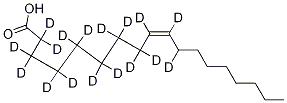
- 223487-44-3
- C18H17D17O2
- 300
- All (0)
- China (0)
- (0)
Related Products More >

- CNY Request For Quotation
- CNY Request For Quotation
- CNY Request For Quotation
- 2074-53-5
- CNY 30.0000
- 25kg
- 60-33-3
- USD 30.0000
- 25kg
- 30999-06-5
- Request For Quotation
- 50kg
- 30999-06-5
- Request For Quotation
- 1kg
- 96702-03-3
- Request For Quotation


Because it's rich in vitamin E and healthy fats, almond oil can also give your skin a nice, natural glow. It’s not heavy or greasy like some other oils, so it won’t clog your pores if used in small amounts. A lot of people like using it as a night moisturizer or even to remove makeup.
Of course, everyone’s skin is different, so it's always smart to do a patch test first. But overall, almond oil is a pretty easy and natural way to care for your face without needing a bunch of fancy products.
Vitamin E, a potent antioxidant in almond oil, neutralizes free radicals that break down collagen, the protein responsible for skin elasticity; over time, this helps reduce the appearance of fine lines that form as collagen levels decline. Meanwhile, vitamin A promotes cell turnover, encouraging the shedding of dead skin cells to reveal a smoother, brighter complexion—this is why those with dull or uneven skin often notice a more radiant look after consistent use.
For individuals with sensitive skin, almond oil’s anti-inflammatory properties can soothe redness or irritation, whether from dryness or mild reactions to skincare products. It also acts as a gentle makeup remover, dissolving even waterproof formulas without stripping the skin of its natural oils, making it a versatile addition to both morning and evening routines. Whether applied directly as a moisturizer or mixed into serums, its ability to balance nourishment and absorption ensures it adapts to various skin types, from dry to combination, delivering visible benefits with regular application.
Its low comedogenicity allows it to be absorbed without heavily clogging pores, making it suitable for various skin types. The fatty acids in almond oil help restructure the lipid matrix of the skin, which is critical in maintaining hydration and preventing environmental stressors from penetrating. Inflammatory skin conditions like eczema and dermatitis can be alleviated due to the oil’s ability to modulate cytokine activity at a cellular level, thereby reducing inflammation. The presence of vitamin E further supports protection against oxidative stress caused by UV radiation or pollution, aiding in the reduction of photoaging markers like fine lines and uneven pigmentation.
From a biochemical perspective, the unsaturated fats in almond oil assist in maintaining membrane fluidity and cell signaling in keratinocytes. It also plays a role in percutaneous absorption of certain drugs or nutrients when used as a carrier, a property exploited in transdermal delivery systems. In industrial applications, its stability and mildness have led to its inclusion in a wide range of skincare formulations including lotions, serums, and cleansers.
On a broader scale, the use of almond oil bridges domains such as dermatology, cosmetic chemistry, and even ethnobotany, where it has a long history in traditional medicine systems. The oil’s multifunctionality underscores the intersection of natural product chemistry with human physiology. Understanding its properties not only enhances cosmetic utility but also opens discussion on sustainable sourcing and bioavailability in therapeutic contexts.
The mechanism behind almond oil’s effectiveness lies in its ability to reinforce the skin barrier. Oleic acid helps retain moisture by reducing transepidermal water loss, while linoleic acid supports ceramide production, crucial for maintaining skin elasticity. Vitamin E neutralizes free radicals generated by UV exposure or pollution, slowing oxidative stress that leads to premature aging. For instance, individuals with dry or flaky skin often find almond oil improves hydration levels within days, as it mimics the skin’s natural lipids.
In practice, almond oil’s anti-inflammatory effects can soothe conditions like eczema or rosacea. Anecdotal evidence suggests gentle massage with almond oil reduces redness and irritation due to its polyphenol content. Additionally, its mild exfoliating properties, when combined with mild abrasives like sugar, help remove dead skin cells without stripping natural oils. Some users also note diminished dark circles when applied sparingly under the eyes, likely due to improved circulation and vitamin K content. However, those with nut allergies should patch-test before use, as residual proteins may trigger reactions. Its versatility—from a makeup remover to an overnight serum—makes it a staple in holistic skincare routines.