


 Home
Home
Hi, I'd like to ask— is bleach a base or an acid? What's the role of sodium hypochlorite in determining bleach's pH? Why does bleach feel slippery if it's a base? How does its acid-base property affect its disinfecting capabilities? Can bleach react with acidic substances, and what safety risks does that pose? Thanks!
Is Bleach (Sodium Hypochlorite) a Base or an Acid—And Why?
Related Encyclopedia
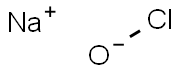
- 7681-52-9
- ClNaO
- 74.44
- All (22)
- China (20)
- (22)
- 64131-03-9
- ClH14NaO8
- 200.54900
- All (0)
- China (0)
- (0)
- 10022-70-5
- NaClO.5H2O
- 165.53
- All (0)
- China (0)
- (0)
Related Products More >

- 7681-52-9
- CNY 450.0000
- 1ton
- 7681-52-9
- CNY 650.0000
- 1ton
- 7778-54-3
- USD 50.0000
- 45kg
- 7778-54-3
- Request For Quotation
- 7681-52-9
- Request For Quotation
- 100g;1kg;25g
- 7681-52-9
- Request For Quotation
- 25kg/drum
- 7681-52-9
- Request For Quotation
- 25KG/Bag
- 7681-52-9
- Request For Quotation
- 1kg/bag,25kg/drum,25kg/bag


The slippery texture of bleach arises from its basic properties. Alkalis like bleach react with oils on the skin through a process called saponification, forming soapy compounds that create the smooth, slick feel. This is similar to how soap (a base) interacts with fats, which is why handling bleach often leaves a soapy residue on hands.
Bleach’s disinfecting capabilities are tied to its acid-base chemistry. While bleach is alkaline, its antimicrobial action relies on hypochlorous acid (HClO), a powerful oxidant. When ClO– encounters trace acids or when the pH drops, HClO forms. Lowering the pH enhances HClO production, boosting disinfecting efficiency, but excessive acidity causes bleach to decompose rapidly, reducing its potency.
Mixing bleach with acidic substances—such as vinegar, toilet bowl cleaners, or citrus-based products—poses severe risks. The acid neutralizes OH– ions, prompting ClO– to react with chloride ions (present in bleach) to form toxic chlorine gas (Cl2). Inhalation of chlorine gas irritates the respiratory tract, causes coughing and breathing difficulties, and can lead to permanent lung damage.
The role of sodium hypochlorite in determining bleach's pH is fundamental. The hypochlorite ion's interaction with water molecules generates hydroxide ions through a process called hydrolysis. This reaction increases the concentration of OH⁻ ions in the solution, directly raising the pH. The high alkalinity of bleach not only contributes to its cleaning power but also enhances its disinfecting capabilities by denaturing proteins and disrupting cell membranes of microorganisms.
The slippery sensation experienced when handling bleach is a direct result of its basic nature. When bleach comes into contact with the oils on human skin, it initiates a saponification reaction, converting these oils into soap-like substances. Simultaneously, the hydroxide ions penetrate the skin's protective acidic barrier, breaking down proteins and causing irritation. This combination of chemical reactions creates the characteristic slippery feeling and explains why prolonged exposure can lead to severe skin damage.
Bleach's basic property significantly enhances its disinfecting effectiveness. The hypochlorite ion functions as a potent oxidizing agent under alkaline conditions, breaking down the cell walls and internal structures of bacteria, viruses, and fungi. The high pH environment further denatures essential proteins and enzymes in pathogens, ensuring their inactivation. This dual mechanism makes bleach particularly effective against a wide range of microorganisms, which is why it's widely used for disinfection in households and healthcare settings.
Mixing bleach with acidic substances poses serious safety risks due to the potential formation of chlorine gas (Cl₂). When hypochlorite ions encounter hydrogen ions from acids, they react violently to produce chlorine gas, a toxic substance that can cause respiratory distress and other health complications. This reaction can occur when bleach is combined with common acidic products like vinegar, toilet bowl cleaners, or even some types of cleaning acids. The release of chlorine gas not only endangers human health but can also lead to environmental contamination and material corrosion.
Understanding these chemical properties highlights why proper handling and storage of bleach are crucial. Its strong basic nature requires careful use, particularly when considering potential reactions with other household chemicals. The risks associated with improper mixing underscore the importance of following safety guidelines to prevent accidental exposure to toxic byproducts.
Sodium hypochlorite plays a central and decisive role in determining the pH of bleach. As a salt formed from the reaction of a strong base, sodium hydroxide (NaOH), and a weak acid, hypochlorous acid (HClO), sodium hypochlorite behaves in a predictable way in an aqueous environment. According to the principles of chemical reactions involving salts, when a salt is derived from a strong base and a weak acid, it tends to hydrolyze in water and form a basic solution. The hypochlorite ion, being the conjugate base of hypochlorous acid, reacts with water molecules. The chemical equation for this reaction is ClO⁻ + H₂O ⇌ HClO + OH⁻. Through this reaction, more OH⁻ ions are generated, which directly influences the pH of the solution. The greater the concentration of sodium hypochlorite in the bleach, the more OH⁻ ions are produced, resulting in a higher pH and a more strongly basic solution.
The slippery sensation that bleach gives when it comes into contact with the skin is a typical property associated with bases. Bases, including bleach, can react with the fats and oils present on the skin. Skin has a natural layer of oils that act as a protective barrier, and these oils are composed of esters. When bleach touches the skin, it initiates a chemical reaction known as saponification. In saponification, the base in the bleach (due to the presence of OH⁻ ions) reacts with the esters in the oils. This reaction breaks down the esters into glycerol and fatty acid salts. These fatty acid salts have a soapy texture, which is why bleach feels slippery when rubbed between the fingers. However, this saponification reaction also means that bases like bleach can be corrosive to the skin over time, as they gradually break down the skin's protective lipid layer.
The acid-base properties of bleach have a profound impact on its disinfecting capabilities. The main active disinfecting agent in bleach is hypochlorous acid (HClO). In the alkaline environment of bleach, most of the chlorine exists in the form of the hypochlorite ion (ClO⁻). But when the pH of the bleach solution decreases (becomes more acidic), the ClO⁻ ions react with H⁺ ions present in the solution to form HClO. Hypochlorous acid is a more potent disinfectant compared to the hypochlorite ion. This is because HClO is a neutral molecule, which allows it to more easily penetrate the cell membranes of microorganisms such as bacteria and viruses. Once inside the cells, HClO can disrupt the normal functioning of enzymes and other vital cellular structures, effectively killing the microorganisms. For example, at a pH around 6 - 7, bleach is more effective at eliminating germs because a higher proportion of HClO is present. However, if the pH drops too low, the bleach can start to decompose, releasing toxic chlorine gas. This is why commercial bleach is formulated to be alkaline - to strike a balance between maximizing its disinfecting power and ensuring safety.