


 Home
Home
Have you ever wondered how everyday items like plastic bottles, rubber bands, or even your clothes are made? These objects often have something in common: they’re made of polymers. But what exactly is a polymer in chemistry? How are they formed, and why are they so important in our lives? Are they all man-made, or do they also occur in nature? And is there a difference between polymers like plastic and those in natural products like DNA or silk?
What Is a Polymer in Chemistry and Why Does It Matter?
Related Encyclopedia
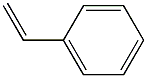
- 25086-18-4
- C8H8
- 104.14912
- All (33)
- China (14)
- (33)
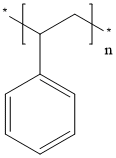
- 9003-53-6
- [CH2CH(C6H5)]n
- 2.01588
- All (33)
- China (14)
- (33)
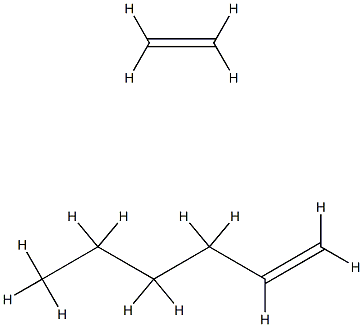
- 25213-02-9
- C8H16
- 112.21264
- All (24)
- China (2)
- (24)
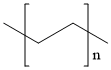
- 9002-88-4
- (C2H4)n
- 28.05316
- All (24)
- China (2)
- (24)
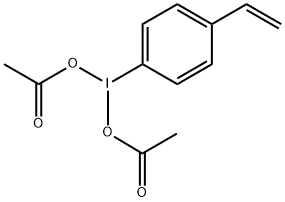
- 36290-94-5
- C12H13IO4
- 348.14
- All (0)
- China (0)
- (0)
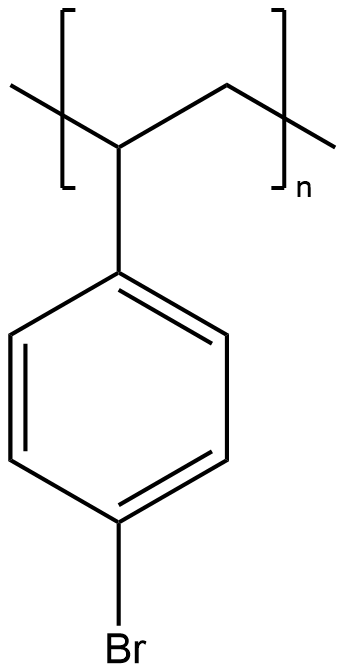
- 88497-56-7
- (C10H13Br)n
- 213.11422
- All (24)
- China (8)
- (24)
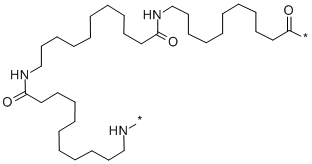
- 25035-04-5
- C33H63N3O3X2
- 549.87
- All (0)
- China (0)
- (0)
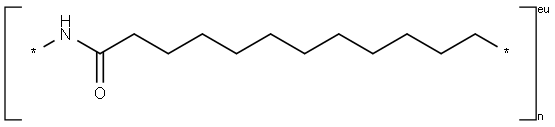
- 24937-16-4
- (C12H23NO)n
- 591.95
- All (0)
- China (0)
- (0)

- 25038-54-4
- C18H33N3O3X2
- 339.47
- All (15)
- China (3)
- (15)
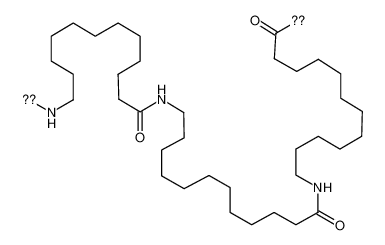
- 25038-74-8
- C36H69N3O3X2
- 591.95100
- All (0)
- China (0)
- (0)
Related Products More >

- 63231-66-3
- CNY Request For Quotation
- 9003-55-8
- CNY Request For Quotation
- 9002-88-4
- Request For Quotation
- 25322-68-3
- Request For Quotation


You see polymers every day, even if you don’t realize it. Plastic bags, water bottles, rubber tires, clothes made from polyester, and even chewing gum—all of these are made from different kinds of polymers. Some are man-made, like nylon or polystyrene, while others are natural, like the proteins in your body or the cellulose in plants.
What makes polymers special is how useful and versatile they are. They can be soft, stretchy, hard, or even heat-resistant. That’s why they’re used in everything from packaging to medicine to electronics.
So next time you open a soda bottle or put on a raincoat, you’re actually using some pretty cool chemistry—without even thinking about it!
Polymers exhibit unique attributes such as high molecular weight and tunable properties, making them indispensable in modern materials science. Their behavior under stress, temperature, or chemical exposure depends on factors like chain length and intermolecular forces. Take polyvinyl chloride (PVC) as an example: its rigidity can be adjusted with plasticizers, enabling uses in plumbing pipes or flexible vinyl records. Natural polymers like cellulose and proteins also play critical roles in biological systems, illustrating how structure-function relationships govern their performance. Synthetic polymers, such as nylon and polyester, further demonstrate how tailored designs meet specific needs, from textiles to medical devices.
The practical significance of polymers stems from their versatility and adaptability. Rubber, a natural polymer, gains enhanced durability through vulcanization—a process introducing cross-links between chains. Similarly, superabsorbent polymers in diapers leverage their ability to retain water, showcasing how molecular design addresses real-world challenges. From insulating materials to biodegradable plastics, polymers bridge the gap between laboratory innovation and everyday applications, underscoring their centrality in both industrial and environmental contexts. Understanding their underlying mechanisms allows scientists to engineer materials with precision, meeting evolving technological and sustainability demands.
The properties of polymers stem from their molecular structure and interactions. Molecular weight plays a critical role: higher molecular weight often leads to greater tensile strength and melting points, as longer chains entangle more, resisting deformation. Additionally, the nature of monomers affects characteristics—polystyrene, made from styrene monomers, is rigid and transparent, making it useful for disposable cups, while polypropylene, derived from propylene, combines flexibility and heat resistance, suitable for food containers and automotive parts.
Understanding polymer behavior involves examining how monomers interact and how chain structure responds to external factors like temperature and stress. For example, thermoplastic polymers soften when heated and harden when cooled, allowing repeated shaping, which is why polyethylene can be molded into bottles or films. In contrast, thermosetting polymers, once formed, cannot be reshaped due to permanent cross-links, making them ideal for durable products like epoxy resins in adhesives and coatings. This versatility ensures polymers are integral to industries ranging from packaging to medicine, where biodegradable polymers are used in sutures that dissolve over time.
Polymers exhibit a wide range of behaviors due to their macromolecular structure. Physically, they can transition between rubbery, glassy, or viscous states depending on temperature and composition—a concept described by the glass transition temperature. They can also exhibit elasticity, plasticity, and viscoelasticity, making them suitable for various mechanical functions. On a molecular level, intermolecular forces such as hydrogen bonding, van der Waals interactions, and dipole-dipole attractions contribute to their strength and stability, while their entropic flexibility underlies many of their unique responses to stress, strain, and temperature.
From an interdisciplinary standpoint, polymers bridge multiple scientific fields. In biology, they form the backbone of life—DNA stores genetic information, proteins carry out cellular functions, and polysaccharides provide structural support. In materials science, they are foundational in developing lightweight composites, biodegradable plastics, and flexible electronics. In medicine, polymers are used in drug delivery systems, prosthetics, sutures, and even artificial organs due to their biocompatibility and tunable properties.
Polymers are deeply woven into the fabric of modern life. Their adaptability allows engineers and scientists to design materials tailored to specific needs—whether it’s creating membranes for water purification, scaffolds for tissue engineering, or packaging that prolongs shelf life. The environmental implications of polymers, particularly plastics, are also prompting innovation in sustainable alternatives and recycling methods. Thus, polymers are not just chemical structures—they are key enablers of technological progress and essential to addressing global challenges.