


 Home
Home
I'm studying chemistry, and I'm really confused about the bonding in sodium carbonate. I know it's an important compound, but I'm not sure what types of bonds it has. I've heard that ionic bonds are common in compounds with metals, and since sodium is a metal, does that mean there are definitely ionic bonds in sodium carbonate? But what about the carbonate part? Are there other types of bonds, like covalent bonds, within the carbonate ion? How do these different bonds work together to hold the sodium carbonate structure together? I'm worried I'll misunderstand and mess up my understanding of chemical bonding. I'd really appreciate it if someone could clear this up for me!
What types of bonds are present in sodium carbonate?
Related Encyclopedia

- 398507-55-6
- C47H62N12O11S2
- 1035.2
- All (0)
- China (0)
- (0)
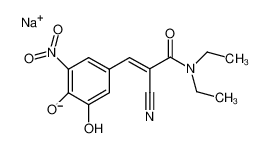
- 1047659-02-8
- C14H14N3NaO5
- 327.26800
- All (0)
- China (0)
- (0)
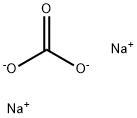
- 497-19-8
- CH2O3.2Na
- 105.99
- All (113)
- China (64)
- (113)
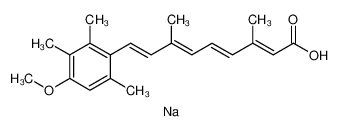
- 925701-88-8
- C21H26NaO3
- 349.41900
- All (0)
- China (0)
- (0)
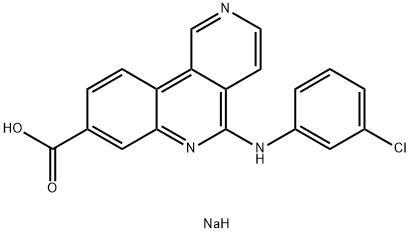
- 1309357-15-0
- C19H13ClN3NaO2
- 373.77
- All (0)
- China (0)
- (0)
- 92598-79-3
- C11H17N2NaO3
- 248.25405
- All (0)
- China (0)
- (0)
- 54422-92-3
- C4H7NaO3
- 126.08600
- All (0)
- China (0)
- (0)
- 18802-49-8
- C4H5NaO3
- 124.07000
- All (0)
- China (0)
- (0)
- 86041-66-9
- C13H10NaO3Sb
- 358.96600
- All (0)
- China (0)
- (0)
- 6482-39-9
- C2H3NaO3
- 98.03320
- All (0)
- China (0)
- (0)
Related Products More >

- 7757-82-6
- CNY Request For Quotation
- 10124-56-8
- CNY Request For Quotation
- 7758-19-2
- CNY Request For Quotation
- 2893-78-9
- CNY Request For Quotation
- 55310-46-8
- CNY Request For Quotation
- 136-30-1 DibutylCarbamodithioic acid sodium salt
- CNY Request For Quotation
- CNY Request For Quotation
- CNY Request For Quotation


You're totally right about the ionic bonds! Sodium is a metal, and it has a strong tendency to lose electrons. Carbonate, on the other hand, is a polyatomic ion made up of carbon and oxygen atoms. When sodium and carbonate come together, sodium donates its outermost electron to the carbonate ion. This creates a sodium cation (Na⁺) with a positive charge and a carbonate anion (CO₃²⁻) with a negative charge. Opposite charges attract, and that's how the ionic bond between sodium and the carbonate ion forms. These ionic bonds are what hold the sodium and carbonate units together in the crystal lattice of sodium carbonate. They're like the "glue" that keeps the whole compound from falling apart.
Now, let's talk about what's going on inside the carbonate ion itself. The carbonate ion (CO₃²⁻) has covalent bonds. Covalent bonds form when atoms share electrons. In the case of carbonate, the carbon atom is in the middle, and it shares electrons with three oxygen atoms. Each oxygen atom forms a bond with the carbon atom. Some of these bonds are single bonds, where two electrons are shared, and others are double bonds, where four electrons are shared. These covalent bonds within the carbonate ion give it its structure and stability. The sharing of electrons allows the carbon and oxygen atoms to achieve a more stable electron configuration, kind of like they're all helping each other out.
So, how do these different bonds work together? Well, the ionic bonds between the sodium cations and the carbonate anions hold the overall structure of sodium carbonate together in a big, repeating pattern. Meanwhile, the covalent bonds within the carbonate ion keep that part of the compound stable. It's like a two - part system. The ionic bonds are the framework that arranges the ions in a particular order, and the covalent bonds within the carbonate ion make sure that the carbonate ion itself stays intact. When you dissolve sodium carbonate in water, the ionic bonds can break, and the sodium and carbonate ions separate, but the covalent bonds within the carbonate ion remain strong. Keep studying, and you'll get the hang of these bonding concepts in no time!
The sodium (Na⁺) and carbonate (CO₃²⁻) ions are held together by ionic bonds—strong electrostatic attractions between the positively charged sodium ions and the negatively charged carbonate ion. This is classic metal-nonmetal bonding, where sodium "donates" an electron to the carbonate group.
But inside the carbonate ion itself, the carbon and oxygen atoms are linked by covalent bonds (shared electrons). These bonds are polar because oxygen pulls electrons harder than carbon, creating partial charges. The whole CO₃²⁻ ion acts as a single unit with a -2 charge, which then sticks to the Na⁺ ions ionically.
Why does this matter? The ionic bonds make sodium carbonate soluble in water (the polar H₂O molecules rip apart the Na⁺ and CO₃²⁻), while the covalent bonds keep the carbonate ion intact during reactions. Together, they create a stable crystal at room temperature.
Bottom line? Sodium carbonate is a hybrid: ionic between Na⁺ and CO₃²⁻, covalent within CO₃²⁻. No contradictions here—just different bonds doing different jobs!
Let's start with the ionic bonds. Sodium is a metal, and metals tend to lose electrons easily. In sodium carbonate, each sodium atom donates one electron to form a sodium ion with a +1 charge (Na⁺). This is a classic example of ionic bonding. The electrons are transferred from the metal (sodium) to a non - metal or a polyatomic ion, and the resulting opposite charges attract each other.
Now, onto the carbonate part. The carbonate ion is CO₃²⁻, and within this ion, there are covalent bonds. Carbon has four valence electrons, and each oxygen atom has six. In the carbonate ion, carbon shares electrons with the three oxygen atoms to form covalent bonds. These are shared - electron bonds where the electrons are attracted to the nuclei of both the carbon and oxygen atoms.
The carbonate ion has a resonance structure. That means the double bond between carbon and one of the oxygen atoms isn't fixed; it can shift among the three oxygen atoms. This gives the carbonate ion a special stability.
So, how do these different bonds work together in sodium carbonate? The ionic bonds hold the sodium ions and the carbonate ions together. The positive sodium ions are attracted to the negative carbonate ions, creating a strong electrostatic force that keeps the compound in a solid lattice structure.
Meanwhile, the covalent bonds within the carbonate ion hold the carbon and oxygen atoms together in a stable unit. It's like a little team (the carbonate ion) that then teams up with the sodium ions through ionic bonding. This combination of ionic and covalent bonds gives sodium carbonate its unique properties, like its solubility in water and its role in various chemical reactions. Don't worry about mixing things up; once you get the hang of how these different bonds interact, it'll all start to make a lot more sense.