


 Home
Home
Cold sores are caused by the herpes simplex virus and can be painful, irritating, and slow to heal. Some natural remedies suggest using coconut oil to soothe the area or speed up recovery. But is it actually effective? Does coconut oil help cold sores in a meaningful way?
Does Coconut Oil Help Cold Sores?
Related Encyclopedia
- 142-18-7
- C15H30O4
- 274.4
- All (4)
- China (2)
- (4)

- 86559-73-1
- C34H66NO12P
- 711.86
- All (0)
- China (0)
- (0)
- 97055-81-7
- C110H207N2O23P
- 1956.79000
- All (0)
- China (0)
- (0)
- 88598-53-2
- C94H177N2O22P
- 1718.39000
- All (0)
- China (0)
- (0)
Related Products More >

- 869062-42-0
- Request For Quotation
- Bottle,barrel,cargo,container,etc.
- 82410-32-0
- Request For Quotation
- 82410-32-0
- Request For Quotation
- 40738-26-9
- Request For Quotation
- 25kg
- 29984-33-6
- Request For Quotation
- 27215-38-9
- Request For Quotation
- 1kg/aluminium foil bag
- 27215-38-9
- Request For Quotation
- 27215-38-9
- Request For Quotation


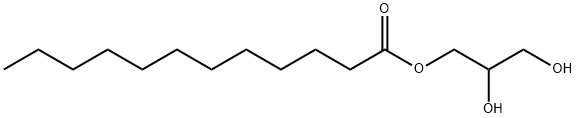
One reason coconut oil gets attention for cold sores is because of something called lauric acid, a natural fat found in the oil. When lauric acid breaks down in the body or on the skin, it turns into monolaurin, which has been shown to have some antiviral effects. Since cold sores are caused by a virus, this could offer mild support in keeping the sore from getting worse or spreading.
Coconut oil also has moisturizing and anti-inflammatory properties. Cold sores tend to dry out, crack, or become irritated—especially around the lips. Applying a small amount of coconut oil may help soften the area and make it feel less painful or tight. Keeping the sore moisturized can also reduce the risk of scabbing or bleeding, which might speed up recovery.
Still, it’s important to know that coconut oil isn’t a replacement for antiviral creams or medications. If you get frequent or severe cold sores, it's best to talk to a doctor. But for occasional relief, coconut oil can be a gentle, natural option to help calm the area and support healing.
Cold sores occur due to the reactivation of HSV-1, which remains latent in nerve cells and can flare up in response to stress, illness, or sun exposure. When active, the virus replicates in epithelial cells, resulting in inflammation, blistering, and discomfort. The therapeutic potential of coconut oil in this context lies not in eradicating the virus, but in modifying the local environment in a way that could interfere with viral replication, reduce inflammation, and enhance barrier protection.
Monolaurin’s lipid-disrupting mechanism works by integrating into the viral envelope, weakening its structural integrity and ultimately leading to inactivation of the virus. While most of this evidence comes from laboratory studies rather than human clinical trials, the biochemical plausibility is well-supported. However, the concentration of monolaurin formed on the skin from topically applied coconut oil may be insufficient for a strong antiviral effect unless the oil is highly enriched or combined with other agents.
Coconut oil also exhibits mild anti-inflammatory and emollient properties, which are relevant to the symptomatic management of cold sores. When applied to the skin, it can help maintain moisture, reduce irritation, and create a semi-occlusive barrier that protects against secondary infection. This is particularly useful during the drying and scabbing phases of a cold sore, where cracks in the skin can increase discomfort and prolong healing. Additionally, its antimicrobial effects may offer some protection against bacterial colonization, which is a known complication of open or weeping sores.
In pharmaceutical and cosmetic formulations, coconut oil is often used as a base or carrier oil for antiviral and anti-inflammatory agents. Its relatively stable structure and high oxidative resistance make it a preferred choice for lip balms, ointments, and natural skin-care remedies targeting lip and facial applications. Moreover, in traditional medicine systems, coconut oil has long been applied to minor wounds and skin infections, and modern interest in its utility for HSV-1 aligns with this historical usage, albeit now with more biochemical clarity.
The broader significance of coconut oil’s role in cold sore treatment lies in the emerging field of lipid-based antivirals and natural adjunct therapies. As drug resistance and side effects continue to challenge synthetic antiviral treatments, research is increasingly exploring how natural fatty acids and their derivatives can modulate viral behavior without directly targeting nucleic acid replication. This opens avenues for complementary approaches, especially for individuals with mild symptoms or those seeking alternative options with fewer adverse reactions.
Physiologically, cold sore progression involves viral latency in sensory ganglia, reactivation triggered by stress or UV exposure, and subsequent replication in epidermal cells, leading to blister formation. Coconut oil’s emollient properties may mitigate symptomatic discomfort by moisturizing irritated skin, potentially reducing cracking and secondary bacterial infection risk. However, this differs from antiviral action; it addresses symptoms, not viral load.
Misconceptions often conflate coconut oil with clinical antivirals like acyclovir. Unlike acyclovir, which inhibits viral DNA polymerase, coconut oil lacks targeted enzymatic inhibition. Clinical trials comparing topical coconut oil to placebo for cold sores are limited, with existing data primarily from in vitro or animal models. A 2018 study in Phytomedicine noted modest reduction in lesion duration in mice, but human studies are scarce, and results are inconsistent.
Professional consensus emphasizes that coconut oil cannot replace prescribed antivirals for HSV suppression or acute treatment. Its utility, if any, is adjunctive: possible symptom relief and mild antiviral effects in early stages, but insufficient to prevent reactivation or shorten outbreaks significantly. Readers should prioritize evidence-based interventions while considering coconut oil as a supportive, low-risk option, not a primary therapy.
The oil’s medium-chain fatty acids also exhibit anti-inflammatory effects, which may alleviate the redness, swelling, and discomfort associated with cold sores. Its emollient properties help prevent cracking and promote healing by forming a protective barrier over the sore, reducing exposure to irritants. Unlike synthetic antivirals, coconut oil is less likely to cause resistance or side effects, making it an appealing natural alternative. However, its efficacy varies; some users report faster healing and reduced severity, while others notice minimal improvement.
Practical application involves applying virgin coconut oil directly to the sore at the first tingling sensation, reapplying several times daily. Anecdotal evidence suggests combining it with essential oils like peppermint or tea tree oil, which have complementary antiviral effects, may enhance results. For instance, a 2017 study in the *Journal of Complementary and Integrative Medicine* found that coconut oil combined with tea tree oil exhibited synergistic antiviral activity against HSV-1 in vitro.
Despite its potential, coconut oil isn’t a substitute for proven treatments like acyclovir or docosanol, especially for severe outbreaks. Its role is better suited as a supportive measure or for mild cases. The lack of standardized clinical trials means recommendations rely heavily on mechanistic evidence and user experiences. For those prone to cold sores, maintaining a balanced diet and immune support—factors coconut oil may indirectly aid through its antimicrobial properties—can be as critical as topical application. The key lies in managing expectations; while it may soothe and possibly shorten outbreaks, it’s not a guaranteed cure.