


 Home
Home
Extra virgin olive oil is often praised for being healthier than other cooking oils. But what exactly is in it that makes it so special? Is it just about fats, or are there other ingredients that contribute to its benefits and flavor? What is in extra virgin olive oil?
What Is in Extra Virgin Olive Oil and What Makes It Special?
Related Encyclopedia
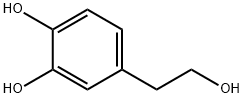
- 10597-60-1
- C8H10O3
- 154.16
- All (25)
- China (21)
- (25)
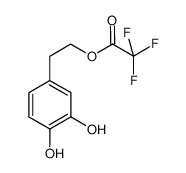
- 1056355-55-5
- C10H9F3O4
- 250.17100
- All (0)
- China (0)
- (0)
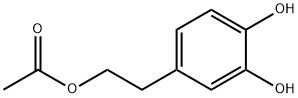
- 69039-02-7
- C10H12O4
- 196.2
- All (0)
- China (0)
- (0)
- 1345866-03-6
- C26H42O4
- 418.60900
- All (0)
- China (0)
- (0)
- 205241-38-9
- C16H24O4
- 280.35900
- All (0)
- China (0)
- (0)
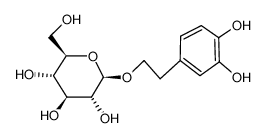
- 76873-99-9
- C14H20O8
- 316.30400
- All (0)
- China (0)
- (0)
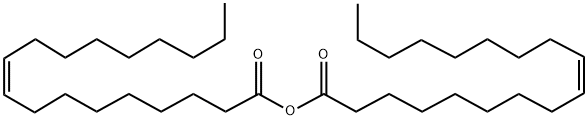
- 24909-72-6
- C36H66O3
- 546.91
- All (0)
- China (0)
- (0)

- 112-80-1
- C18H34O2
- 282.46
- All (141)
- China (22)
- (141)
- 141903-93-7
- C17H35N
- 253.46600
- All (141)
- China (22)
- (141)
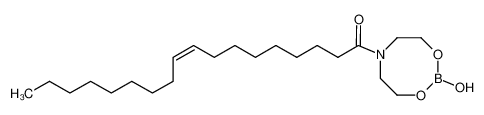
- 101635-90-9
- C22H42BNO4
- 395.38400
- All (0)
- China (0)
- (0)
Related Products More >

- 60-33-3
- USD 30.0000
- 25kg
- 60-33-3
- Request For Quotation
- 1kg
- 60-33-3
- Request For Quotation
- 25kg
- 60-33-3
- Request For Quotation
- 25kg
- 60-33-3
- Request For Quotation
- 1ton
- 60-33-3
- Request For Quotation
- 1kg
- 60-33-3
- Request For Quotation
- 1ton
- 60-33-3
- Request For Quotation
- 25kg


But it’s not just about fat. What really sets extra virgin olive oil apart is that it’s the least processed kind. That means it’s just made by pressing olives — no chemicals, no high heat. Because of that, it keeps a lot of the natural stuff that olives have, like antioxidants and plant compounds. These include things like polyphenols and vitamin E, which help protect your body’s cells and may lower inflammation.
You’ll also notice that good extra virgin olive oil has a strong smell and a bit of a peppery kick when you taste it — that’s because of those natural compounds. They don’t just add health benefits, but also give it a rich flavor that’s great on salads, veggies, or even just with bread.
So while the healthy fats are important, it’s really the combination of natural antioxidants, flavor, and minimal processing that makes extra virgin olive oil stand out. It’s not just oil — it’s kind of like nature’s blend of health and taste in one bottle.
Polyphenols, such as hydroxytyrosol and oleocanthal, are another critical component, giving EVOO its pungency and bitterness—key indicators of quality. Oleocanthal, for instance, mimics the anti-inflammatory action of ibuprofen, albeit at much lower intensities, which explains EVOO’s anecdotal benefits for joint pain. The presence of these compounds depends heavily on olive variety, ripeness, and processing. For example, early-harvest oils from Tuscan cultivars like Frantoio often exhibit higher polyphenol levels, resulting in a sharper taste and longer shelf life.
The volatile compounds in EVOO, including hexanal and trans-2-hexenal, are responsible for its grassy or fruity aromas. These degrade over time or when exposed to light and heat, which is why storing EVOO in dark, cool environments is crucial. In practical terms, this degradation explains why a freshly opened bottle of high-quality EVOO might smell vibrant and peppery, while an old or improperly stored one tastes flat.
In real-world applications, EVOO’s composition dictates its use. Its low smoke point (around 190–210°C) makes it unsuitable for deep-frying but ideal for drizzling or low-heat sautéing, where its flavors and nutrients remain intact. Mediterranean diets leverage EVOO’s properties by pairing it with vegetables; the fat enhances the absorption of fat-soluble vitamins like A and K. A study showed that tomatoes cooked in EVOO released more lycopene, a potent antioxidant, than those cooked without it. This synergy underscores how EVOO’s chemistry amplifies nutritional outcomes in everyday cooking.
Chemically, extra virgin olive oil is composed primarily of triglycerides, with oleic acid accounting for 55–83% of the total fatty acids. This monounsaturated fatty acid contributes to EVOO’s oxidative stability and its known cardioprotective effects. The remaining fatty acids include linoleic acid (a polyunsaturated fat) and palmitic acid (a saturated fat), but in lower concentrations. What distinguishes EVOO from other oils, however, is not just its lipid profile but its unsaponifiable fraction — a small but bioactive part that includes polyphenols, tocopherols (notably vitamin E), phytosterols, and squalene.
Polyphenols, such as hydroxytyrosol, tyrosol, and oleocanthal, are potent antioxidants and anti-inflammatory agents. These compounds have been widely studied in the context of human health, particularly their roles in reducing oxidative stress, modulating immune responses, and potentially offering neuroprotective benefits. The presence of oleocanthal is especially interesting because it produces a throat-irritating sensation similar to that of ibuprofen, hinting at its natural anti-inflammatory potential via COX enzyme inhibition. This mechanism has opened up discussions about EVOO’s role in chronic disease prevention, especially in Mediterranean populations where it is a dietary staple.
The stability of EVOO under moderate heat and its resistance to oxidation make it valuable not just for flavor enhancement but also for cooking. While it’s best used in raw applications (like dressings or drizzles) to preserve its delicate phenolic compounds, moderate-heat cooking does not significantly degrade its healthful properties compared to polyunsaturated oils like sunflower or soybean oil.
Physically, EVOO is characterized by its density (approx. 0.91 g/cm³), refractive index, and low peroxide value in fresh, high-quality samples. These attributes are critical in industrial quality control and authentication processes. Adulteration is a significant concern in the global olive oil market, and analytical techniques such as high-performance liquid chromatography (HPLC) and nuclear magnetic resonance (NMR) spectroscopy are now standard for verifying origin, purity, and freshness.
Beyond the culinary and nutritional realms, EVOO’s bioactive components have applications in pharmaceuticals and cosmeceuticals. Squalene, for example, serves as a natural moisturizer and is increasingly used in skincare formulations. Its high biocompatibility and antioxidant properties make it suitable for treating sensitive skin conditions. Similarly, phenolic extracts from EVOO are being investigated for their antimicrobial and anticancer potential, with studies showing that certain compounds can modulate gene expression and inhibit tumor growth pathways.
The broader implications of EVOO consumption extend into environmental and agricultural practices as well. The demand for cold-pressed, unrefined oils has driven sustainable farming methods and biodiverse cultivation in Mediterranean regions. Moreover, by-products from olive oil production, such as olive pomace, are being repurposed into biofuels, livestock feed, and compost, aligning with circular economy principles.
The minor fraction, though quantitatively small, is biochemically significant, containing polar phenolic compounds such as hydroxytyrosol, tyrosol, and oleuropein derivatives, which act as natural antioxidants by scavenging reactive oxygen species (ROS) and inhibiting lipid oxidation enzymes like lipoxygenase. These phenolics also contribute to EVOO’s anti-inflammatory properties, mediated through modulation of cyclooxygenase (COX) pathways. Additionally, EVOO contains fat-soluble vitamins (α-tocopherol, vitamin K), carotenoids (lutein, β-carotene), and phytosterols (β-sitosterol), which support membrane integrity and cholesterol homeostasis.
A critical distinction from refined olive oils is the absence of chemical refining in EVOO production, preserving these labile minor components. A common misconception equates EVOO’s "purity" to fatty acid content alone, but its health benefits are synergistic, arising from the interplay of MUFAs and phenolics. This complexity underscores EVOO’s unique position in lipid biochemistry, bridging nutritional science and food technology through its unadulterated molecular fingerprint.