


 Home
Home
Hello, I'd like to ask about "citric acid and ascorbic acid". First, could you give me the answer and explain why? Also, what are the similarities and differences in their chemical structures and properties between citric acid and ascorbic acid? And how do their applications in the food industry differ and relate to each other?
Citric Acid and Ascorbic Acid: Chemical Structure, Properties, and Applications in the Food Industry
Related Encyclopedia
- 1348091-16-6
- C7H10O7
- 206.15000
- All (893)
- China (66)
- (893)
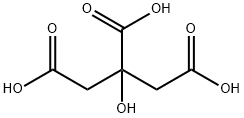
- 77-92-9
- C6H8O7
- 192.12
- All (893)
- China (66)
- (893)
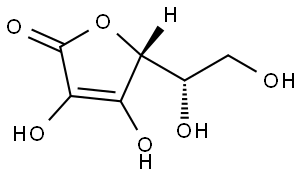
- 50-81-7
- C6H8O6
- 176.12
- All (105)
- China (2)
- (105)
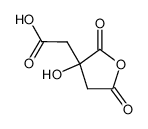
- 24555-16-6
- C6H6O6
- 174.10800
- All (0)
- China (0)
- (0)
- 334886-99-6
- C10H12O8
- 260.19700
- All (0)
- China (0)
- (0)
- 85698-65-3
- C6H5Cl3O4
- 247.46000
- All (0)
- China (0)
- (0)
- 1177936-31-0
- C6H10O8
- 210.13900
- All (185)
- China (5)
- (185)
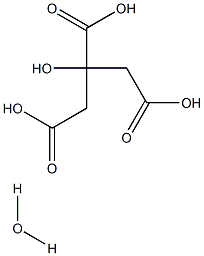
- 5949-29-1
- C6H10O8
- 210.1388
- All (185)
- China (5)
- (185)
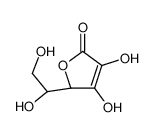
- 10504-35-5
- C6H8O6
- 176.12400
- All (0)
- China (0)
- (0)
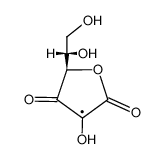
- 1141863-91-3
- C6H7O6
- 175.11600
- All (0)
- China (0)
- (0)
Related Products More >

- CNY Request For Quotation
- CNY Request For Quotation
- CNY Request For Quotation
- CNY Request For Quotation
- CNY Request For Quotation
- CNY Request For Quotation
- CNY Request For Quotation
- CNY Request For Quotation


Reason:
Citric acid and ascorbic acid are essential additives in the food industry, each with unique chemical properties and applications. Understanding their differences and similarities helps in optimizing their use for preservation, flavor enhancement, and nutritional fortification.
Chemical Structure and Properties:
Citric Acid:
Structure: A tricarboxylic acid with three carboxyl (–COOH) groups and one hydroxyl (–OH) group.
Properties: Weak acidity, high solubility in water, and strong metal-chelating ability.
Ascorbic Acid:
Structure: A lactone with one carboxyl (–COOH) group and multiple hydroxyl (–OH) groups, forming a ring structure.
Properties: Weak acidity, antioxidant activity, and sensitivity to heat and light.
Applications in the Food Industry:
Citric Acid:
Preservative: Extends shelf life by lowering pH and inhibiting microbial growth.
Flavor Enhancer: Adds a sour taste to beverages, candies, and processed foods.
Chelating Agent: Prevents discoloration and maintains texture by binding metal ions.
Ascorbic Acid:
Antioxidant: Protects foods from oxidation, preserving color and flavor.
Nutritional Additive: Fortifies foods with vitamin C, supporting immune health.
Dough Improver: Enhances bread texture and volume in baking.
Differences and Connections:
Preservation:
Both acids act as preservatives, but citric acid is more effective in lowering pH, while ascorbic acid focuses on preventing oxidation.
Nutritional Value:
Ascorbic acid provides vitamin C, offering health benefits, whereas citric acid does not have nutritional value.
Synergistic Use:
They are often used together in food products to combine their preservative and antioxidant effects.
In daily life, both acids find numerous applications. Citric acid is frequently used in the food industry to add a sour taste to foods and beverages, prevent browning of cut fruits, and preserve canned goods by lowering pH levels to inhibit bacterial growth. In household cleaning products, it serves as an effective cleaner and descaler due to its ability to dissolve hard water stains and limescale. Ascorbic acid plays a crucial role in dietary supplements and skincare products for its antioxidant properties. It's also used in food preservation to delay oxidation and spoilage, extending shelf life without compromising nutritional value.
When utilizing citric acid and ascorbic acid, certain considerations should be kept in mind. For citric acid, ensure it is stored in airtight containers in cool, dry places to maintain its effectiveness. When using it in cleaning solutions, avoid mixing with bleach as this can produce harmful fumes. Regarding ascorbic acid, overconsumption through supplements should be avoided since excessive intake may lead to adverse effects. Moreover, ascorbic acid is sensitive to heat, light, and air, which can degrade its potency; thus, proper storage and handling are essential. By understanding these guidelines, one can safely and effectively use citric acid and ascorbic acid across various domains, from culinary experiments to personal care routines.