


 Home
Home
Hi, I'd like to ask—is KCl soluble in water? Could you explain why it dissolves so easily? Also, what are some common uses of KCl in aqueous solutions? Thanks!
Why Does KCl Dissolve So Well in Water? Understanding Ionic Solubility
Related Encyclopedia
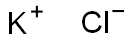
- 7447-40-7
- KCl
- 74.55
- All (273)
- China (27)
- (273)
- 20582-71-2
- Cl4HgK-
- 381.49000
- All (0)
- China (0)
- (0)

- 25443-63-4
- Cl6K3Ru
- 431.08
- All (0)
- China (0)
- (0)
- 15707-74-1
- Cl4KNbO
- 289.81600
- All (0)
- China (0)
- (0)
- 65567-96-6
- Cl2KLi
- 116.95
- All (0)
- China (0)
- (0)
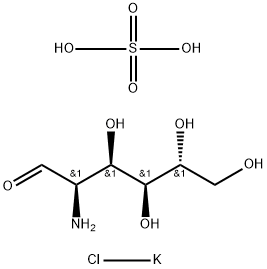
- 1296149-08-0
- C6H15ClKNO9S
- 351.79
- All (1)
- China (1)
- (1)
- 61789-31-9
- 0
- All (6)
- China (6)
- (6)
- 84086-46-4
- CCl4KOPt
- 403.99800
- All (0)
- China (0)
- (0)
- 63889-66-7
- C12H24ClKO6
- 338.86700
- All (0)
- China (0)
- (0)
- 75393-87-2
- C2H4FN7O4
- 209.09600
- All (0)
- China (0)
- (0)
Related Products More >

- 7447-40-9
- CNY Request For Quotation
- 7447-40-8
- CNY Request For Quotation
- 7447-40-7
- CNY Request For Quotation
- 7447-40-7
- CNY 25.0000
- 25kg
- 93348-22-2
- Request For Quotation
- 25KG/50KG/1000KG
- 93348-22-2
- Request For Quotation
- 25kg/Cardboard Drum
- 91031-63-9
- Request For Quotation


Why KCl Dissolves Easily in Water
Ionic Nature of KCl:
Potassium chloride is an ionic compound composed of potassium ions and chloride ions . In its solid state, KCl exists as a crystalline lattice where these ions are held together by strong electrostatic forces known as ionic bonds.
Polar Nature of Water:
Water is a polar molecule, meaning it has a partial positive charge on the hydrogen atoms and a partial negative charge on the oxygen atom. This polarity allows water molecules to interact strongly with ions.
Dissolution Process:
When KCl is placed in water, the polar water molecules surround the KCl crystal. The positively charged hydrogen atoms of water molecules are attracted to the chloride ions , while the negatively charged oxygen atoms are attracted to the potassium ions . This interaction is known as ion-dipole interaction.
As the water molecules surround the KCl crystal, they gradually pull the K⁺ and Cl⁻ ions away from the crystal lattice. Once an ion is separated from the lattice, it becomes surrounded by water molecules in a process called hydration. The hydration of ions releases energy, which helps to overcome the lattice energy of KCl, making it easier for the compound to dissolve.
Thermodynamic Favorability:
The dissolution of KCl in water is thermodynamically favorable because the energy released during the hydration of ions is sufficient to overcome the energy required to break the ionic bonds in the KCl lattice. This results in a net decrease in the system's free energy, driving the dissolution process forward.
Common Uses of KCl in Aqueous Solutions
Potassium chloride is widely used in various applications, particularly when dissolved in water. Here are some of its common uses:
Medical Applications:
Electrolyte Replacement: In medicine, KCl is commonly used to replenish potassium levels in the body. Potassium is an essential electrolyte that helps regulate nerve and muscle function, including the heart. KCl solutions are often administered intravenously or orally to patients with low potassium levels .
Nutritional Supplements: KCl is also used as a dietary supplement to ensure adequate potassium intake. It is often found in sports drinks and other electrolyte-replenishing beverages.
Laboratory and Research:
Buffer Solutions: In laboratories, KCl is used to prepare buffer solutions that help maintain a stable pH. It is often combined with other chemicals to create solutions that resist changes in acidity or alkalinity.
Electrophysiology: KCl solutions are used in electrophysiological studies to mimic the ionic environment of biological cells. For example, they are used in patch-clamp techniques to study ion channels in cell membranes.
Industrial Uses:
Electroplating: In electroplating processes, KCl solutions are used as electrolytes to deposit a thin layer of metal onto a substrate. This technique is used to improve the corrosion resistance, wear resistance, and appearance of metal surfaces.
De-icing: KCl can be used as a de-icing agent for roads and sidewalks. When dissolved in water, it lowers the freezing point of the solution, preventing ice formation.
Food Industry:
Salt Substitute: KCl is sometimes used as a salt substitute for people who need to reduce their sodium intake. While it has a similar salty taste to sodium chloride , it does not contain sodium. However, it is often blended with small amounts of sodium chloride to improve its taste.
Food Processing: In food processing, KCl is used to regulate the ionic strength of solutions, which can affect the ure and stability of food products.
Conclusion
In summary, potassium chloride is highly soluble in water due to its ionic nature and the polar nature of water. The dissolution process involves ion-dipole interactions and hydration of ions, making it thermodynamically favorable. KCl has a wide range of applications in medicine, research, industry, and the food sector, particularly when used in aqueous solutions. Its versatility and high solubility make it a valuable compound in many fields.
I hope this detailed explanation helps you understand the solubility of KCl and its various uses! If you have any further questions, feel free to ask.
Why is this important? The solubility of KCl in water makes it highly useful in various applications. For example, in the medical field, KCl is commonly used to prepare intravenous solutions to replenish potassium levels in the body. In the food industry, KCl is used as a low-sodium salt substitute because it has a similar salty taste to table salt but contains less sodium. Additionally, KCl's solubility in water makes it easy to prepare solutions of various concentrations for laboratory experiments and analyses.
What are some practical applications? In medical settings, KCl solutions are carefully administered to patients to correct potassium deficiencies. In the food industry, KCl is used to create healthier alternatives to traditional table salt. In laboratories, KCl solutions are used in a variety of experiments, from simple conductivity tests to more complex biochemical assays.
What should you keep in mind? While KCl is highly soluble in water, it's important to use it appropriately. In medical applications, KCl solutions must be carefully administered to avoid complications such as hyperkalemia, a condition where potassium levels in the blood are too high. In the laboratory, KCl solutions can be used for a variety of experiments, but it's important to ensure that the concentration is appropriate for the intended use. By understanding the solubility of KCl and how to manage it, you can effectively use this compound in a wide range of applications.
What does this mean in practical terms? The solubility of KCl in water makes it highly useful in various applications. For example, in the medical field, KCl is commonly used to prepare intravenous solutions to replenish potassium levels in the body. In the food industry, KCl is used as a low-sodium salt substitute because it has a similar salty taste to table salt but contains less sodium. Additionally, KCl's solubility in water makes it easy to prepare solutions of various concentrations for laboratory experiments and analyses.
Why is this important? Understanding the solubility of KCl can help you make the most of its properties in different settings. For instance, if you need to dissolve KCl in water, using warmer water can increase its solubility. However, be careful not to heat the water too much, as this can cause the solution to evaporate too quickly. Additionally, it's important to monitor the pH of the solution, as KCl solutions are typically neutral . If you need to adjust the pH for a specific application, you can add small amounts of acid or base to achieve the desired level.
What should you keep in mind? While KCl is highly soluble in water, it's important to use it appropriately. In medical applications, KCl solutions must be carefully administered to avoid complications such as hyperkalemia, a condition where potassium levels in the blood are too high. In the laboratory, KCl solutions can be used for a variety of experiments, but it's important to ensure that the concentration is appropriate for the intended use. By understanding the solubility of KCl and how to manage it, you can effectively use this compound in a wide range of applications.